 Add to Chrome
 Add to Firefox
 Add to Edge
Revisiting Parameter Server in LLM Post-Training
Jan 27, 2026
Modern data parallel (DP) training favors collective communication over parameter servers (PS) for its simplicity and efficiency under balanced workloads. However, the balanced workload assumption no longer holds in large language model (LLM) post-training due to the high variance in sequence lengths. Under imbalanced workloads, collective communication creates synchronization barriers, leading to under-utilization of devices with smaller workloads. This change in training dynamics calls for a revisit of the PS paradigm for its robustness to such imbalance. We propose \textbf{On-Demand Communication (ODC)}, which adapts PS into Fully Sharded Data Parallel (FSDP) by replacing collective all-gather and reduce-scatter with direct point-to-point communication. Compared to FSDP, ODC reduces the synchronization barrier from once per layer to once per minibatch and decouples the workload on each device so that faster workers are not stalled. It also enables simpler and more effective load balancing at the minibatch level. Across diverse LLM post-training tasks, ODC consistently improves device utilization and training throughput, achieving up to a 36\% speedup over standard FSDP. These results demonstrate that ODC is a superior fit for the prevalent imbalanced workloads in LLM post-training. Our implementation of ODC and integration with FSDP is open-sourced at https://github.com/sail-sg/odc.

PipeOffload: Improving Scalability of Pipeline Parallelism with Memory Optimization
Mar 03, 2025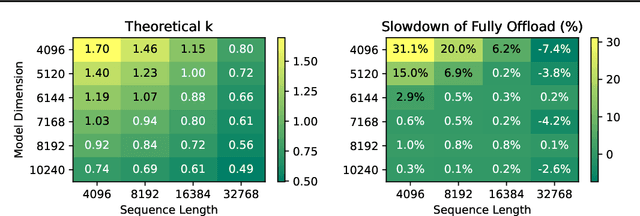
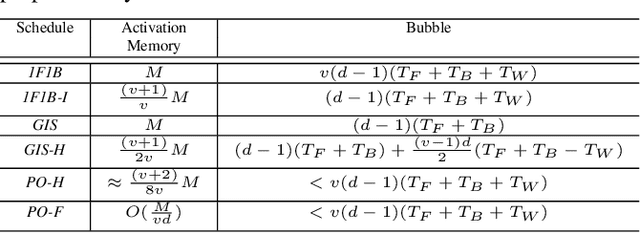
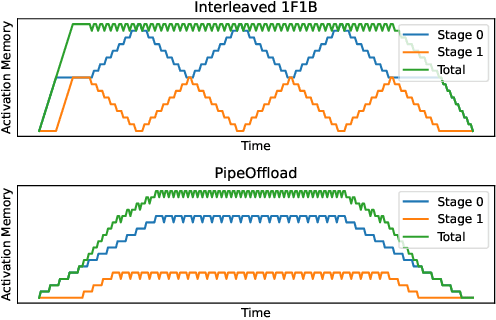
Pipeline parallelism (PP) is widely used for training large language models (LLMs), yet its scalability is often constrained by high activation memory consumption as the number of in-flight microbatches grows with the degree of PP. In this paper, we focus on addressing this challenge by leveraging the under-explored memory offload strategy in PP. With empirical study, we discover that in the majority of standard configurations, at least half, and potentially all, of the activations can be offloaded with negligible overhead. In the cases where full overload is not possible, we introduce a novel selective offload strategy that decreases peak activation memory in a better-than-linear manner. Furthermore, we integrate memory offload with other techniques to jointly consider overall throughput and memory limitation. Our experiments proves that the per-device activation memory effectively reduces with the total number of stages, making PP a stronger alternative than TP, offering up to a 19\% acceleration with even lower memory consumption. The implementation is open-sourced at \href{https://github.com/sail-sg/zero-bubble-pipeline-parallelism}{this url}.