 Add to Chrome
 Add to Firefox
 Add to Edge
MILE-RefHumEval: A Reference-Free, Multi-Independent LLM Framework for Human-Aligned Evaluation
Feb 10, 2026
We introduce MILE-RefHumEval, a reference-free framework for evaluating Large Language Models (LLMs) without ground-truth annotations or evaluator coordination. It leverages an ensemble of independently prompted evaluators guided by a human-aligned schema, supporting both discrete and continuous scoring judgement. With task-specific prompts from best candidate selection, summarization and image captioning to dialogue, MILE-RefHumEval provides flexible, interpretable, and scalable assessments. Experiments show it aligns closely with human judgments, outperforms prior methods, and reduces computational overhead, offering an efficient, robust, and human-aligned solution for real-world LLM evaluation.

Deep Learning Approaches for Dynamic Mechanical Analysis of Viscoelastic Fiber Composites
Oct 20, 2023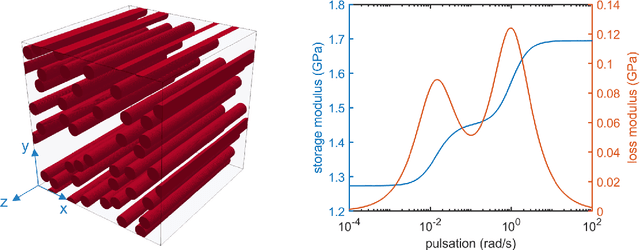
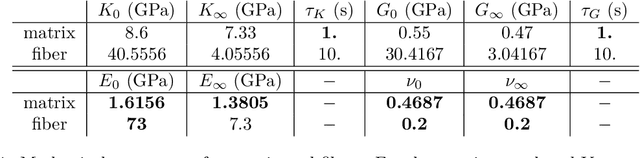
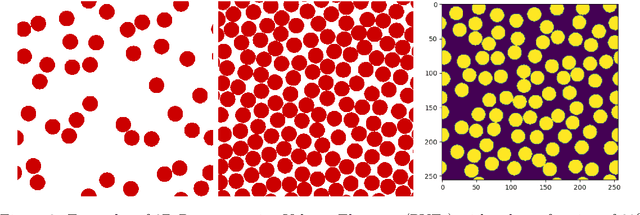
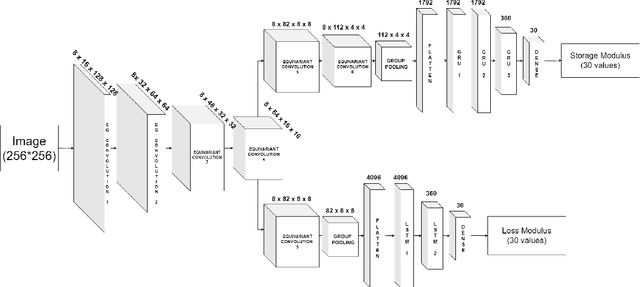
The increased adoption of reinforced polymer (RP) composite materials, driven by eco-design standards, calls for a fine balance between lightness, stiffness, and effective vibration control. These materials are integral to enhancing comfort, safety, and energy efficiency. Dynamic Mechanical Analysis (DMA) characterizes viscoelastic behavior, yet there's a growing interest in using Machine Learning (ML) to expedite the design and understanding of microstructures. In this paper we aim to map microstructures to their mechanical properties using deep neural networks, speeding up the process and allowing for the generation of microstructures from desired properties.
On the use of Wasserstein metric in topological clustering of distributional data
Sep 09, 2021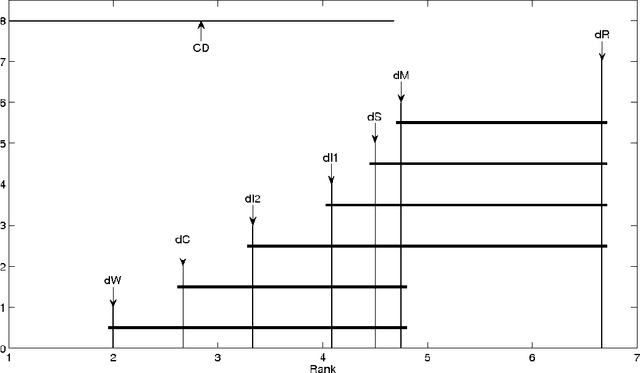
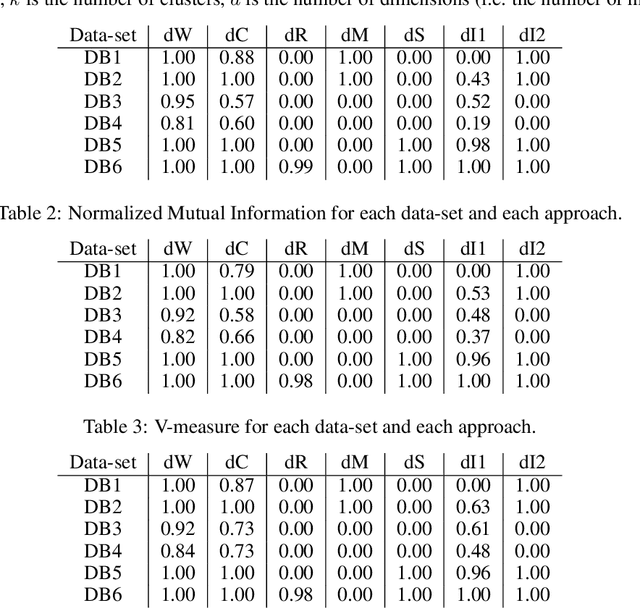
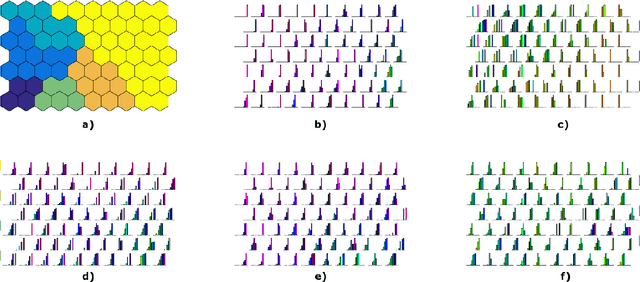
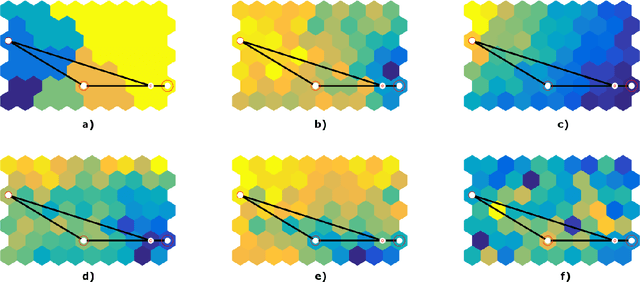
This paper deals with a clustering algorithm for histogram data based on a Self-Organizing Map (SOM) learning. It combines a dimension reduction by SOM and the clustering of the data in a reduced space. Related to the kind of data, a suitable dissimilarity measure between distributions is introduced: the $L_2$ Wasserstein distance. Moreover, the number of clusters is not fixed in advance but it is automatically found according to a local data density estimation in the original space. Applications on synthetic and real data sets corroborate the proposed strategy.