 Add to Chrome
 Add to Firefox
 Add to Edge
T-STAR: A Context-Aware Transformer Framework for Short-Term Probabilistic Demand Forecasting in Dock-Based Shared Micro-Mobility
Feb 06, 2026
Reliable short-term demand forecasting is essential for managing shared micro-mobility services and ensuring responsive, user-centered operations. This study introduces T-STAR (Two-stage Spatial and Temporal Adaptive contextual Representation), a novel transformer-based probabilistic framework designed to forecast station-level bike-sharing demand at a 15-minute resolution. T-STAR addresses key challenges in high-resolution forecasting by disentangling consistent demand patterns from short-term fluctuations through a hierarchical two-stage structure. The first stage captures coarse-grained hourly demand patterns, while the second stage improves prediction accuracy by incorporating high-frequency, localized inputs, including recent fluctuations and real-time demand variations in connected metro services, to account for temporal shifts in short-term demand. Time series transformer models are employed in both stages to generate probabilistic predictions. Extensive experiments using Washington D.C.'s Capital Bikeshare data demonstrate that T-STAR outperforms existing methods in both deterministic and probabilistic accuracy. The model exhibits strong spatial and temporal robustness across stations and time periods. A zero-shot forecasting experiment further highlights T-STAR's ability to transfer to previously unseen service areas without retraining. These results underscore the framework's potential to deliver granular, reliable, and uncertainty-aware short-term demand forecasts, which enable seamless integration to support multimodal trip planning for travelers and enhance real-time operations in shared micro-mobility services.

How To Discover Short, Shorter, and the Shortest Proofs of Unsatisfiability: A Branch-and-Bound Approach for Resolution Proof Length Minimization
Nov 12, 2024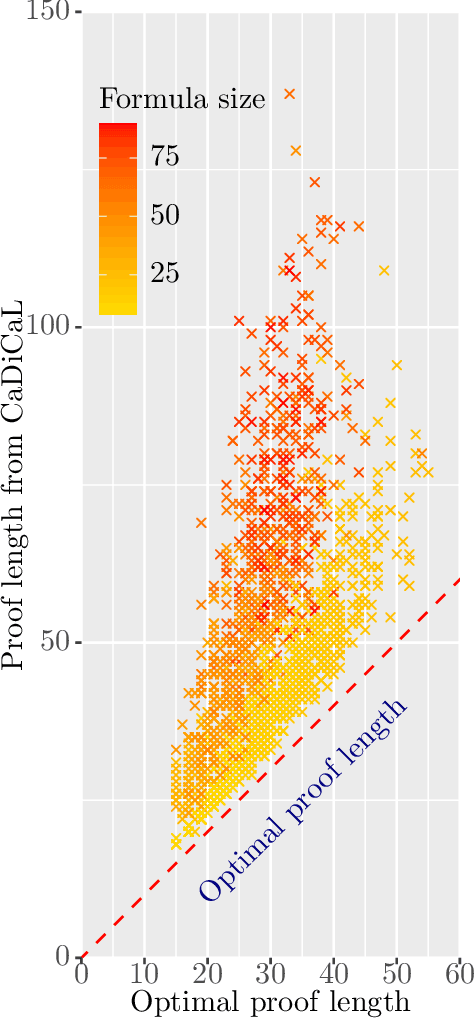

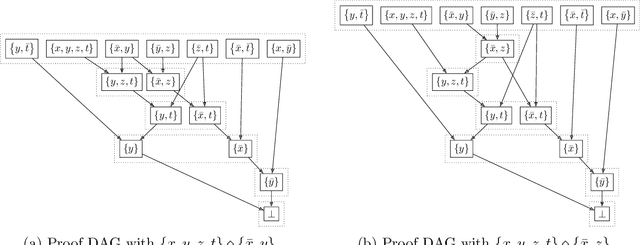

Modern software for propositional satisfiability problems gives a powerful automated reasoning toolkit, capable of outputting not only a satisfiable/unsatisfiable signal but also a justification of unsatisfiability in the form of resolution proof (or a more expressive proof), which is commonly used for verification purposes. Empirically, modern SAT solvers produce relatively short proofs, however, there are no inherent guarantees that these proofs cannot be significantly reduced. This paper proposes a novel branch-and-bound algorithm for finding the shortest resolution proofs; to this end, we introduce a layer list representation of proofs that groups clauses by their level of indirection. As we show, this representation breaks all permutational symmetries, thereby improving upon the state-of-the-art symmetry-breaking and informing the design of a novel workflow for proof minimization. In addition to that, we design pruning procedures that reason on proof length lower bound, clause subsumption, and dominance. Our experiments suggest that the proofs from state-of-the-art solvers could be shortened by 30-60% on the instances from SAT Competition 2002 and by 25-50% on small synthetic formulas. When treated as an algorithm for finding the shortest proof, our approach solves twice as many instances as the previous work based on SAT solving and reduces the time to optimality by orders of magnitude for the instances solved by both approaches.