 Add to Chrome
 Add to Firefox
 Add to Edge
A Theory of Diversity for Random Matrices with Applications to In-Context Learning of Schrödinger Equations
Jan 18, 2026
We address the following question: given a collection $\{\mathbf{A}^{(1)}, \dots, \mathbf{A}^{(N)}\}$ of independent $d \times d$ random matrices drawn from a common distribution $\mathbb{P}$, what is the probability that the centralizer of $\{\mathbf{A}^{(1)}, \dots, \mathbf{A}^{(N)}\}$ is trivial? We provide lower bounds on this probability in terms of the sample size $N$ and the dimension $d$ for several families of random matrices which arise from the discretization of linear Schrödinger operators with random potentials. When combined with recent work on machine learning theory, our results provide guarantees on the generalization ability of transformer-based neural networks for in-context learning of Schrödinger equations.

In-Context Operator Learning on the Space of Probability Measures
Jan 15, 2026We introduce \emph{in-context operator learning on probability measure spaces} for optimal transport (OT). The goal is to learn a single solution operator that maps a pair of distributions to the OT map, using only few-shot samples from each distribution as a prompt and \emph{without} gradient updates at inference. We parameterize the solution operator and develop scaling-law theory in two regimes. In the \emph{nonparametric} setting, when tasks concentrate on a low-intrinsic-dimension manifold of source--target pairs, we establish generalization bounds that quantify how in-context accuracy scales with prompt size, intrinsic task dimension, and model capacity. In the \emph{parametric} setting (e.g., Gaussian families), we give an explicit architecture that recovers the exact OT map in context and provide finite-sample excess-risk bounds. Our numerical experiments on synthetic transports and generative-modeling benchmarks validate the framework.
In-Context Learning of Linear Dynamical Systems with Transformers: Error Bounds and Depth-Separation
Feb 12, 2025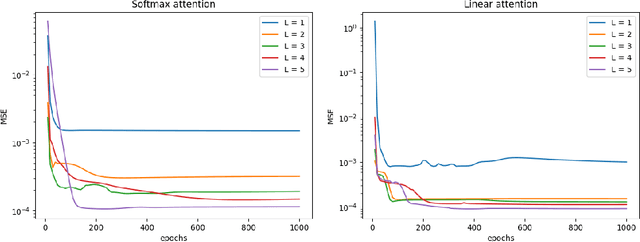
This paper investigates approximation-theoretic aspects of the in-context learning capability of the transformers in representing a family of noisy linear dynamical systems. Our first theoretical result establishes an upper bound on the approximation error of multi-layer transformers with respect to an $L^2$-testing loss uniformly defined across tasks. This result demonstrates that transformers with logarithmic depth can achieve error bounds comparable with those of the least-squares estimator. In contrast, our second result establishes a non-diminishing lower bound on the approximation error for a class of single-layer linear transformers, which suggests a depth-separation phenomenon for transformers in the in-context learning of dynamical systems. Moreover, this second result uncovers a critical distinction in the approximation power of single-layer linear transformers when learning from IID versus non-IID data.
Score-based generative models break the curse of dimensionality in learning a family of sub-Gaussian probability distributions
Feb 23, 2024While score-based generative models (SGMs) have achieved remarkable success in enormous image generation tasks, their mathematical foundations are still limited. In this paper, we analyze the approximation and generalization of SGMs in learning a family of sub-Gaussian probability distributions. We introduce a notion of complexity for probability distributions in terms of their relative density with respect to the standard Gaussian measure. We prove that if the log-relative density can be locally approximated by a neural network whose parameters can be suitably bounded, then the distribution generated by empirical score matching approximates the target distribution in total variation with a dimension-independent rate. We illustrate our theory through examples, which include certain mixtures of Gaussians. An essential ingredient of our proof is to derive a dimension-free deep neural network approximation rate for the true score function associated with the forward process, which is interesting in its own right.