 Add to Chrome
 Add to Firefox
 Add to Edge
Achievable Degrees of Freedom Analysis and Optimization in Massive MIMO via Characteristic Mode Analysis
Jan 15, 2026
Massive multiple-input multiple-output (MIMO) is esteemed as a critical technology in 6G communications, providing large degrees of freedom (DoF) to improve multiplexing gain. This paper introduces characteristic mode analysis (CMA) to derive the achievable DoF. Unlike existing works primarily focusing on the DoF of the wireless channel,the excitation and radiation properties of antennas are also involved in our DoF analysis, which influences the number of independent data streams for communication of a MIMO system. Specifically, we model the excitation and radiation properties of transceiver antennas using CMA to analyze the excitation and radiation properties of antennas. The CMA-based DoF analysis framework is established and the achievable DoF is derived. A characteristic mode optimization problem of antennas is then formulated to maximize the achievable DoF. A case study where the reconfigurable holographic surface (RHS) antennas are deployed at the transceiver is investigated, and a CMA-based genetic algorithm is later proposed to solve the above problem. By changing the characteristic modes electric field and surface current distribution of RHS, the achievable DoF is enhanced. Full-wave simulation verifies the theoretical analysis on the the achievable DoF and shows that, via the reconfiguration of RHS based on the proposed algorithm, the achievable DoF is improved.

Intelligent Omni-Surfaces Aided Wireless Communications: Does the Reciprocity Hold?
Nov 06, 2022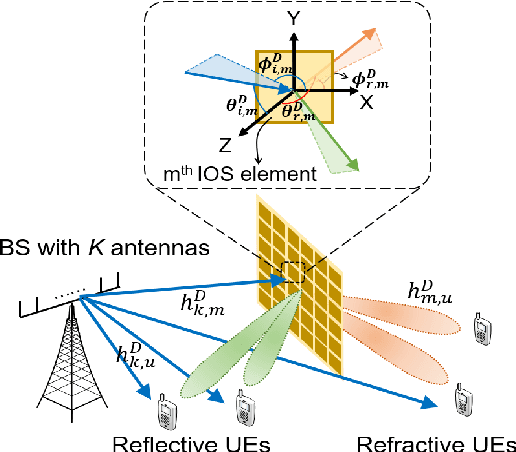
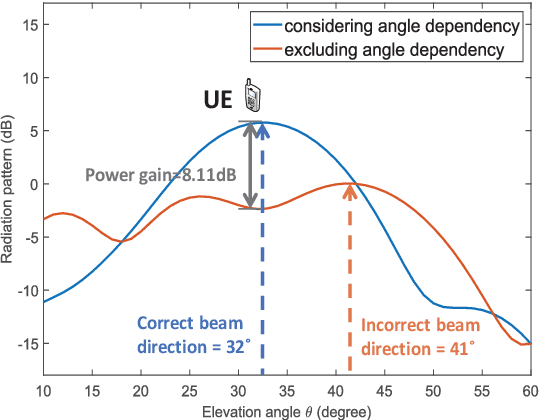
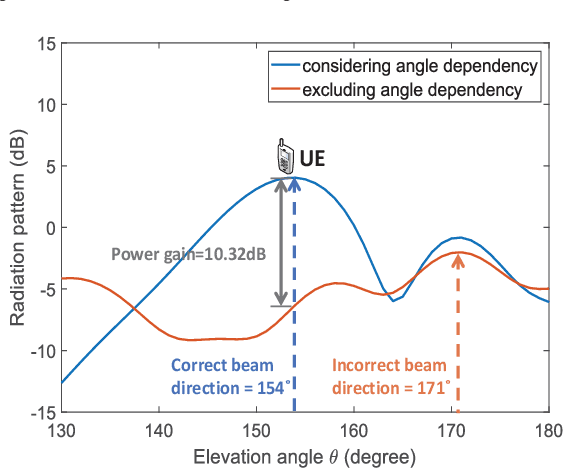
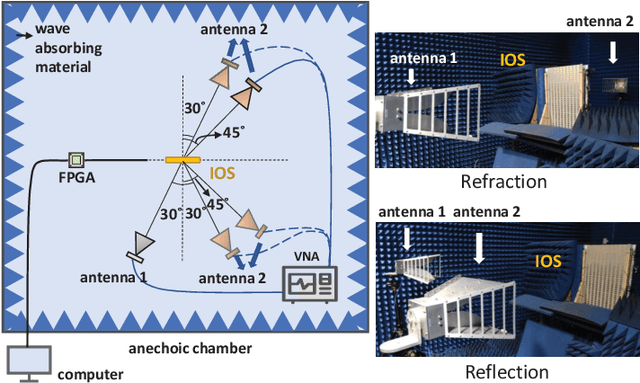
Intelligent omni-surfaces (IOS) have attracted great attention recently due to its potential to achieve full-dimensional communications by simultaneously reflecting and refracting signals toward both sides of the surface. However, it still remains an open question whether the reciprocity holds between the uplink and downlink channels in the IOS-aided wireless communications. In this work, we first present a physics-compliant IOS related channel model, based on which the channel reciprocity is investigated. We then demonstrate the angle-dependent electromagnetic response of the IOS element in terms of both incident and departure angles. This serves as the key feature of IOS that drives our analytical results on beam non-reciprocity. Finally, simulation and experimental results are provided to verify our theoretical analyses.