 Add to Chrome
 Add to Firefox
 Add to Edge
Model Optimization for Multi-Camera 3D Detection and Tracking
Feb 03, 2026
Outside-in multi-camera perception is increasingly important in indoor environments, where networks of static cameras must support multi-target tracking under occlusion and heterogeneous viewpoints. We evaluate Sparse4D, a query-based spatiotemporal 3D detection and tracking framework that fuses multi-view features in a shared world frame and propagates sparse object queries via instance memory. We study reduced input frame rates, post-training quantization (INT8 and FP8), transfer to the WILDTRACK benchmark, and Transformer Engine mixed-precision fine-tuning. To better capture identity stability, we report Average Track Duration (AvgTrackDur), which measures identity persistence in seconds. Sparse4D remains stable under moderate FPS reductions, but below 2 FPS, identity association collapses even when detections are stable. Selective quantization of the backbone and neck offers the best speed-accuracy trade-off, while attention-related modules are consistently sensitive to low precision. On WILDTRACK, low-FPS pretraining yields large zero-shot gains over the base checkpoint, while small-scale fine-tuning provides limited additional benefit. Transformer Engine mixed precision reduces latency and improves camera scalability, but can destabilize identity propagation, motivating stability-aware validation.

Unsupervised Microscopy Video Denoising
Apr 17, 2024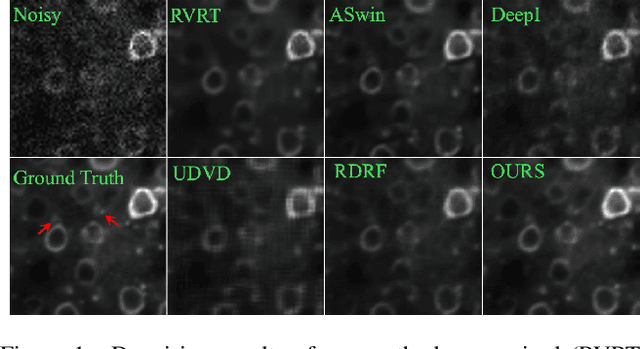
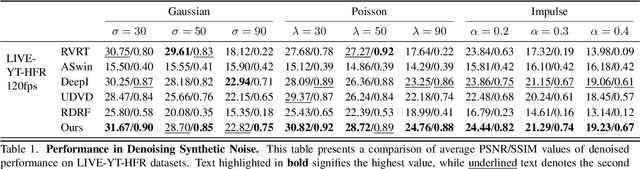
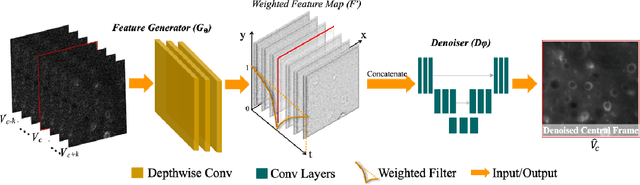
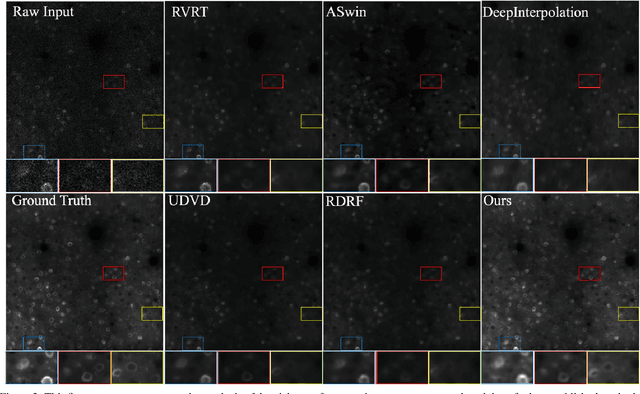
In this paper, we introduce a novel unsupervised network to denoise microscopy videos featured by image sequences captured by a fixed location microscopy camera. Specifically, we propose a DeepTemporal Interpolation method, leveraging a temporal signal filter integrated into the bottom CNN layers, to restore microscopy videos corrupted by unknown noise types. Our unsupervised denoising architecture is distinguished by its ability to adapt to multiple noise conditions without the need for pre-existing noise distribution knowledge, addressing a significant challenge in real-world medical applications. Furthermore, we evaluate our denoising framework using both real microscopy recordings and simulated data, validating our outperforming video denoising performance across a broad spectrum of noise scenarios. Extensive experiments demonstrate that our unsupervised model consistently outperforms state-of-the-art supervised and unsupervised video denoising techniques, proving especially effective for microscopy videos.