 Add to Chrome
 Add to Firefox
 Add to Edge
PrevizWhiz: Combining Rough 3D Scenes and 2D Video to Guide Generative Video Previsualization
Feb 03, 2026
In pre-production, filmmakers and 3D animation experts must rapidly prototype ideas to explore a film's possibilities before fullscale production, yet conventional approaches involve trade-offs in efficiency and expressiveness. Hand-drawn storyboards often lack spatial precision needed for complex cinematography, while 3D previsualization demands expertise and high-quality rigged assets. To address this gap, we present PrevizWhiz, a system that leverages rough 3D scenes in combination with generative image and video models to create stylized video previews. The workflow integrates frame-level image restyling with adjustable resemblance, time-based editing through motion paths or external video inputs, and refinement into high-fidelity video clips. A study with filmmakers demonstrates that our system lowers technical barriers for film-makers, accelerates creative iteration, and effectively bridges the communication gap, while also surfacing challenges of continuity, authorship, and ethical consideration in AI-assisted filmmaking.

Thing2Reality: Transforming 2D Content into Conditioned Multiviews and 3D Gaussian Objects for XR Communication
Oct 09, 2024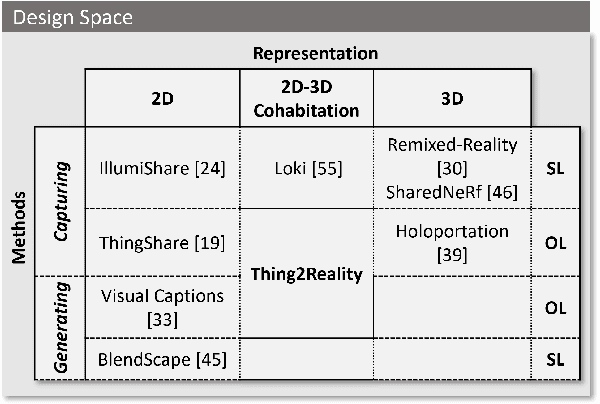
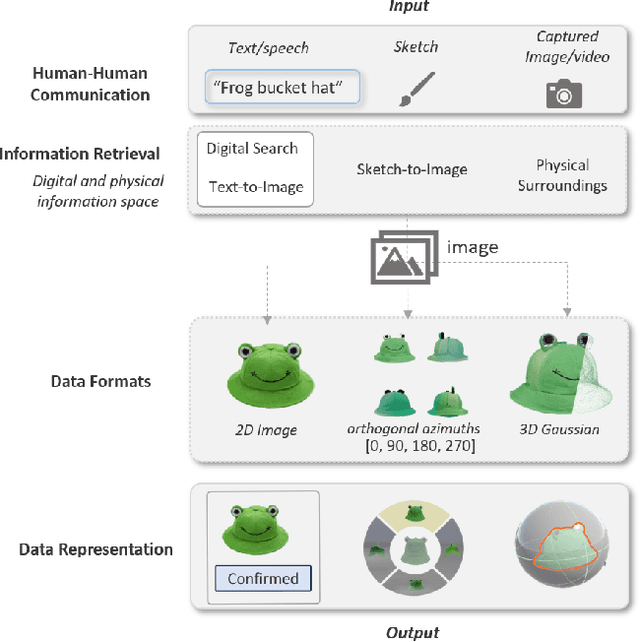
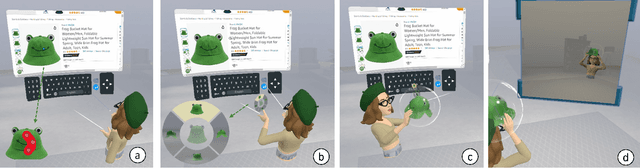
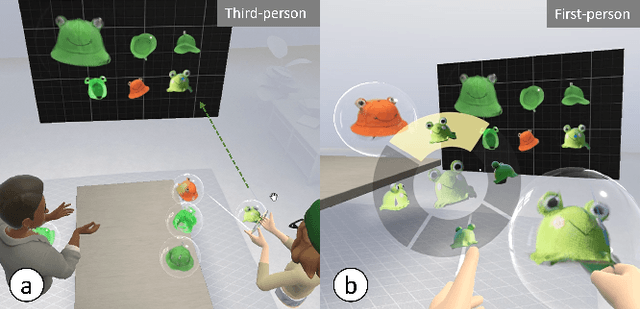
During remote communication, participants often share both digital and physical content, such as product designs, digital assets, and environments, to enhance mutual understanding. Recent advances in augmented communication have facilitated users to swiftly create and share digital 2D copies of physical objects from video feeds into a shared space. However, conventional 2D representations of digital objects restricts users' ability to spatially reference items in a shared immersive environment. To address this, we propose Thing2Reality, an Extended Reality (XR) communication platform that enhances spontaneous discussions of both digital and physical items during remote sessions. With Thing2Reality, users can quickly materialize ideas or physical objects in immersive environments and share them as conditioned multiview renderings or 3D Gaussians. Thing2Reality enables users to interact with remote objects or discuss concepts in a collaborative manner. Our user study revealed that the ability to interact with and manipulate 3D representations of objects significantly enhances the efficiency of discussions, with the potential to augment discussion of 2D artifacts.