 Add to Chrome
 Add to Firefox
 Add to Edge
EvolVE: Evolutionary Search for LLM-based Verilog Generation and Optimization
Jan 26, 2026
Verilog's design cycle is inherently labor-intensive and necessitates extensive domain expertise. Although Large Language Models (LLMs) offer a promising pathway toward automation, their limited training data and intrinsic sequential reasoning fail to capture the strict formal logic and concurrency inherent in hardware systems. To overcome these barriers, we present EvolVE, the first framework to analyze multiple evolution strategies on chip design tasks, revealing that Monte Carlo Tree Search (MCTS) excels at maximizing functional correctness, while Idea-Guided Refinement (IGR) proves superior for optimization. We further leverage Structured Testbench Generation (STG) to accelerate the evolutionary process. To address the lack of complex optimization benchmarks, we introduce IC-RTL, targeting industry-scale problems derived from the National Integrated Circuit Contest. Evaluations establish EvolVE as the new state-of-the-art, achieving 98.1% on VerilogEval v2 and 92% on RTLLM v2. Furthermore, on the industry-scale IC-RTL suite, our framework surpasses reference implementations authored by contest participants, reducing the Power, Performance, Area (PPA) product by up to 66% in Huffman Coding and 17% in the geometric mean across all problems. The source code of the IC-RTL benchmark is available at https://github.com/weiber2002/ICRTL.

MVA2023 Small Object Detection Challenge for Spotting Birds: Dataset, Methods, and Results
Jul 18, 2023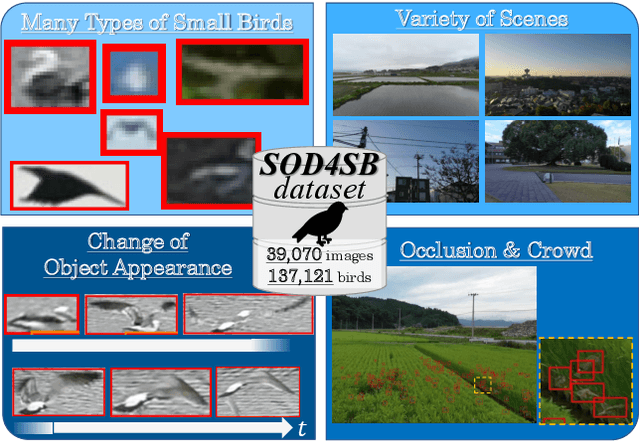
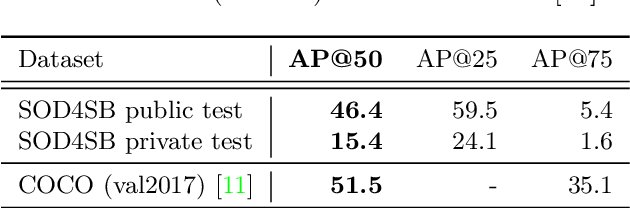
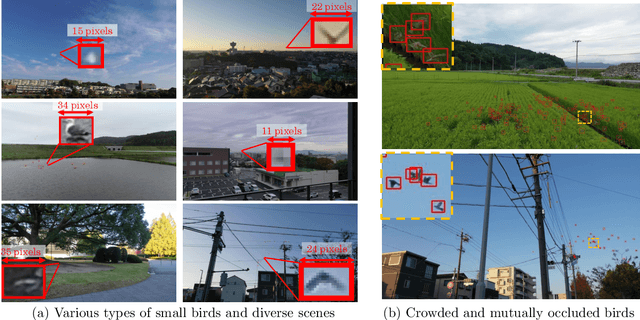
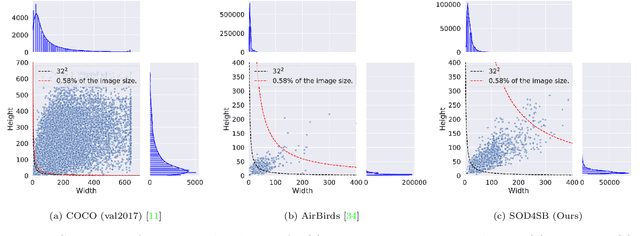
Small Object Detection (SOD) is an important machine vision topic because (i) a variety of real-world applications require object detection for distant objects and (ii) SOD is a challenging task due to the noisy, blurred, and less-informative image appearances of small objects. This paper proposes a new SOD dataset consisting of 39,070 images including 137,121 bird instances, which is called the Small Object Detection for Spotting Birds (SOD4SB) dataset. The detail of the challenge with the SOD4SB dataset is introduced in this paper. In total, 223 participants joined this challenge. This paper briefly introduces the award-winning methods. The dataset, the baseline code, and the website for evaluation on the public testset are publicly available.