 Add to Chrome
 Add to Firefox
 Add to Edge
From Vision to Decision: Neuromorphic Control for Autonomous Navigation and Tracking
Feb 05, 2026
Robotic navigation has historically struggled to reconcile reactive, sensor-based control with the decisive capabilities of model-based planners. This duality becomes critical when the absence of a predominant option among goals leads to indecision, challenging reactive systems to break symmetries without computationally-intense planners. We propose a parsimonious neuromorphic control framework that bridges this gap for vision-guided navigation and tracking. Image pixels from an onboard camera are encoded as inputs to dynamic neuronal populations that directly transform visual target excitation into egocentric motion commands. A dynamic bifurcation mechanism resolves indecision by delaying commitment until a critical point induced by the environmental geometry. Inspired by recently proposed mechanistic models of animal cognition and opinion dynamics, the neuromorphic controller provides real-time autonomy with a minimal computational burden, a small number of interpretable parameters, and can be seamlessly integrated with application-specific image processing pipelines. We validate our approach in simulation environments as well as on an experimental quadrotor platform.

LATMOS: Latent Automaton Task Model from Observation Sequences
Mar 11, 2025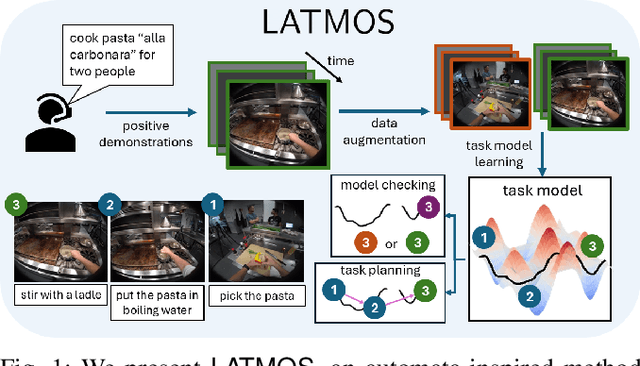
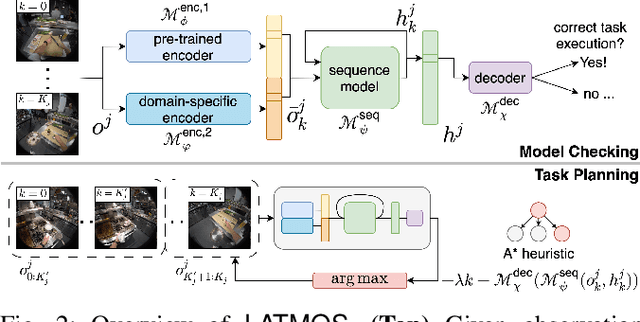
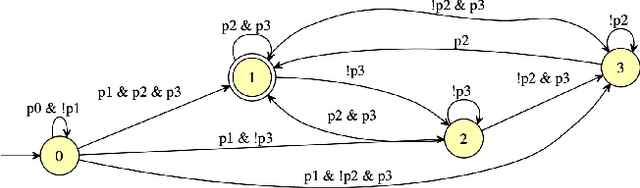
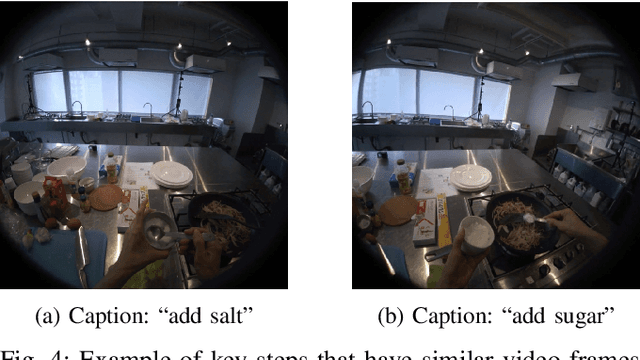
Robot task planning from high-level instructions is an important step towards deploying fully autonomous robot systems in the service sector. Three key aspects of robot task planning present challenges yet to be resolved simultaneously, namely, (i) factorization of complex tasks specifications into simpler executable subtasks, (ii) understanding of the current task state from raw observations, and (iii) planning and verification of task executions. To address these challenges, we propose LATMOS, an automata-inspired task model that, given observations from correct task executions, is able to factorize the task, while supporting verification and planning operations. LATMOS combines an observation encoder to extract the features from potentially high-dimensional observations with automata theory to learn a sequential model that encapsulates an automaton with symbols in the latent feature space. We conduct extensive evaluations in three task model learning setups: (i) abstract tasks described by logical formulas, (ii) real-world human tasks described by videos and natural language prompts and (iii) a robot task described by image and state observations. The results demonstrate the improved plan generation and verification capabilities of LATMOS across observation modalities and tasks.
AVOCADO: Adaptive Optimal Collision Avoidance driven by Opinion
Jun 29, 2024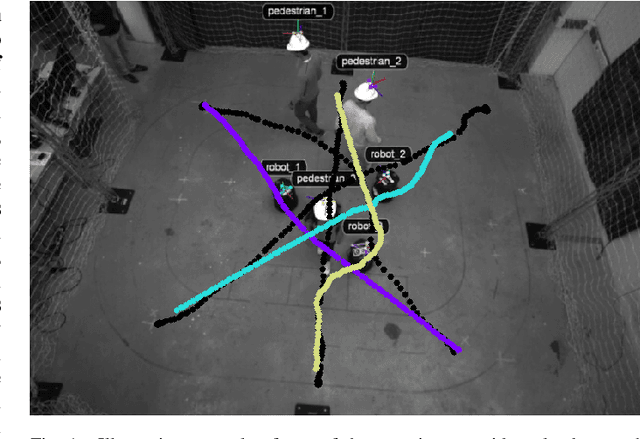
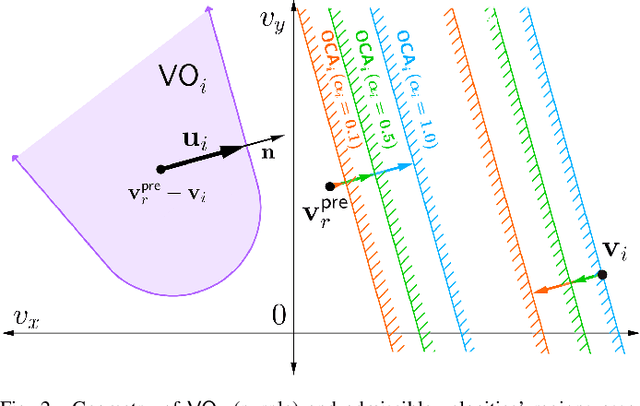
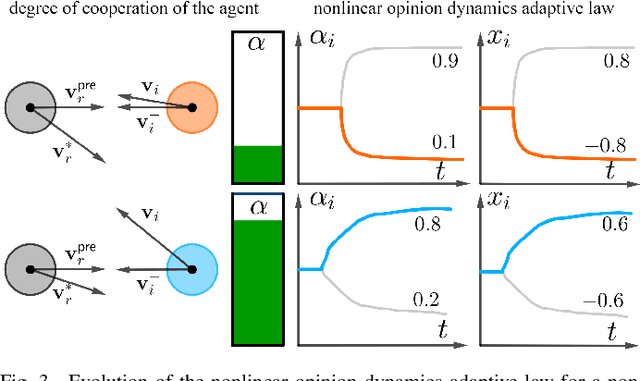
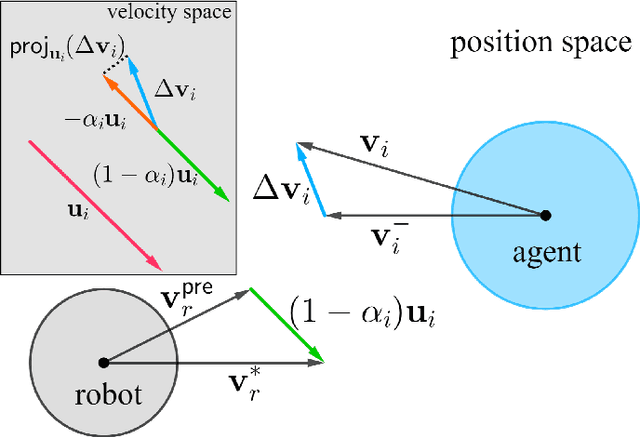
We present AVOCADO (AdaptiVe Optimal Collision Avoidance Driven by Opinion), a novel navigation approach to address holonomic robot collision avoidance when the degree of cooperation of the other agents in the environment is unknown. AVOCADO departs from a Velocity Obstacle's formulation akin to the Optimal Reciprocal Collision Avoidance method. However, instead of assuming reciprocity, AVOCADO poses an adaptive control problem that aims at adapting in real-time to the cooperation degree of other robots and agents. Adaptation is achieved through a novel nonlinear opinion dynamics design that relies solely on sensor observations. As a by-product, based on the nonlinear opinion dynamics, we propose a novel method to avoid the deadlocks under geometrical symmetries among robots and agents. Extensive numerical simulations show that AVOCADO surpasses existing geometrical, learning and planning-based approaches in mixed cooperative/non-cooperative navigation environments in terms of success rate, time to goal and computational time. In addition, we conduct multiple real experiments that verify that AVOCADO is able to avoid collisions in environments crowded with other robots and humans.