 Add to Chrome
 Add to Firefox
 Add to Edge
An adjoint method for training data-driven reduced-order models
Jan 12, 2026
Reduced-order modeling lies at the interface of numerical analysis and data-driven scientific computing, providing principled ways to compress high-fidelity simulations in science and engineering. We propose a training framework that couples a continuous-time form of operator inference with the adjoint-state method to obtain robust data-driven reduced-order models. This method minimizes a trajectory-based loss between reduced-order solutions and projected snapshot data, which removes the need to estimate time derivatives from noisy measurements and provides intrinsic temporal regularization through time integration. We derive the corresponding continuous adjoint equations to compute gradients efficiently and implement a gradient based optimizer to update the reduced model parameters. Each iteration only requires one forward reduced order solve and one adjoint solve, followed by inexpensive gradient assembly, making the method attractive for large-scale simulations. We validate the proposed method on three partial differential equations: viscous Burgers' equation, the two-dimensional Fisher-KPP equation, and an advection-diffusion equation. We perform systematic comparisons against standard operator inference under two perturbation regimes, namely reduced temporal snapshot density and additive Gaussian noise. For clean data, both approaches deliver similar accuracy, but in situations with sparse sampling and noise, the proposed adjoint-based training provides better accuracy and enhanced roll-out stability.

MathLearner: A Large Language Model Agent Framework for Learning to Solve Mathematical Problems
Aug 03, 2024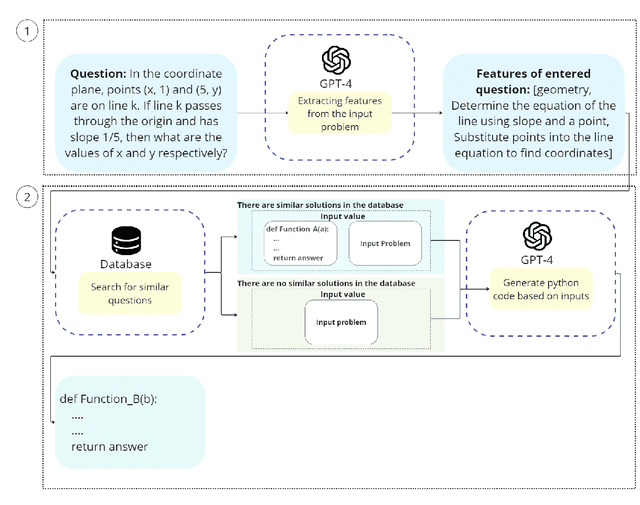

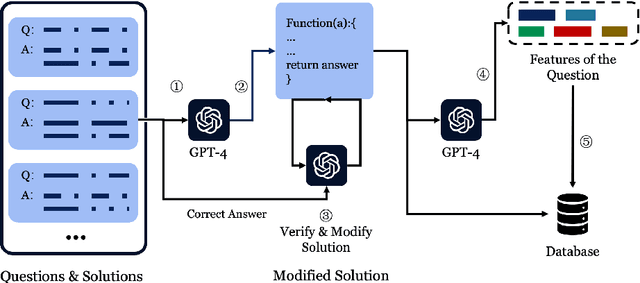
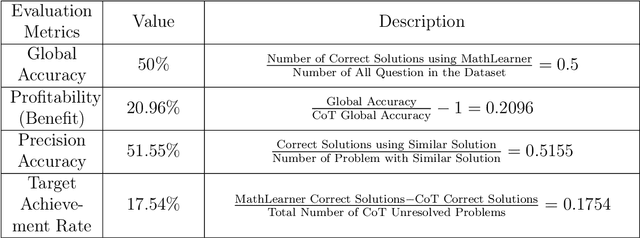
With the development of artificial intelligence (AI), large language models (LLM) are widely used in many fields. However, the reasoning ability of LLM is still very limited when it comes to mathematical reasoning. Mathematics plays an important role in all aspects of human society and is a technical guarantee in the fields of healthcare, transport and aerospace, for this reason, the development of AI big language models in the field of mathematics has great potential significance. To improve the mathematical reasoning ability of large language models, we proposed an agent framework for learning to solve mathematical problems based on inductive reasoning. By emulating the human learning process of generalization of learned information and effective application of previous knowledge in new reasoning tasks, this framework has great performance in the mathematical reasoning process. It improves global accuracy over the baseline method (chain-of-thought) by 20.96% and solves 17.54% of the mathematical problems that the baseline cannot solve. Benefiting from the efficient RETRIEVAL method, our model improves the ability of large language models to efficiently use external knowledge, i.e., the mathematical computation of the model can be based on written procedures. In education, our model can be used as a personalised learning aid, thus reducing the inequality of educational resources.