 Add to Chrome
 Add to Firefox
 Add to Edge
Learnable Multipliers: Freeing the Scale of Language Model Matrix Layers
Jan 08, 2026
Applying weight decay (WD) to matrix layers is standard practice in large-language-model pretraining. Prior work suggests that stochastic gradient noise induces a Brownian-like expansion of the weight matrices W, whose growth is counteracted by WD, leading to a WD-noise equilibrium with a certain weight norm ||W||. In this work, we view the equilibrium norm as a harmful artifact of the training procedure, and address it by introducing learnable multipliers to learn the optimal scale. First, we attach a learnable scalar multiplier to W and confirm that the WD-noise equilibrium norm is suboptimal: the learned scale adapts to data and improves performance. We then argue that individual row and column norms are similarly constrained, and free their scale by introducing learnable per-row and per-column multipliers. Our method can be viewed as a learnable, more expressive generalization of muP multipliers. It outperforms a well-tuned muP baseline, reduces the computational overhead of multiplier tuning, and surfaces practical questions such as forward-pass symmetries and the width-scaling of the learned multipliers. Finally, we validate learnable multipliers with both Adam and Muon optimizers, where it shows improvement in downstream evaluations matching the improvement of the switching from Adam to Muon.

Falcon Mamba: The First Competitive Attention-free 7B Language Model
Oct 07, 2024
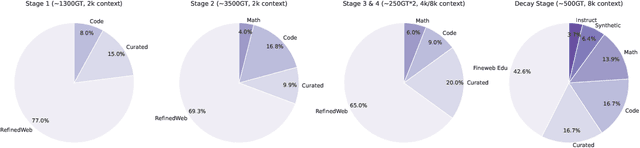
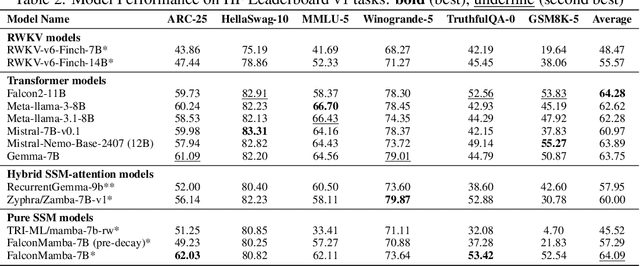
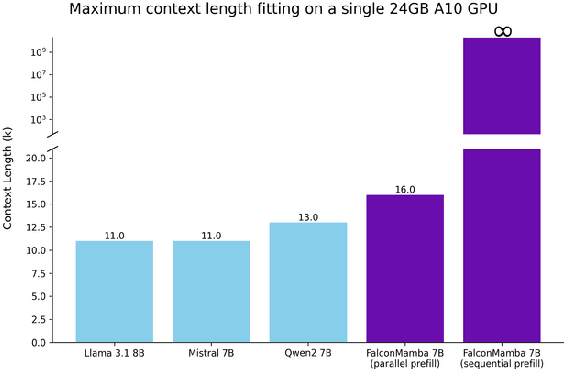
In this technical report, we present Falcon Mamba 7B, a new base large language model based on the novel Mamba architecture. Falcon Mamba 7B is trained on 5.8 trillion tokens with carefully selected data mixtures. As a pure Mamba-based model, Falcon Mamba 7B surpasses leading open-weight models based on Transformers, such as Mistral 7B, Llama3.1 8B, and Falcon2 11B. It is on par with Gemma 7B and outperforms models with different architecture designs, such as RecurrentGemma 9B and RWKV-v6 Finch 7B/14B. Currently, Falcon Mamba 7B is the best-performing Mamba model in the literature at this scale, surpassing both existing Mamba and hybrid Mamba-Transformer models, according to the Open LLM Leaderboard. Due to its architecture, Falcon Mamba 7B is significantly faster at inference and requires substantially less memory for long sequence generation. Despite recent studies suggesting that hybrid Mamba-Transformer models outperform pure architecture designs, we demonstrate that even the pure Mamba design can achieve similar, or even superior results compared to the Transformer and hybrid designs. We make the weights of our implementation of Falcon Mamba 7B publicly available on https://huggingface.co/tiiuae/falcon-mamba-7b, under a permissive license.