 Add to Chrome
 Add to Firefox
 Add to Edge
Search-Based Risk Feature Discovery in Document Structure Spaces under a Constrained Budget
Jan 29, 2026
Enterprise-grade Intelligent Document Processing (IDP) systems support high-stakes workflows across finance, insurance, and healthcare. Early-phase system validation under limited budgets mandates uncovering diverse failure mechanisms, rather than identifying a single worst-case document. We formalize this challenge as a Search-Based Software Testing (SBST) problem, aiming to identify complex interactions between document variables, with the objective to maximize the number of distinct failure types discovered within a fixed evaluation budget. Our methodology operates on a combinatorial space of document configurations, rendering instances of structural \emph{risk features} to induce realistic failure conditions. We benchmark a diverse portfolio of search strategies spanning evolutionary, swarm-based, quality-diversity, learning-based, and quantum under identical budget constraints. Through configuration-level exclusivity, win-rate, and cross-temporal overlap analyses, we show that different solvers consistently uncover failure modes that remain undiscovered by specific alternatives at comparable budgets. Crucially, cross-temporal analysis reveals persistent solver-specific discoveries across all evaluated budgets, with no single strategy exhibiting absolute dominance. While the union of all solvers eventually recovers the observed failure space, reliance on any individual method systematically delays the discovery of important risks. These results demonstrate intrinsic solver complementarity and motivate portfolio-based SBST strategies for robust industrial IDP validation.

PROTEUS: SLA-Aware Routing via Lagrangian RL for Multi-LLM Serving Systems
Jan 27, 2026Production LLM deployments serve diverse workloads where cost and quality requirements vary by customer tier, time of day, and query criticality. Model serving systems accept latency SLOs directly. LLM routers do not. They force operators to tune parameters offline and guess what accuracy might result. The relationship between parameters and outcomes is indirect, non-monotonic, and dataset-dependent. Operators need to specify accuracy targets, not infer them from opaque settings. We present PROTEUS (Polymorphic Router for Operational Target Enforcement with Unified SLA), a router that accepts accuracy targets tau as runtime input. PROTEUS uses Lagrangian dual control. A learned dual variable lambda tracks constraint violations during training and conditions the policy network. This lets the router translate specified tau values into routing decisions that satisfy them. A single trained model serves the full accuracy spectrum without retraining.We evaluate on RouterBench (11 models, 405K queries) and SPROUT (14 models, 45K queries). PROTEUS achieves consistent floor compliance where accuracy meets or exceeds tau. The target-response correlation reaches 0.97 to 0.98. The closest baseline, OmniRouter, meets floors only 22% of the time despite also using Lagrangian optimization. PROTEUS operates across tau in [0.85, 0.95] from a single model. On RouterBench it achieves 90.1% accuracy, within 1.3% of oracle. On SPROUT it achieves 94.0% accuracy, within 4.6% of oracle. Cost savings reach 89.8% versus the best fixed model.
Responsible AI for General-Purpose Systems: Overview, Challenges, and A Path Forward
Jan 19, 2026Modern general-purpose AI systems made using large language and vision models, are capable of performing a range of tasks like writing text articles, generating and debugging codes, querying databases, and translating from one language to another, which has made them quite popular across industries. However, there are risks like hallucinations, toxicity, and stereotypes in their output that make them untrustworthy. We review various risks and vulnerabilities of modern general-purpose AI along eight widely accepted responsible AI (RAI) principles (fairness, privacy, explainability, robustness, safety, truthfulness, governance, and sustainability) and compare how they are non-existent or less severe and easily mitigable in traditional task-specific counterparts. We argue that this is due to the non-deterministically high Degree of Freedom in output (DoFo) of general-purpose AI (unlike the deterministically constant or low DoFo of traditional task-specific AI systems), and there is a need to rethink our approach to RAI for general-purpose AI. Following this, we derive C2V2 (Control, Consistency, Value, Veracity) desiderata to meet the RAI requirements for future general-purpose AI systems, and discuss how recent efforts in AI alignment, retrieval-augmented generation, reasoning enhancements, etc. fare along one or more of the desiderata. We believe that the goal of developing responsible general-purpose AI can be achieved by formally modeling application- or domain-dependent RAI requirements along C2V2 dimensions, and taking a system design approach to suitably combine various techniques to meet the desiderata.
A Multi-Objective Genetic Algorithm for Healthcare Workforce Scheduling
Aug 28, 2025Workforce scheduling in the healthcare sector is a significant operational challenge, characterized by fluctuating patient loads, diverse clinical skills, and the critical need to control labor costs while upholding high standards of patient care. This problem is inherently multi-objective, demanding a delicate balance between competing goals: minimizing payroll, ensuring adequate staffing for patient needs, and accommodating staff preferences to mitigate burnout. We propose a Multi-objective Genetic Algorithm (MOO-GA) that models the hospital unit workforce scheduling problem as a multi-objective optimization task. Our model incorporates real-world complexities, including hourly appointment-driven demand and the use of modular shifts for a multi-skilled workforce. By defining objective functions for cost, patient care coverage, and staff satisfaction, the GA navigates the vast search space to identify a set of high-quality, non-dominated solutions. Demonstrated on datasets representing a typical hospital unit, the results show that our MOO-GA generates robust and balanced schedules. On average, the schedules produced by our algorithm showed a 66\% performance improvement over a baseline that simulates a conventional, manual scheduling process. This approach effectively manages trade-offs between critical operational and staff-centric objectives, providing a practical decision support tool for nurse managers and hospital administrators.
Accelerated Gradient-based Design Optimization Via Differentiable Physics-Informed Neural Operator: A Composites Autoclave Processing Case Study
Feb 17, 2025Simulation and optimization are crucial for advancing the engineering design of complex systems and processes. Traditional optimization methods require substantial computational time and effort due to their reliance on resource-intensive simulations, such as finite element analysis, and the complexity of rigorous optimization algorithms. Data-agnostic AI-based surrogate models, such as Physics-Informed Neural Operators (PINOs), offer a promising alternative to these conventional simulations, providing drastically reduced inference time, unparalleled data efficiency, and zero-shot super-resolution capability. However, the predictive accuracy of these models is often constrained to small, low-dimensional design spaces or systems with relatively simple dynamics. To address this, we introduce a novel Physics-Informed DeepONet (PIDON) architecture, which extends the capabilities of conventional neural operators to effectively model the nonlinear behavior of complex engineering systems across high-dimensional design spaces and a wide range of dynamic design configurations. This new architecture outperforms existing SOTA models, enabling better predictions across broader design spaces. Leveraging PIDON's differentiability, we integrate a gradient-based optimization approach using the Adam optimizer to efficiently determine optimal design variables. This forms an end-to-end gradient-based optimization framework that accelerates the design process while enhancing scalability and efficiency. We demonstrate the effectiveness of this framework in the optimization of aerospace-grade composites curing processes achieving a 3x speedup in obtaining optimal design variables compared to gradient-free methods. Beyond composites processing, the proposed model has the potential to be used as a scalable and efficient optimization tool for broader applications in advanced engineering and digital twin systems.
FB-HyDON: Parameter-Efficient Physics-Informed Operator Learning of Complex PDEs via Hypernetwork and Finite Basis Domain Decomposition
Sep 13, 2024Deep operator networks (DeepONet) and neural operators have gained significant attention for their ability to map infinite-dimensional function spaces and perform zero-shot super-resolution. However, these models often require large datasets for effective training. While physics-informed operators offer a data-agnostic learning approach, they introduce additional training complexities and convergence issues, especially in highly nonlinear systems. To overcome these challenges, we introduce Finite Basis Physics-Informed HyperDeepONet (FB-HyDON), an advanced operator architecture featuring intrinsic domain decomposition. By leveraging hypernetworks and finite basis functions, FB-HyDON effectively mitigates the training limitations associated with existing physics-informed operator learning methods. We validated our approach on the high-frequency harmonic oscillator, Burgers' equation at different viscosity levels, and Allen-Cahn equation demonstrating substantial improvements over other operator learning models.
An Advanced Physics-Informed Neural Operator for Comprehensive Design Optimization of Highly-Nonlinear Systems: An Aerospace Composites Processing Case Study
Jun 20, 2024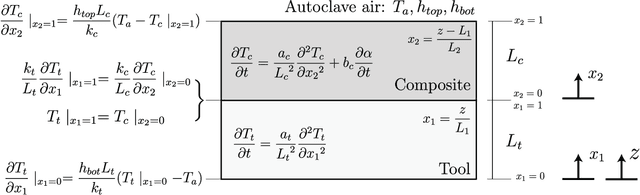
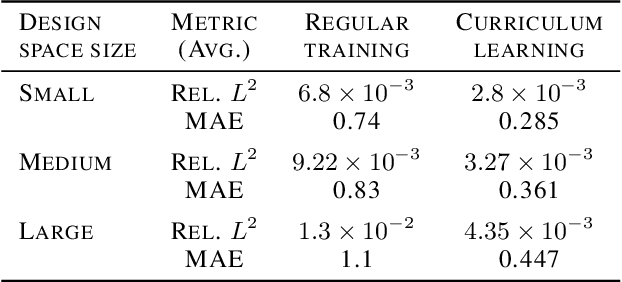
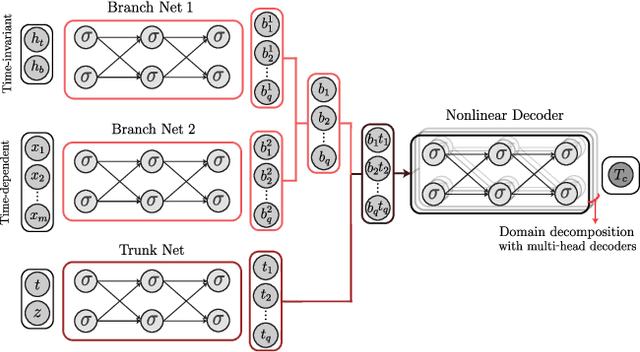
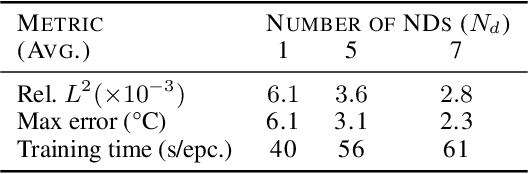
Deep Operator Networks (DeepONets) and their physics-informed variants have shown significant promise in learning mappings between function spaces of partial differential equations, enhancing the generalization of traditional neural networks. However, for highly nonlinear real-world applications like aerospace composites processing, existing models often fail to capture underlying solutions accurately and are typically limited to single input functions, constraining rapid process design development. This paper introduces an advanced physics-informed DeepONet tailored for such complex systems with multiple input functions. Equipped with architectural enhancements like nonlinear decoders and effective training strategies such as curriculum learning and domain decomposition, the proposed model handles high-dimensional design spaces with significantly improved accuracy, outperforming the vanilla physics-informed DeepONet by two orders of magnitude. Its zero-shot prediction capability across a broad design space makes it a powerful tool for accelerating composites process design and optimization, with potential applications in other engineering fields characterized by strong nonlinearity.