 Add to Chrome
 Add to Firefox
 Add to Edge
Latent-Level Enhancement with Flow Matching for Robust Automatic Speech Recognition
Jan 08, 2026
Noise-robust automatic speech recognition (ASR) has been commonly addressed by applying speech enhancement (SE) at the waveform level before recognition. However, speech-level enhancement does not always translate into consistent recognition improvements due to residual distortions and mismatches with the latent space of the ASR encoder. In this letter, we introduce a complementary strategy termed latent-level enhancement, where distorted representations are refined during ASR inference. Specifically, we propose a plug-and-play Flow Matching Refinement module (FM-Refiner) that operates on the output latents of a pretrained CTC-based ASR encoder. Trained to map imperfect latents-either directly from noisy inputs or from enhanced-but-imperfect speech-toward their clean counterparts, the FM-Refiner is applied only at inference, without fine-tuning ASR parameters. Experiments show that FM-Refiner consistently reduces word error rate, both when directly applied to noisy inputs and when combined with conventional SE front-ends. These results demonstrate that latent-level refinement via flow matching provides a lightweight and effective complement to existing SE approaches for robust ASR.

Improving Noise Robust Audio-Visual Speech Recognition via Router-Gated Cross-Modal Feature Fusion
Aug 26, 2025Robust audio-visual speech recognition (AVSR) in noisy environments remains challenging, as existing systems struggle to estimate audio reliability and dynamically adjust modality reliance. We propose router-gated cross-modal feature fusion, a novel AVSR framework that adaptively reweights audio and visual features based on token-level acoustic corruption scores. Using an audio-visual feature fusion-based router, our method down-weights unreliable audio tokens and reinforces visual cues through gated cross-attention in each decoder layer. This enables the model to pivot toward the visual modality when audio quality deteriorates. Experiments on LRS3 demonstrate that our approach achieves an 16.51-42.67% relative reduction in word error rate compared to AV-HuBERT. Ablation studies confirm that both the router and gating mechanism contribute to improved robustness under real-world acoustic noise.
FLOWER: Flow-Based Estimated Gaussian Guidance for General Speech Restoration
May 03, 2025
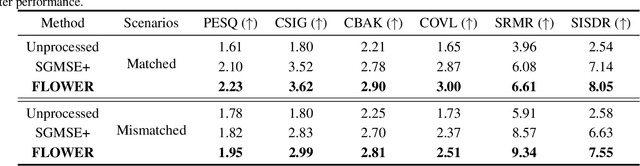
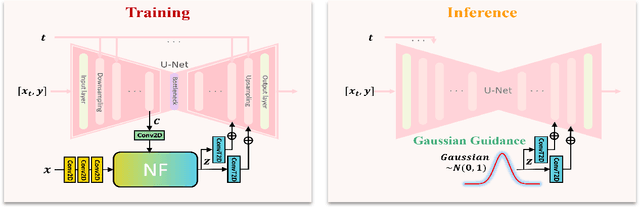

We introduce FLOWER, a novel conditioning method designed for speech restoration that integrates Gaussian guidance into generative frameworks. By transforming clean speech into a predefined prior distribution (e.g., Gaussian distribution) using a normalizing flow network, FLOWER extracts critical information to guide generative models. This guidance is incorporated into each block of the generative network, enabling precise restoration control. Experimental results demonstrate the effectiveness of FLOWER in improving performance across various general speech restoration tasks.
DM: Dual-path Magnitude Network for General Speech Restoration
Sep 13, 2024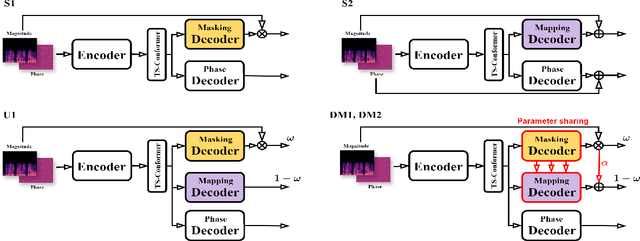
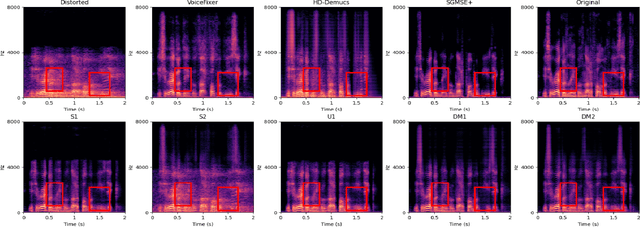
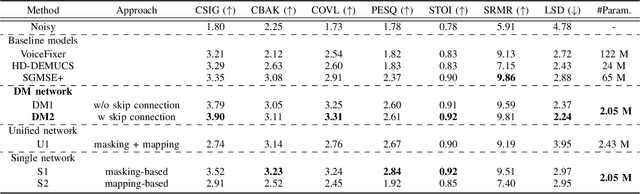
In this paper, we introduce a novel general speech restoration model: the Dual-path Magnitude (DM) network, designed to address multiple distortions including noise, reverberation, and bandwidth degradation effectively. The DM network employs dual parallel magnitude decoders that share parameters: one uses a masking-based algorithm for distortion removal and the other employs a mapping-based approach for speech restoration. A novel aspect of the DM network is the integration of the magnitude spectrogram output from the masking decoder into the mapping decoder through a skip connection, enhancing the overall restoration capability. This integrated approach overcomes the inherent limitations observed in previous models, as detailed in a step-by-step analysis. The experimental results demonstrate that the DM network outperforms other baseline models in the comprehensive aspect of general speech restoration, achieving substantial restoration with fewer parameters.