 Add to Chrome
 Add to Firefox
 Add to Edge
AP-OOD: Attention Pooling for Out-of-Distribution Detection
Feb 05, 2026
Out-of-distribution (OOD) detection, which maps high-dimensional data into a scalar OOD score, is critical for the reliable deployment of machine learning models. A key challenge in recent research is how to effectively leverage and aggregate token embeddings from language models to obtain the OOD score. In this work, we propose AP-OOD, a novel OOD detection method for natural language that goes beyond simple average-based aggregation by exploiting token-level information. AP-OOD is a semi-supervised approach that flexibly interpolates between unsupervised and supervised settings, enabling the use of limited auxiliary outlier data. Empirically, AP-OOD sets a new state of the art in OOD detection for text: in the unsupervised setting, it reduces the FPR95 (false positive rate at 95% true positives) from 27.84% to 4.67% on XSUM summarization, and from 77.08% to 70.37% on WMT15 En-Fr translation.

Energy-based Hopfield Boosting for Out-of-Distribution Detection
May 14, 2024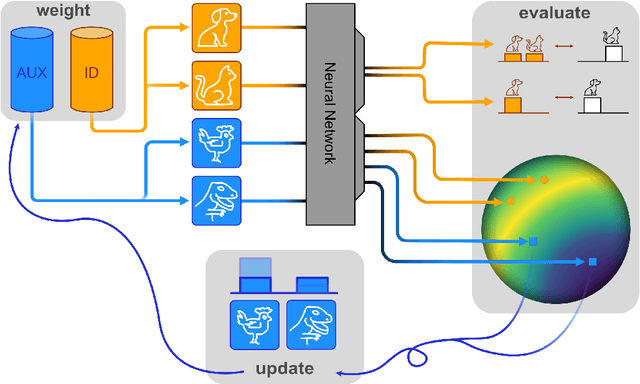
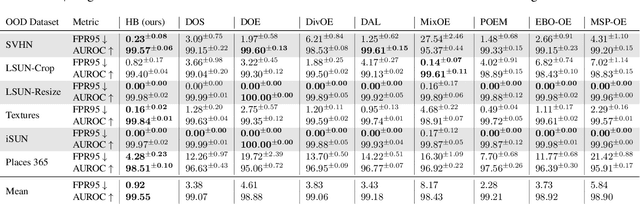
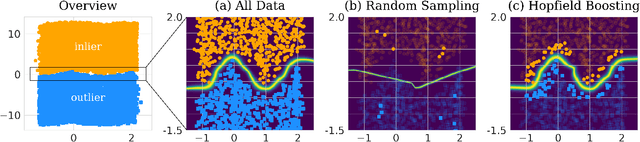
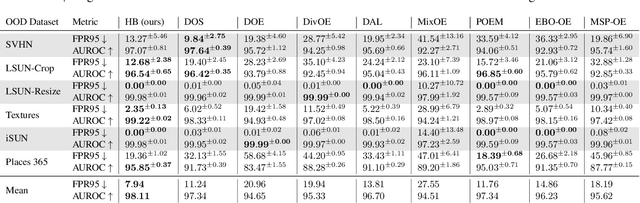
Out-of-distribution (OOD) detection is critical when deploying machine learning models in the real world. Outlier exposure methods, which incorporate auxiliary outlier data in the training process, can drastically improve OOD detection performance compared to approaches without advanced training strategies. We introduce Hopfield Boosting, a boosting approach, which leverages modern Hopfield energy (MHE) to sharpen the decision boundary between the in-distribution and OOD data. Hopfield Boosting encourages the model to concentrate on hard-to-distinguish auxiliary outlier examples that lie close to the decision boundary between in-distribution and auxiliary outlier data. Our method achieves a new state-of-the-art in OOD detection with outlier exposure, improving the FPR95 metric from 2.28 to 0.92 on CIFAR-10 and from 11.76 to 7.94 on CIFAR-100.