 Add to Chrome
 Add to Firefox
 Add to Edge
REV-INR: Regularized Evidential Implicit Neural Representation for Uncertainty-Aware Volume Visualization
Jan 25, 2026
Applications of Implicit Neural Representations (INRs) have emerged as a promising deep learning approach for compactly representing large volumetric datasets. These models can act as surrogates for volume data, enabling efficient storage and on-demand reconstruction via model predictions. However, conventional deterministic INRs only provide value predictions without insights into the model's prediction uncertainty or the impact of inherent noisiness in the data. This limitation can lead to unreliable data interpretation and visualization due to prediction inaccuracies in the reconstructed volume. Identifying erroneous results extracted from model-predicted data may be infeasible, as raw data may be unavailable due to its large size. To address this challenge, we introduce REV-INR, Regularized Evidential Implicit Neural Representation, which learns to predict data values accurately along with the associated coordinate-level data uncertainty and model uncertainty using only a single forward pass of the trained REV-INR during inference. By comprehensively comparing and contrasting REV-INR with existing well-established deep uncertainty estimation methods, we show that REV-INR achieves the best volume reconstruction quality with robust data (aleatoric) and model (epistemic) uncertainty estimates using the fastest inference time. Consequently, we demonstrate that REV-INR facilitates assessment of the reliability and trustworthiness of the extracted isosurfaces and volume visualization results, enabling analyses to be solely driven by model-predicted data.

Uncertainty-Informed Volume Visualization using Implicit Neural Representation
Aug 12, 2024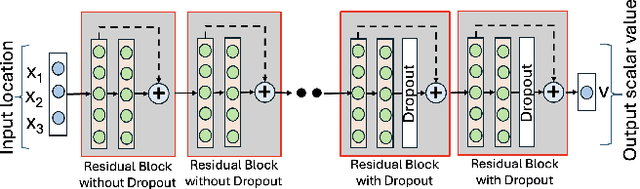
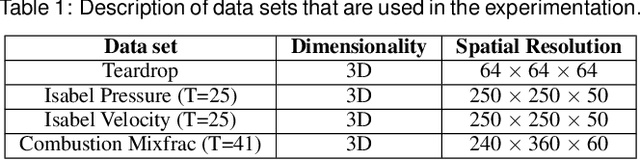
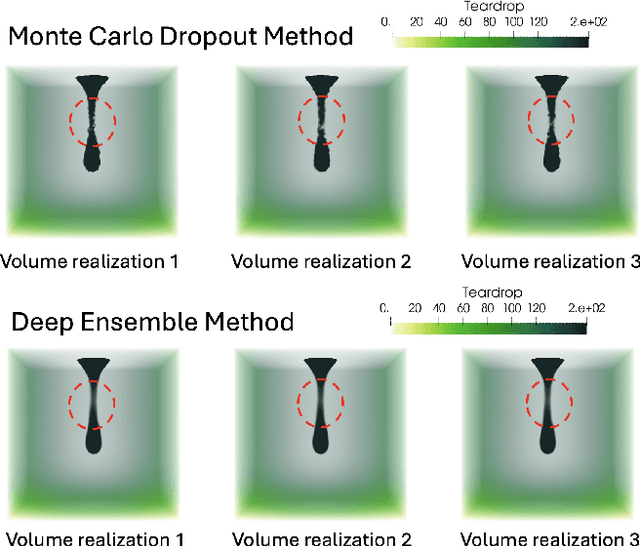
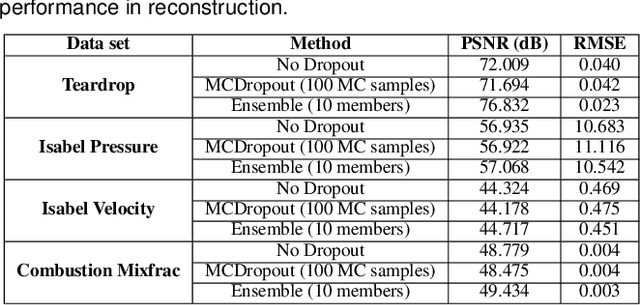
The increasing adoption of Deep Neural Networks (DNNs) has led to their application in many challenging scientific visualization tasks. While advanced DNNs offer impressive generalization capabilities, understanding factors such as model prediction quality, robustness, and uncertainty is crucial. These insights can enable domain scientists to make informed decisions about their data. However, DNNs inherently lack ability to estimate prediction uncertainty, necessitating new research to construct robust uncertainty-aware visualization techniques tailored for various visualization tasks. In this work, we propose uncertainty-aware implicit neural representations to model scalar field data sets effectively and comprehensively study the efficacy and benefits of estimated uncertainty information for volume visualization tasks. We evaluate the effectiveness of two principled deep uncertainty estimation techniques: (1) Deep Ensemble and (2) Monte Carlo Dropout (MCDropout). These techniques enable uncertainty-informed volume visualization in scalar field data sets. Our extensive exploration across multiple data sets demonstrates that uncertainty-aware models produce informative volume visualization results. Moreover, integrating prediction uncertainty enhances the trustworthiness of our DNN model, making it suitable for robustly analyzing and visualizing real-world scientific volumetric data sets.