 Add to Chrome
 Add to Firefox
 Add to Edge
Guided Diffusion by Optimized Loss Functions on Relaxed Parameters for Inverse Material Design
Feb 17, 2026
Inverse design problems are common in engineering and materials science. The forward direction, i.e., computing output quantities from design parameters, typically requires running a numerical simulation, such as a FEM, as an intermediate step, which is an optimization problem by itself. In many scenarios, several design parameters can lead to the same or similar output values. For such cases, multi-modal probabilistic approaches are advantageous to obtain diverse solutions. A major difficulty in inverse design stems from the structure of the design space, since discrete parameters or further constraints disallow the direct use of gradient-based optimization. To tackle this problem, we propose a novel inverse design method based on diffusion models. Our approach relaxes the original design space into a continuous grid representation, where gradients can be computed by implicit differentiation in the forward simulation. A diffusion model is trained on this relaxed parameter space in order to serve as a prior for plausible relaxed designs. Parameters are sampled by guided diffusion using gradients that are propagated from an objective function specified at inference time through the differentiable simulation. A design sample is obtained by backprojection into the original parameter space. We develop our approach for a composite material design problem where the forward process is modeled as a linear FEM problem. We evaluate the performance of our approach in finding designs that match a specified bulk modulus. We demonstrate that our method can propose diverse designs within 1% relative error margin from medium to high target bulk moduli in 2D and 3D settings. We also demonstrate that the material density of generated samples can be minimized simultaneously by using a multi-objective loss function.

Improved Training Strategies for Physics-Informed Neural Networks using Real Experimental Data in Aluminum Spot Welding
Aug 06, 2025Resistance spot welding is the dominant joining process for the body-in-white in the automotive industry, where the weld nugget diameter is the key quality metric. Its measurement requires destructive testing, limiting the potential for efficient quality control. Physics-informed neural networks were investigated as a promising tool to reconstruct internal process states from experimental data, enabling model-based and non-invasive quality assessment in aluminum spot welding. A major challenge is the integration of real-world data into the network due to competing optimization objectives. To address this, we introduce two novel training strategies. First, experimental losses for dynamic displacement and nugget diameter are progressively included using a fading-in function to prevent excessive optimization conflicts. We also implement a custom learning rate scheduler and early stopping based on a rolling window to counteract premature reduction due to increased loss magnitudes. Second, we introduce a conditional update of temperature-dependent material parameters via a look-up table, activated only after a loss threshold is reached to ensure physically meaningful temperatures. An axially symmetric two-dimensional model was selected to represent the welding process accurately while maintaining computational efficiency. To reduce computational burden, the training strategies and model components were first systematically evaluated in one dimension, enabling controlled analysis of loss design and contact models. The two-dimensional network predicts dynamic displacement and nugget growth within the experimental confidence interval, supports transferring welding stages from steel to aluminum, and demonstrates strong potential for fast, model-based quality control in industrial applications.
A machine learning based plasticity model using proper orthogonal decomposition
Jan 07, 2020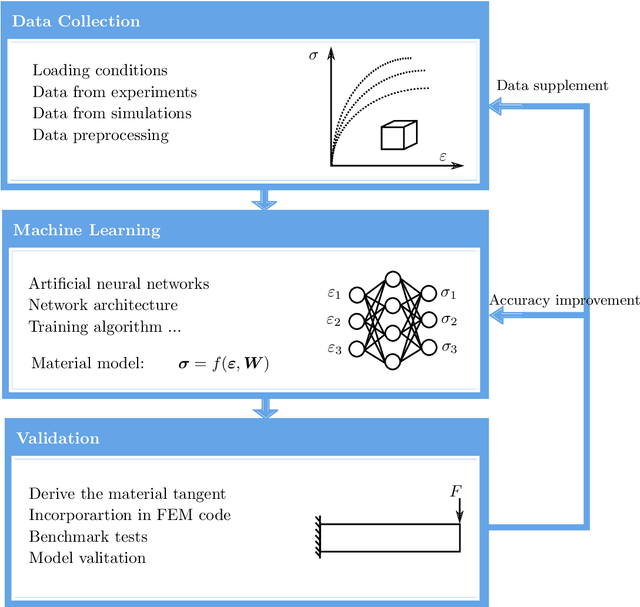
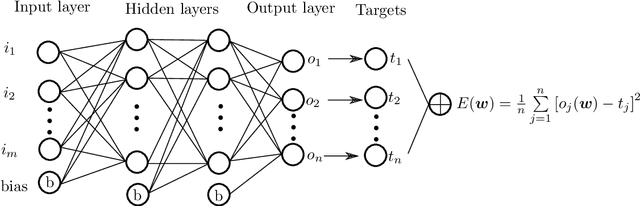

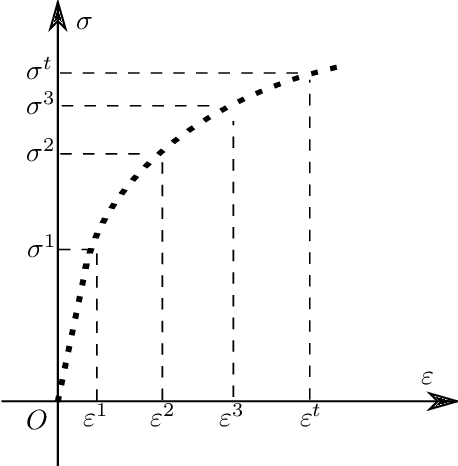
Data-driven material models have many advantages over classical numerical approaches, such as the direct utilization of experimental data and the possibility to improve performance of predictions when additional data is available. One approach to develop a data-driven material model is to use machine learning tools. These can be trained offline to fit an observed material behaviour and then be applied in online applications. However, learning and predicting history dependent material models, such as plasticity, is still challenging. In this work, a machine learning based material modelling framework is proposed for both elasticity and plasticity. The machine learning based hyperelasticity model is developed with the Feed forward Neural Network (FNN) directly whereas the machine learning based plasticity model is developed by using of a novel method called Proper Orthogonal Decomposition Feed forward Neural Network (PODFNN). In order to account for the loading history, the accumulated absolute strain is proposed to be the history variable of the plasticity model. Additionally, the strain-stress sequence data for plasticity is collected from different loading-unloading paths based on the concept of sequence for plasticity. By means of the POD, the multi-dimensional stress sequence is decoupled leading to independent one dimensional coefficient sequences. In this case, the neural network with multiple output is replaced by multiple independent neural networks each possessing a one-dimensional output, which leads to less training time and better training performance. To apply the machine learning based material model in finite element analysis, the tangent matrix is derived by the automatic symbolic differentiation tool AceGen. The effectiveness and generalization of the presented models are investigated by a series of numerical examples using both 2D and 3D finite element analysis.