 Add to Chrome
 Add to Firefox
 Add to Edge
A Real-Time System to Populate FRA Form 57 from News
Dec 27, 2025
Local railway committees need timely situational awareness after highway-rail grade crossing incidents, yet official Federal Railroad Administration (FRA) investigations can take days to weeks. We present a demo system that populates Highway-Rail Grade Crossing Incident Data (Form 57) from news in real time. Our approach addresses two core challenges: the form is visually irregular and semantically dense, and news is noisy. To solve these problems, we design a pipeline that first converts Form 57 into a JSON schema using a vision language model with sample aggregation, and then performs grouped question answering following the intent of the form layout to reduce ambiguity. In addition, we build an evaluation dataset by aligning scraped news articles with official FRA records and annotating retrievable information. We then assess our system against various alternatives in terms of information retrieval accuracy and coverage.

ExpertGenQA: Open-ended QA generation in Specialized Domains
Mar 04, 2025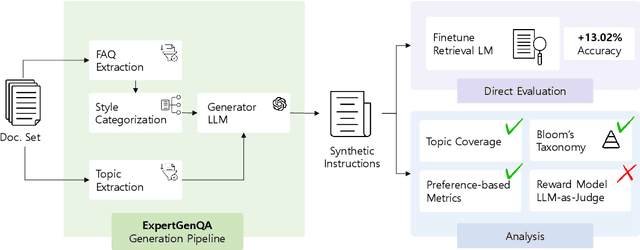
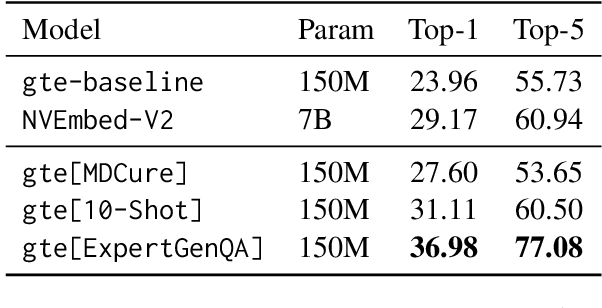
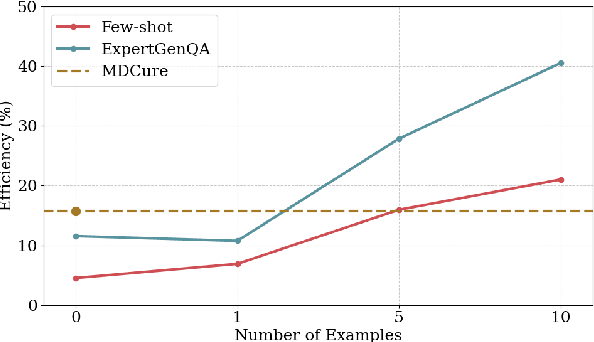
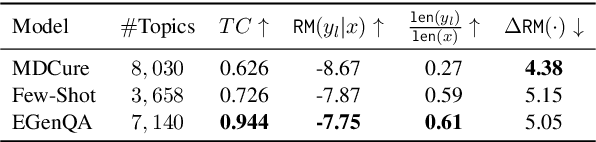
Generating high-quality question-answer pairs for specialized technical domains remains challenging, with existing approaches facing a tradeoff between leveraging expert examples and achieving topical diversity. We present ExpertGenQA, a protocol that combines few-shot learning with structured topic and style categorization to generate comprehensive domain-specific QA pairs. Using U.S. Federal Railroad Administration documents as a test bed, we demonstrate that ExpertGenQA achieves twice the efficiency of baseline few-shot approaches while maintaining $94.4\%$ topic coverage. Through systematic evaluation, we show that current LLM-based judges and reward models exhibit strong bias toward superficial writing styles rather than content quality. Our analysis using Bloom's Taxonomy reveals that ExpertGenQA better preserves the cognitive complexity distribution of expert-written questions compared to template-based approaches. When used to train retrieval models, our generated queries improve top-1 accuracy by $13.02\%$ over baseline performance, demonstrating their effectiveness for downstream applications in technical domains.