 Add to Chrome
 Add to Firefox
 Add to Edge
Deep QP Safety Filter: Model-free Learning for Reachability-based Safety Filter
Jan 29, 2026
We introduce Deep QP Safety Filter, a fully data-driven safety layer for black-box dynamical systems. Our method learns a Quadratic-Program (QP) safety filter without model knowledge by combining Hamilton-Jacobi (HJ) reachability with model-free learning. We construct contraction-based losses for both the safety value and its derivatives, and train two neural networks accordingly. In the exact setting, the learned critic converges to the viscosity solution (and its derivative), even for non-smooth values. Across diverse dynamical systems -- even including a hybrid system -- and multiple RL tasks, Deep QP Safety Filter substantially reduces pre-convergence failures while accelerating learning toward higher returns than strong baselines, offering a principled and practical route to safe, model-free control.

Autonomous Aerial Manipulation at Arbitrary Pose in SE(3) with Robust Control and Whole-body Planning
Aug 27, 2025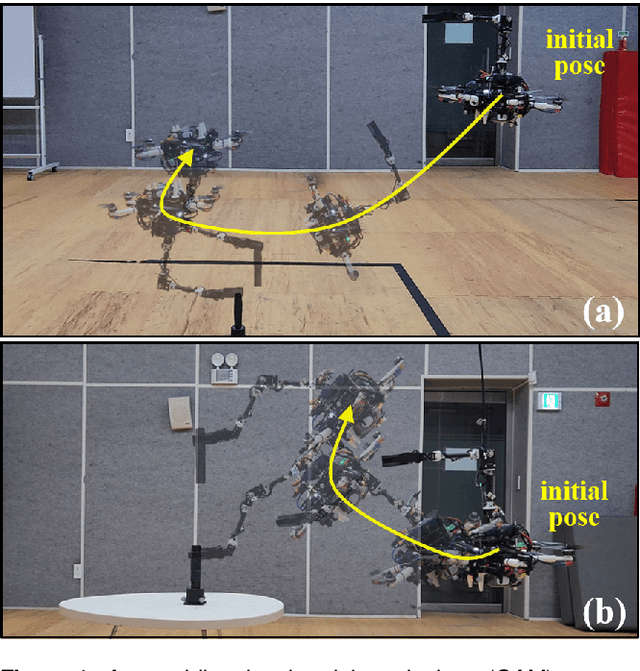
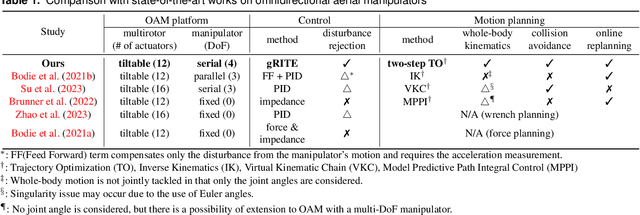
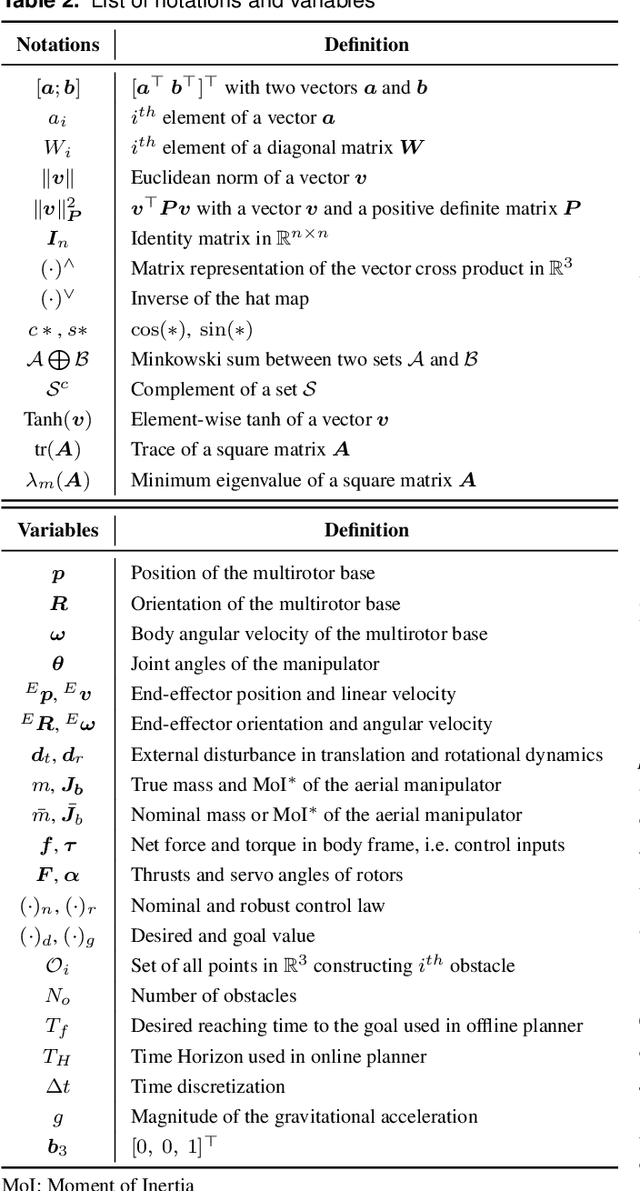
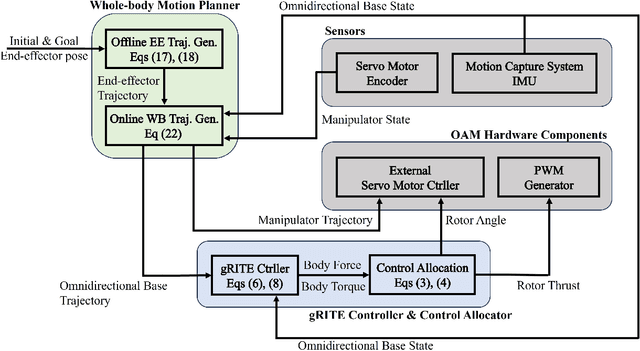
Aerial manipulators based on conventional multirotors can conduct manipulation only in small roll and pitch angles due to the underactuatedness of the multirotor base. If the multirotor base is capable of hovering at arbitrary orientation, the robot can freely locate itself at any point in $\mathsf{SE}(3)$, significantly extending its manipulation workspace and enabling a manipulation task that was originally not viable. In this work, we present a geometric robust control and whole-body motion planning framework for an omnidirectional aerial manipulator (OAM). To maximize the strength of OAM, we first propose a geometric robust controller for a floating base. Since the motion of the robotic arm and the interaction forces during manipulation affect the stability of the floating base, the base should be capable of mitigating these adverse effects while controlling its 6D pose. We then design a two-step optimization-based whole-body motion planner, jointly considering the pose of the floating base and the joint angles of the robotic arm to harness the entire configuration space. The devised two-step approach facilitates real-time applicability and enhances convergence of the optimization problem with non-convex and non-Euclidean search space. The proposed approach enables the base to be stationary at any 6D pose while autonomously carrying out sophisticated manipulation near obstacles without any collision. We demonstrate the effectiveness of the proposed framework through experiments in which an OAM performs grasping and pulling of an object in multiple scenarios, including near $90^\circ$ and even $180^\circ$ pitch angles.
Stable Contact Guaranteeing Motion/Force Control for an Aerial Manipulator on an Arbitrarily Tilted Surface
Jan 19, 2023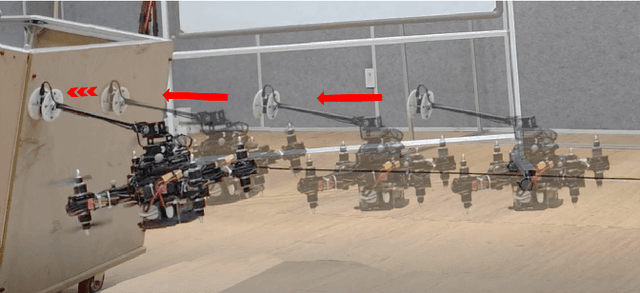
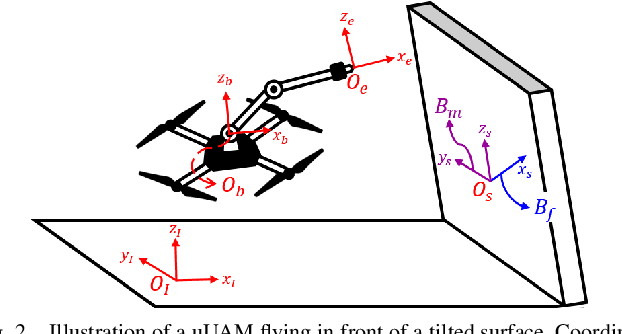
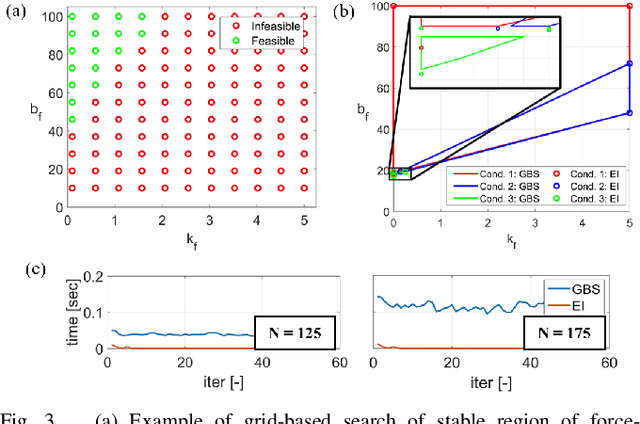
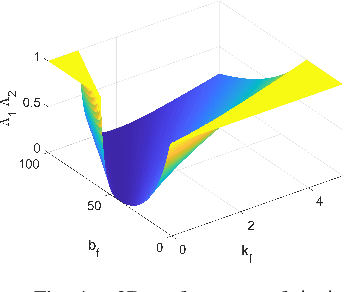
This study aims to design a motion/force controller for an aerial manipulator which guarantees the tracking of time-varying motion/force trajectories as well as the stability during the transition between free and contact motions. To this end, we model the force exerted on the end-effector as the Kelvin-Voigt linear model and estimate its parameters by recursive least-squares estimator. Then, the gains of the disturbance-observer (DOB)-based motion/force controller are calculated based on the stability conditions considering both the model uncertainties in the dynamic equation and switching between the free and contact motions. To validate the proposed controller, we conducted the time-varying motion/force tracking experiments with different approach speeds and orientations of the surface. The results show that our controller enables the aerial manipulator to track the time-varying motion/force trajectories.