 Add to Chrome
 Add to Firefox
 Add to Edge
Exact Instance Compression for Convex Empirical Risk Minimization via Color Refinement
Jan 31, 2026
Empirical risk minimization (ERM) can be computationally expensive, with standard solvers scaling poorly even in the convex setting. We propose a novel lossless compression framework for convex ERM based on color refinement, extending prior work from linear programs and convex quadratic programs to a broad class of differentiable convex optimization problems. We develop concrete algorithms for a range of models, including linear and polynomial regression, binary and multiclass logistic regression, regression with elastic-net regularization, and kernel methods such as kernel ridge regression and kernel logistic regression. Numerical experiments on representative datasets demonstrate the effectiveness of the proposed approach.

METER-ML: A Multi-sensor Earth Observation Benchmark for Automated Methane Source Mapping
Jul 22, 2022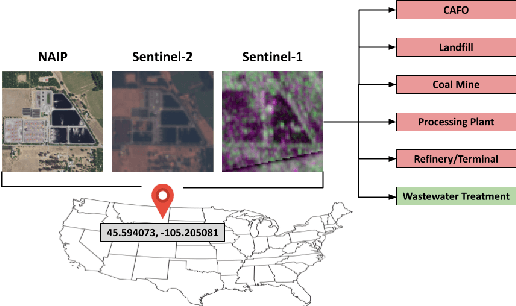
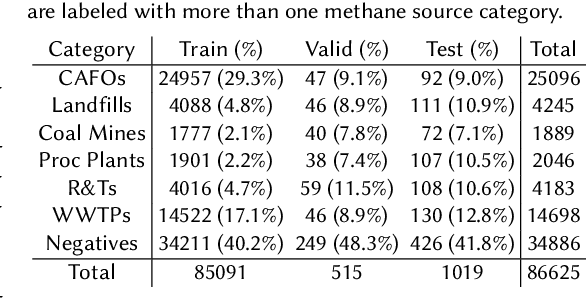
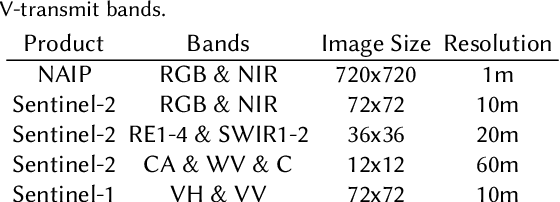
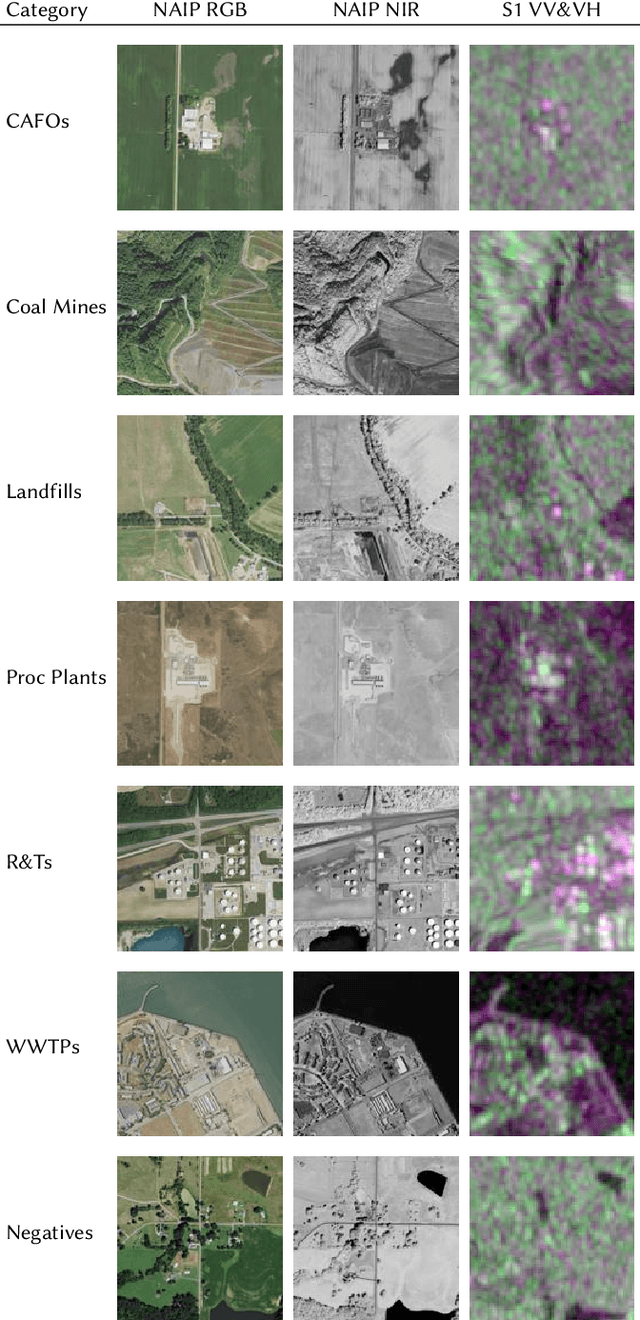
Reducing methane emissions is essential for mitigating global warming. To attribute methane emissions to their sources, a comprehensive dataset of methane source infrastructure is necessary. Recent advancements with deep learning on remotely sensed imagery have the potential to identify the locations and characteristics of methane sources, but there is a substantial lack of publicly available data to enable machine learning researchers and practitioners to build automated mapping approaches. To help fill this gap, we construct a multi-sensor dataset called METER-ML containing 86,625 georeferenced NAIP, Sentinel-1, and Sentinel-2 images in the U.S. labeled for the presence or absence of methane source facilities including concentrated animal feeding operations, coal mines, landfills, natural gas processing plants, oil refineries and petroleum terminals, and wastewater treatment plants. We experiment with a variety of models that leverage different spatial resolutions, spatial footprints, image products, and spectral bands. We find that our best model achieves an area under the precision recall curve of 0.915 for identifying concentrated animal feeding operations and 0.821 for oil refineries and petroleum terminals on an expert-labeled test set, suggesting the potential for large-scale mapping. We make METER-ML freely available at https://stanfordmlgroup.github.io/projects/meter-ml/ to support future work on automated methane source mapping.