 Add to Chrome
 Add to Firefox
 Add to Edge
Dominant Sets Based Band Selection in Hyperspectral Imagery
Jan 25, 2026
Hyperspectral imagery is composed of huge amount of data which creates significant transmission latencies for communication systems. It is vital to decrease the huge data size before transmitting the Hyperspectral imagery. Besides, large data size leads to processing problems, especially in practical applications. Moreover, due to the lack of sufficient training samples, Hughes phenomena occur with huge amount of data. Feature selection can be used in order to get rid of huge data problems. In this paper, a band selection framework is introduced to reduce the data size and to find out the most proper spectral bands for a specific application. The method is based on finding "dominant sets" in hyperspectral data, so that spectral bands are clustered. From each cluster, the band that reflects the cluster behavior the most is selected to form the most valuable band set in the spectra for a specific application. The proposed feature selection method has low computational complexity since it performs on a small size of data when realizing the feature selection. The aim of the study is to find out a general framework that can define required bands for classification without requiring to perform on the whole data set. Results on Pavia and Salinas datasets show that the proposed framework performs better than the state-of-the-art feature selection methods in terms of classification accuracy.

Deep Convolutional Generative Adversarial Networks Based Flame Detection in Video
Feb 05, 2019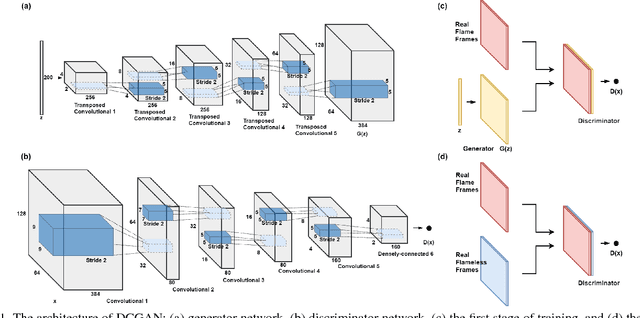
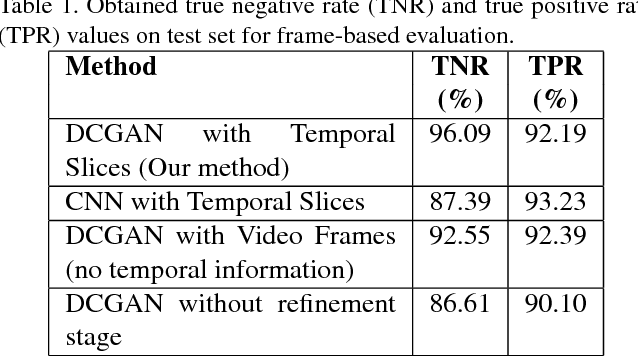
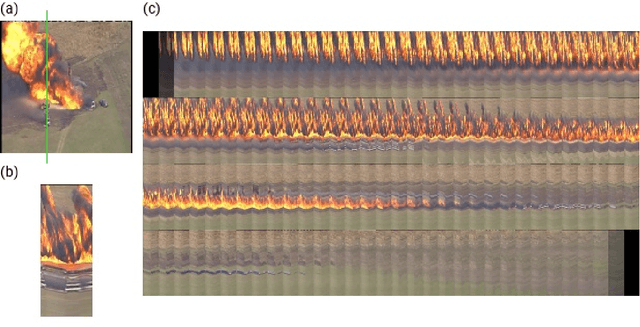
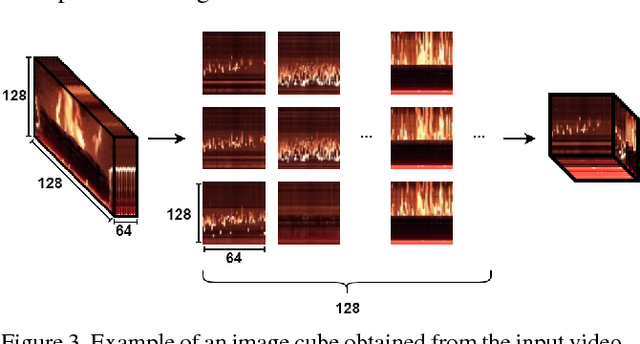
Real-time flame detection is crucial in video based surveillance systems. We propose a vision-based method to detect flames using Deep Convolutional Generative Adversarial Neural Networks (DCGANs). Many existing supervised learning approaches using convolutional neural networks do not take temporal information into account and require substantial amount of labeled data. In order to have a robust representation of sequences with and without flame, we propose a two-stage training of a DCGAN exploiting spatio-temporal flame evolution. Our training framework includes the regular training of a DCGAN with real spatio-temporal images, namely, temporal slice images, and noise vectors, and training the discriminator separately using the temporal flame images without the generator. Experimental results show that the proposed method effectively detects flame in video with negligible false positive rates in real-time.