 Add to Chrome
 Add to Firefox
 Add to Edge
Localized, High-resolution Geographic Representations with Slepian Functions
Jan 30, 2026
Geographic data is fundamentally local. Disease outbreaks cluster in population centers, ecological patterns emerge along coastlines, and economic activity concentrates within country borders. Machine learning models that encode geographic location, however, distribute representational capacity uniformly across the globe, struggling at the fine-grained resolutions that localized applications require. We propose a geographic location encoder built from spherical Slepian functions that concentrate representational capacity inside a region-of-interest and scale to high resolutions without extensive computational demands. For settings requiring global context, we present a hybrid Slepian-Spherical Harmonic encoder that efficiently bridges the tradeoff between local-global performance, while retaining desirable properties such as pole-safety and spherical-surface-distance preservation. Across five tasks spanning classification, regression, and image-augmented prediction, Slepian encodings outperform baselines and retain performance advantages across a wide range of neural network architectures.

A Long Short-Term Memory for AI Applications in Spike-based Neuromorphic Hardware
Jul 08, 2021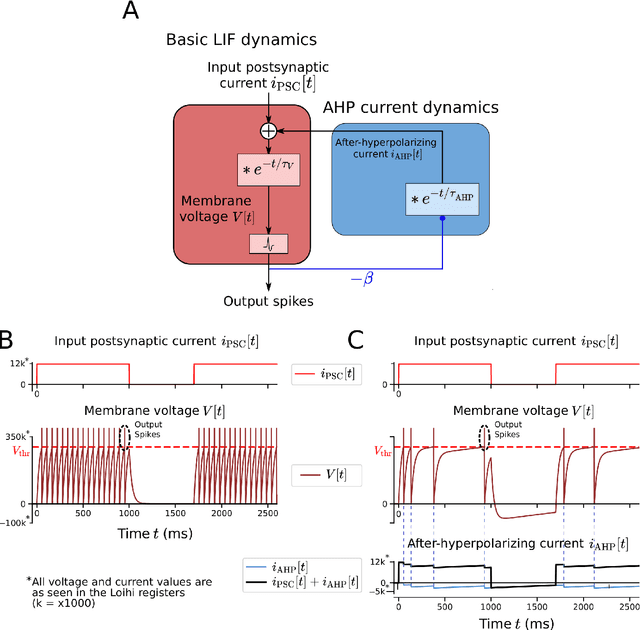
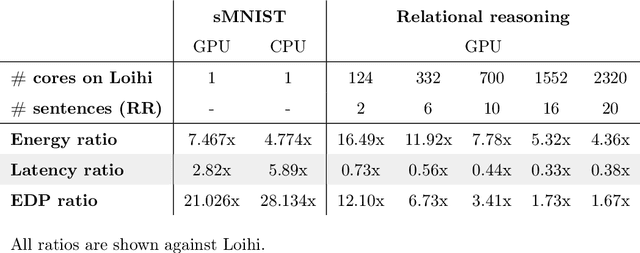
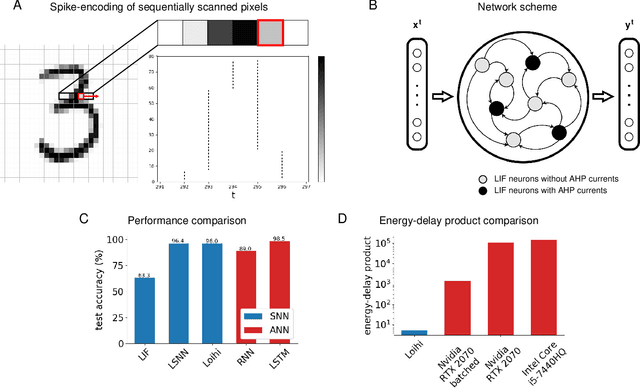
In spite of intensive efforts it has remained an open problem to what extent current Artificial Intelligence (AI) methods that employ Deep Neural Networks (DNNs) can be implemented more energy-efficiently on spike-based neuromorphic hardware. This holds in particular for AI methods that solve sequence processing tasks, a primary application target for spike-based neuromorphic hardware. One difficulty is that DNNs for such tasks typically employ Long Short-Term Memory (LSTM) units. Yet an efficient emulation of these units in spike-based hardware has been missing. We present a biologically inspired solution that solves this problem. This solution enables us to implement a major class of DNNs for sequence processing tasks such as time series classification and question answering with substantial energy savings on neuromorphic hardware. In fact, the Relational Network for reasoning about relations between objects that we use for question answering is the first example of a large DNN that carries out a sequence processing task with substantial energy-saving on neuromorphic hardware.