 Add to Chrome
 Add to Firefox
 Add to Edge
TIRAuxCloud: A Thermal Infrared Dataset for Day and Night Cloud Detection
Feb 25, 2026
Clouds are a major obstacle in Earth observation, limiting the usability and reliability of critical remote sensing applications such as fire disaster response, urban heat island monitoring, and snow and ice cover mapping. Therefore, the ability to detect clouds 24/7 is of paramount importance. While visible and near-infrared bands are effective for daytime cloud detection, their dependence on solar illumination makes them unsuitable for nighttime monitoring. In contrast, thermal infrared (TIR) imagery plays a crucial role in detecting clouds at night, when sunlight is absent. Due to their generally lower temperatures, clouds emit distinct thermal signatures that are detectable in TIR bands. Despite this, accurate nighttime cloud detection remains challenging due to limited spectral information and the typically lower spatial resolution of TIR imagery. To address these challenges, we present TIRAuxCloud, a multi-modal dataset centered around thermal spectral data to facilitate cloud segmentation under both daytime and nighttime conditions. The dataset comprises a unique combination of multispectral data (TIR, optical, and near-infrared bands) from Landsat and VIIRS, aligned with auxiliary information layers. Elevation, land cover, meteorological variables, and cloud-free reference images are included to help reduce surface-cloud ambiguity and cloud formation uncertainty. To overcome the scarcity of manual cloud labels, we include a large set of samples with automated cloud masks and a smaller manually annotated subset to further evaluate and improve models. Comprehensive benchmarks are presented to establish performance baselines through supervised and transfer learning, demonstrating the dataset's value in advancing the development of innovative methods for day and night time cloud detection.

Next day fire prediction via semantic segmentation
Mar 20, 2024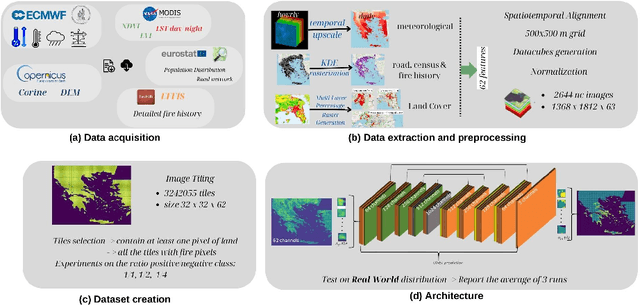

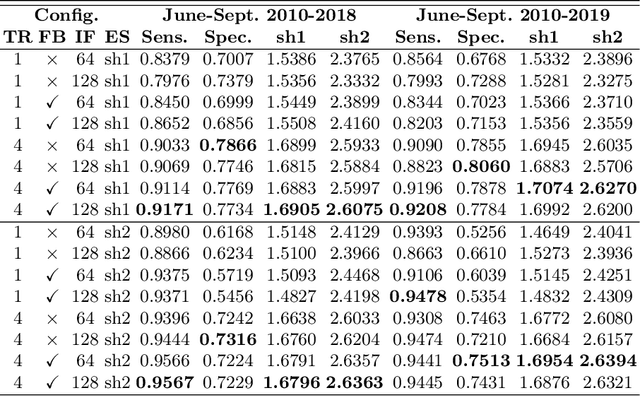
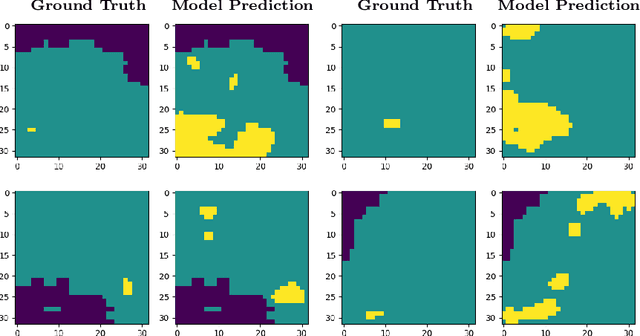
In this paper we present a deep learning pipeline for next day fire prediction. The next day fire prediction task consists in learning models that receive as input the available information for an area up until a certain day, in order to predict the occurrence of fire for the next day. Starting from our previous problem formulation as a binary classification task on instances (daily snapshots of each area) represented by tabular feature vectors, we reformulate the problem as a semantic segmentation task on images; there, each pixel corresponds to a daily snapshot of an area, while its channels represent the formerly tabular training features. We demonstrate that this problem formulation, built within a thorough pipeline achieves state of the art results.