 Add to Chrome
 Add to Firefox
 Add to Edge
Matching of SAR and optical images based on transformation to shared modality
Feb 13, 2026
Significant differences in optical images and Synthetic Aperture Radar (SAR) images are caused by fundamental differences in the physical principles underlying their acquisition by Earth remote sensing platforms. These differences make precise image matching (co-registration) of these two types of images difficult. In this paper, we propose a new approach to image matching of optical and SAR images, which is based on transforming the images to a new modality. The new image modality is common to both optical and SAR images and satisfies the following conditions. First, the transformed images must have an equal pre-defined number of channels. Second, the transformed and co-registered images must be as similar as possible. Third, the transformed images must be non-degenerate, meaning they must preserve the significant features of the original images. To further match images transformed to this shared modality, we train the RoMa image matching model, which is one of the leading solutions for matching of regular digital photographs. We evaluated the proposed approach on the publicly available MultiSenGE dataset containing both optical and SAR images. We demonstrated its superiority over alternative approaches based on image translation between original modalities and various feature matching algorithms. The proposed solution not only provides better quality of matching, but is also more versatile. It enables the use of ready-made RoMa and DeDoDe models, pre-trained for regular images, without retraining for a new modality, while maintaining high-quality matching of optical and SAR images.

Neural Networks for Information Retrieval
Jul 13, 2017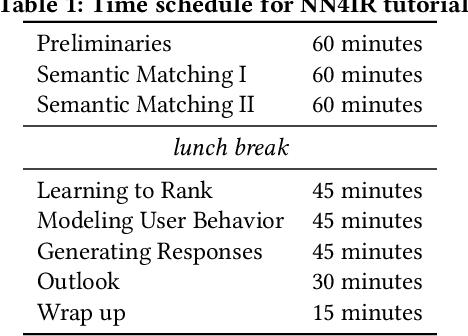
Machine learning plays a role in many aspects of modern IR systems, and deep learning is applied in all of them. The fast pace of modern-day research has given rise to many different approaches for many different IR problems. The amount of information available can be overwhelming both for junior students and for experienced researchers looking for new research topics and directions. Additionally, it is interesting to see what key insights into IR problems the new technologies are able to give us. The aim of this full-day tutorial is to give a clear overview of current tried-and-trusted neural methods in IR and how they benefit IR research. It covers key architectures, as well as the most promising future directions.
Siamese CBOW: Optimizing Word Embeddings for Sentence Representations
Jun 15, 2016
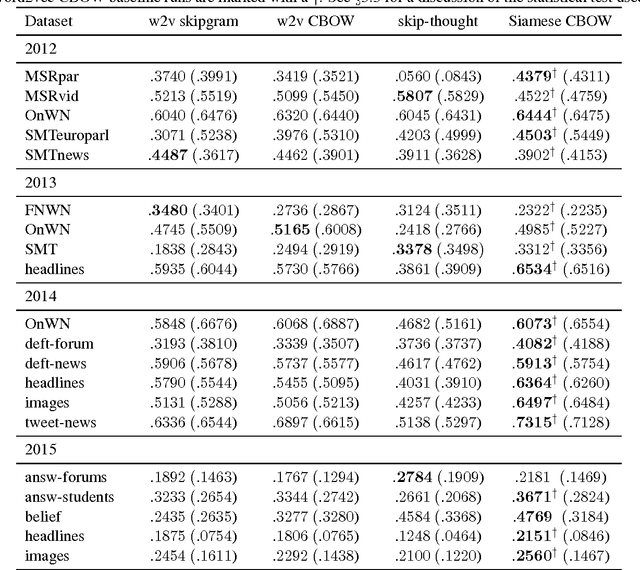
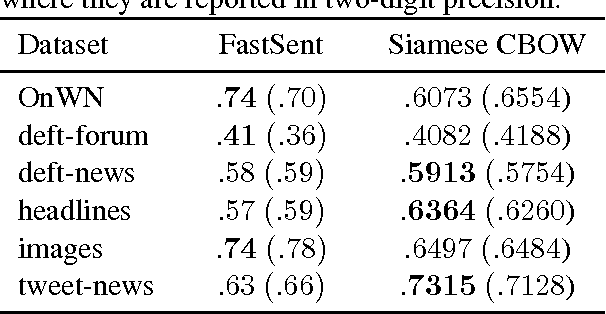
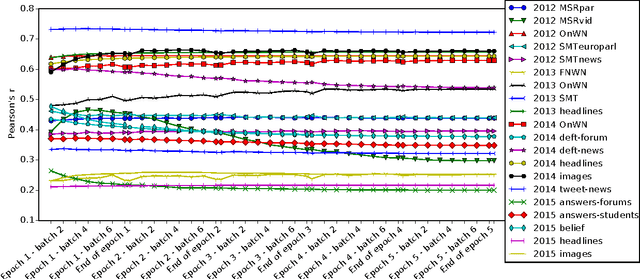
We present the Siamese Continuous Bag of Words (Siamese CBOW) model, a neural network for efficient estimation of high-quality sentence embeddings. Averaging the embeddings of words in a sentence has proven to be a surprisingly successful and efficient way of obtaining sentence embeddings. However, word embeddings trained with the methods currently available are not optimized for the task of sentence representation, and, thus, likely to be suboptimal. Siamese CBOW handles this problem by training word embeddings directly for the purpose of being averaged. The underlying neural network learns word embeddings by predicting, from a sentence representation, its surrounding sentences. We show the robustness of the Siamese CBOW model by evaluating it on 20 datasets stemming from a wide variety of sources.