 Add to Chrome
 Add to Firefox
 Add to Edge
Pantagruel: Unified Self-Supervised Encoders for French Text and Speech
Jan 09, 2026
We release Pantagruel models, a new family of self-supervised encoder models for French text and speech. Instead of predicting modality-tailored targets such as textual tokens or speech units, Pantagruel learns contextualized target representations in the feature space, allowing modality-specific encoders to capture linguistic and acoustic regularities more effectively. Separate models are pre-trained on large-scale French corpora, including Wikipedia, OSCAR and CroissantLLM for text, together with MultilingualLibriSpeech, LeBenchmark, and INA-100k for speech. INA-100k is a newly introduced 100,000-hour corpus of French audio derived from the archives of the Institut National de l'Audiovisuel (INA), the national repository of French radio and television broadcasts, providing highly diverse audio data. We evaluate Pantagruel across a broad range of downstream tasks spanning both modalities, including those from the standard French benchmarks such as FLUE or LeBenchmark. Across these tasks, Pantagruel models show competitive or superior performance compared to strong French baselines such as CamemBERT, FlauBERT, and LeBenchmark2.0, while maintaining a shared architecture that can seamlessly handle either speech or text inputs. These results confirm the effectiveness of feature-space self-supervised objectives for French representation learning and highlight Pantagruel as a robust foundation for multimodal speech-text understanding.

Multi-Label Contrastive Learning : A Comprehensive Study
Nov 27, 2024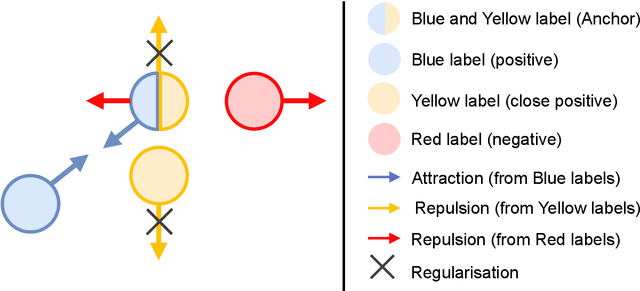
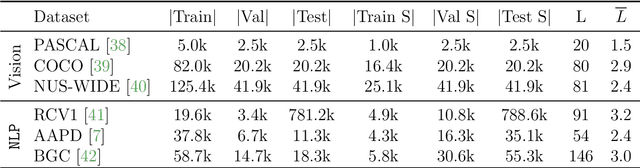
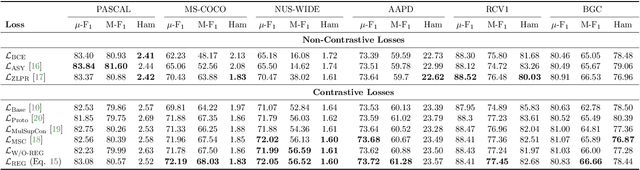
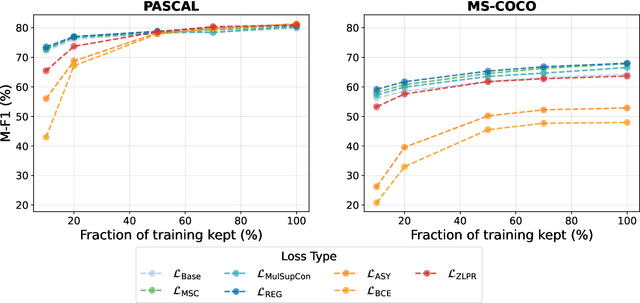
Multi-label classification, which involves assigning multiple labels to a single input, has emerged as a key area in both research and industry due to its wide-ranging applications. Designing effective loss functions is crucial for optimizing deep neural networks for this task, as they significantly influence model performance and efficiency. Traditional loss functions, which often maximize likelihood under the assumption of label independence, may struggle to capture complex label relationships. Recent research has turned to supervised contrastive learning, a method that aims to create a structured representation space by bringing similar instances closer together and pushing dissimilar ones apart. Although contrastive learning offers a promising approach, applying it to multi-label classification presents unique challenges, particularly in managing label interactions and data structure. In this paper, we conduct an in-depth study of contrastive learning loss for multi-label classification across diverse settings. These include datasets with both small and large numbers of labels, datasets with varying amounts of training data, and applications in both computer vision and natural language processing. Our empirical results indicate that the promising outcomes of contrastive learning are attributable not only to the consideration of label interactions but also to the robust optimization scheme of the contrastive loss. Furthermore, while the supervised contrastive loss function faces challenges with datasets containing a small number of labels and ranking-based metrics, it demonstrates excellent performance, particularly in terms of Macro-F1, on datasets with a large number of labels.
Exploring Contrastive Learning for Long-Tailed Multi-Label Text Classification
Apr 12, 2024Learning an effective representation in multi-label text classification (MLTC) is a significant challenge in NLP. This challenge arises from the inherent complexity of the task, which is shaped by two key factors: the intricate connections between labels and the widespread long-tailed distribution of the data. To overcome this issue, one potential approach involves integrating supervised contrastive learning with classical supervised loss functions. Although contrastive learning has shown remarkable performance in multi-class classification, its impact in the multi-label framework has not been thoroughly investigated. In this paper, we conduct an in-depth study of supervised contrastive learning and its influence on representation in MLTC context. We emphasize the importance of considering long-tailed data distributions to build a robust representation space, which effectively addresses two critical challenges associated with contrastive learning that we identify: the "lack of positives" and the "attraction-repulsion imbalance". Building on this insight, we introduce a novel contrastive loss function for MLTC. It attains Micro-F1 scores that either match or surpass those obtained with other frequently employed loss functions, and demonstrates a significant improvement in Macro-F1 scores across three multi-label datasets.