 Add to Chrome
 Add to Firefox
 Add to Edge
Harmful Overfitting in Sobolev Spaces
Jan 31, 2026
Motivated by recent work on benign overfitting in overparameterized machine learning, we study the generalization behavior of functions in Sobolev spaces $W^{k, p}(\mathbb{R}^d)$ that perfectly fit a noisy training data set. Under assumptions of label noise and sufficient regularity in the data distribution, we show that approximately norm-minimizing interpolators, which are canonical solutions selected by smoothness bias, exhibit harmful overfitting: even as the training sample size $n \to \infty$, the generalization error remains bounded below by a positive constant with high probability. Our results hold for arbitrary values of $p \in [1, \infty)$, in contrast to prior results studying the Hilbert space case ($p = 2$) using kernel methods. Our proof uses a geometric argument which identifies harmful neighborhoods of the training data using Sobolev inequalities.

Stratified Non-Negative Tensor Factorization
Nov 27, 2024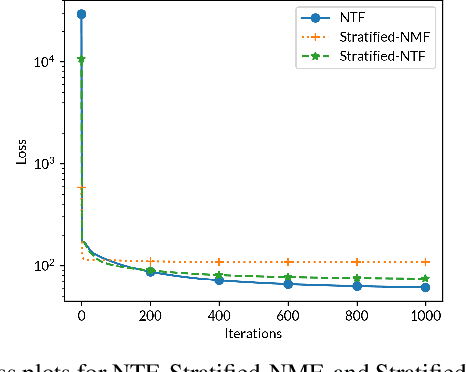
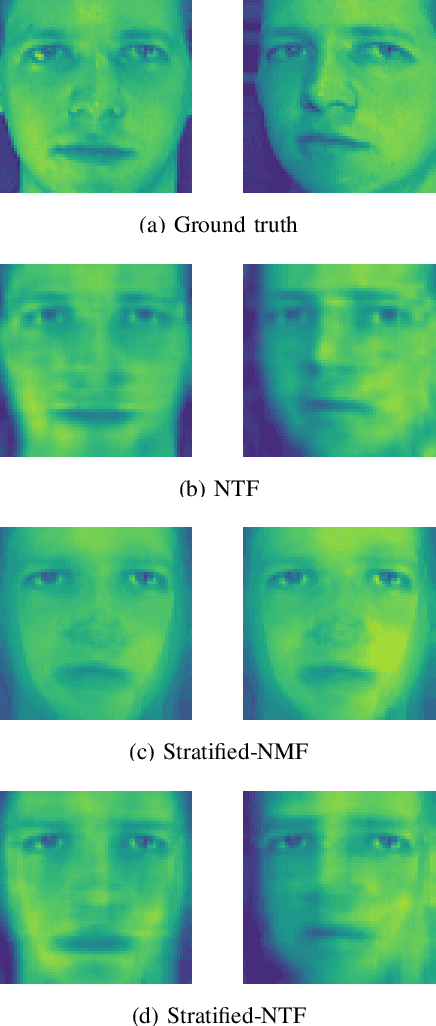
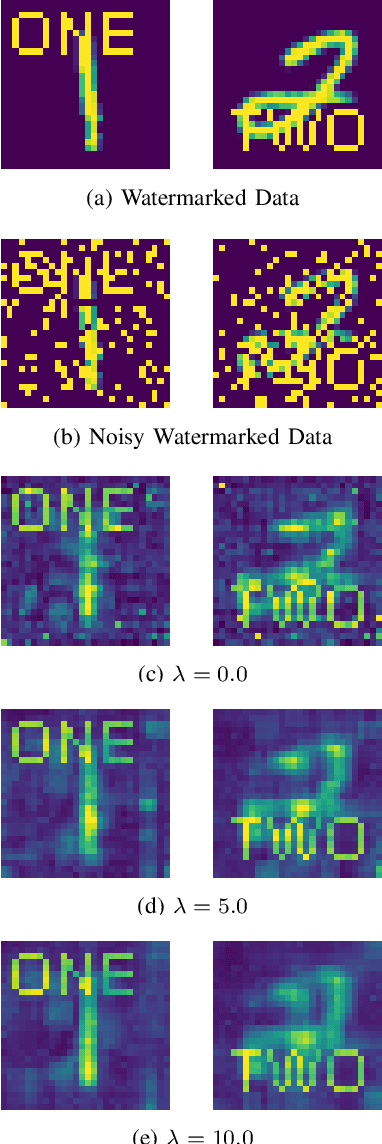
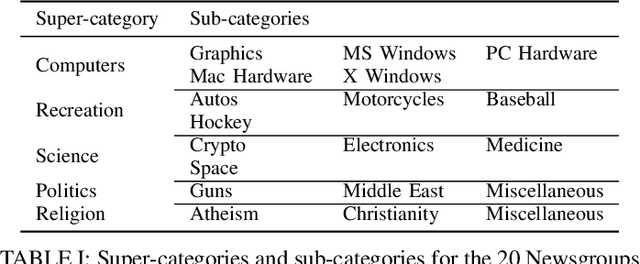
Non-negative matrix factorization (NMF) and non-negative tensor factorization (NTF) decompose non-negative high-dimensional data into non-negative low-rank components. NMF and NTF methods are popular for their intrinsic interpretability and effectiveness on large-scale data. Recent work developed Stratified-NMF, which applies NMF to regimes where data may come from different sources (strata) with different underlying distributions, and seeks to recover both strata-dependent information and global topics shared across strata. Applying Stratified-NMF to multi-modal data requires flattening across modes, and therefore loses geometric structure contained implicitly within the tensor. To address this problem, we extend Stratified-NMF to the tensor setting by developing a multiplicative update rule and demonstrating the method on text and image data. We find that Stratified-NTF can identify interpretable topics with lower memory requirements than Stratified-NMF. We also introduce a regularized version of the method and demonstrate its effects on image data.