 Add to Chrome
 Add to Firefox
 Add to Edge
Local EGOP for Continuous Index Learning
Jan 11, 2026
We introduce the setting of continuous index learning, in which a function of many variables varies only along a small number of directions at each point. For efficient estimation, it is beneficial for a learning algorithm to adapt, near each point $x$, to the subspace that captures the local variability of the function $f$. We pose this task as kernel adaptation along a manifold with noise, and introduce Local EGOP learning, a recursive algorithm that utilizes the Expected Gradient Outer Product (EGOP) quadratic form as both a metric and inverse-covariance of our target distribution. We prove that Local EGOP learning adapts to the regularity of the function of interest, showing that under a supervised noisy manifold hypothesis, intrinsic dimensional learning rates are achieved for arbitrarily high-dimensional noise. Empirically, we compare our algorithm to the feature learning capabilities of deep learning. Additionally, we demonstrate improved regression quality compared to two-layer neural networks in the continuous single-index setting.

Coreset selection for the Sinkhorn divergence and generic smooth divergences
Apr 28, 2025
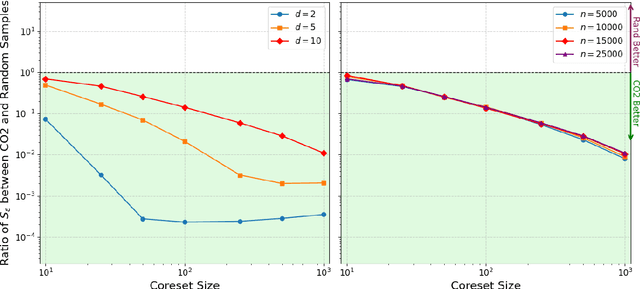
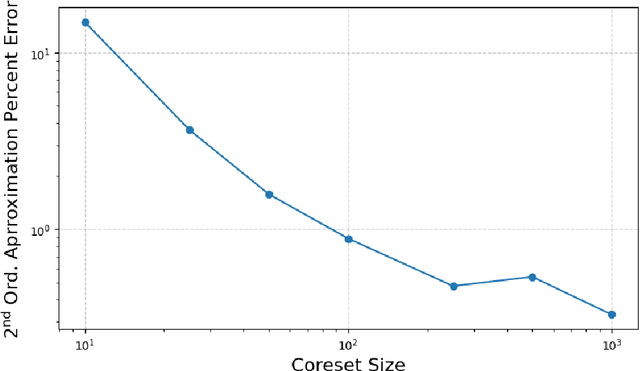
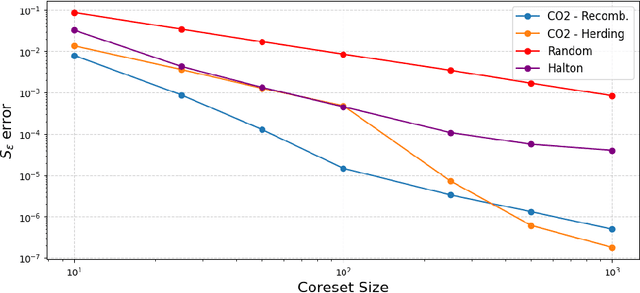
We introduce CO2, an efficient algorithm to produce convexly-weighted coresets with respect to generic smooth divergences. By employing a functional Taylor expansion, we show a local equivalence between sufficiently regular losses and their second order approximations, reducing the coreset selection problem to maximum mean discrepancy minimization. We apply CO2 to the Sinkhorn divergence, providing a novel sampling procedure that requires logarithmically many data points to match the approximation guarantees of random sampling. To show this, we additionally verify several new regularity properties for entropically regularized optimal transport of independent interest. Our approach leads to a new perspective linking coreset selection and kernel quadrature to classical statistical methods such as moment and score matching. We showcase this method with a practical application of subsampling image data, and highlight key directions to explore for improved algorithmic efficiency and theoretical guarantees.
Euclidean and Affine Curve Reconstruction
Jan 24, 2022
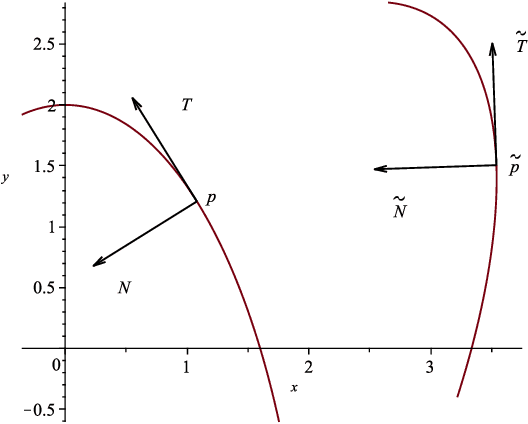


We consider practical aspects of reconstructing planar curves with prescribed Euclidean or affine curvatures. These curvatures are invariant under the special Euclidean group and the equi-affine groups, respectively, and play an important role in computer vision and shape analysis. We discuss and implement algorithms for such reconstruction, and give estimates on how close reconstructed curves are relative to the closeness of their curvatures in appropriate metrics. Several illustrative examples are provided.