 Add to Chrome
 Add to Firefox
 Add to Edge
EmoBang: Detecting Emotion From Bengali Texts
Nov 10, 2025
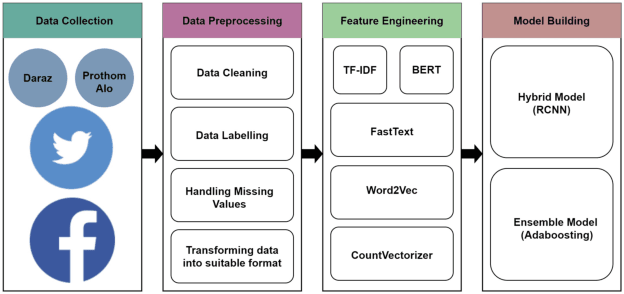
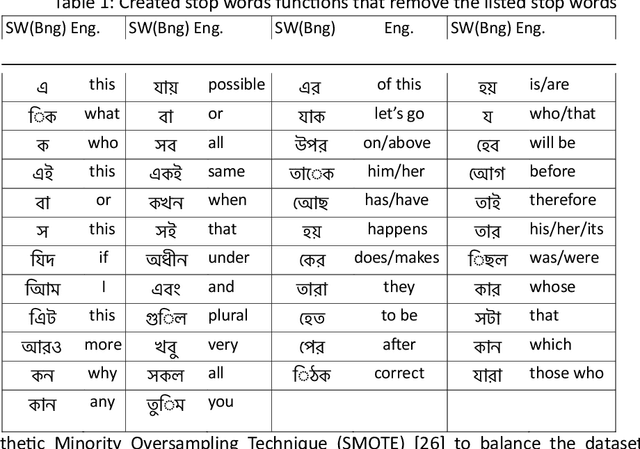
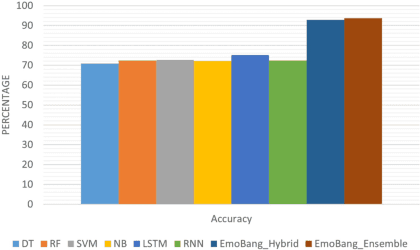
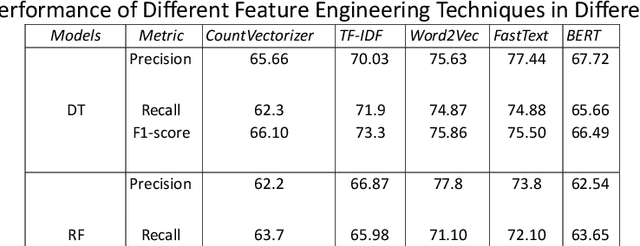
Emotion detection from text seeks to identify an individual's emotional or mental state - positive, negative, or neutral - based on linguistic cues. While significant progress has been made for English and other high-resource languages, Bengali remains underexplored despite being the world's fourth most spoken language. The lack of large, standardized datasets classifies Bengali as a low-resource language for emotion detection. Existing studies mainly employ classical machine learning models with traditional feature engineering, yielding limited performance. In this paper, we introduce a new Bengali emotion dataset annotated across eight emotion categories and propose two models for automatic emotion detection: (i) a hybrid Convolutional Recurrent Neural Network (CRNN) model (EmoBangHybrid) and (ii) an AdaBoost-Bidirectional Encoder Representations from Transformers (BERT) ensemble model (EmoBangEnsemble). Additionally, we evaluate six baseline models with five feature engineering techniques and assess zero-shot and few-shot large language models (LLMs) on the dataset. To the best of our knowledge, this is the first comprehensive benchmark for Bengali emotion detection. Experimental results show that EmoBangH and EmoBangE achieve accuracies of 92.86% and 93.69%, respectively, outperforming existing methods and establishing strong baselines for future research.

ASGM-KG: Unveiling Alluvial Gold Mining Through Knowledge Graphs
Aug 16, 2024Artisanal and Small-Scale Gold Mining (ASGM) is a low-cost yet highly destructive mining practice, leading to environmental disasters across the world's tropical watersheds. The topic of ASGM spans multiple domains of research and information, including natural and social systems, and knowledge is often atomized across a diversity of media and documents. We therefore introduce a knowledge graph (ASGM-KG) that consolidates and provides crucial information about ASGM practices and their environmental effects. The current version of ASGM-KG consists of 1,899 triples extracted using a large language model (LLM) from documents and reports published by both non-governmental and governmental organizations. These documents were carefully selected by a group of tropical ecologists with expertise in ASGM. This knowledge graph was validated using two methods. First, a small team of ASGM experts reviewed and labeled triples as factual or non-factual. Second, we devised and applied an automated factual reduction framework that relies on a search engine and an LLM for labeling triples. Our framework performs as well as five baselines on a publicly available knowledge graph and achieves over 90 accuracy on our ASGM-KG validated by domain experts. ASGM-KG demonstrates an advancement in knowledge aggregation and representation for complex, interdisciplinary environmental crises such as ASGM.