 Add to Chrome
 Add to Firefox
 Add to Edge
Fast Forward: Accelerating LLM Prefill with Predictive FFN Sparsity
Jan 30, 2026
The prefill stage of large language model (LLM) inference is a key computational bottleneck for long-context workloads. At short-to-moderate context lengths (1K--16K tokens), Feed-Forward Networks (FFNs) dominate this cost, accounting for most of the total FLOPs. Existing FFN sparsification methods, designed for autoregressive decoding, fail to exploit the prefill stage's parallelism and often degrade accuracy. To address this, we introduce FastForward, a predictive sparsity framework that accelerates LLM prefill through block-wise, context-aware FFN sparsity. FastForward combines (1) a lightweight expert predictor to select high-importance neurons per block, (2) an error compensation network to correct sparsity-induced errors, and (3) a layer-wise sparsity scheduler to allocate compute based on token-mixing importance. Across LLaMA and Qwen models up to 8B parameters, FastForward delivers up to 1.45$\times$ compute-bound speedup at 50% FFN sparsity with $<$ 6% accuracy loss compared to the dense baseline on LongBench, substantially reducing Time-to-First-Token (TTFT) for efficient, long-context LLM inference on constrained hardware.

Are LLMs Good Annotators for Discourse-level Event Relation Extraction?
Jul 28, 2024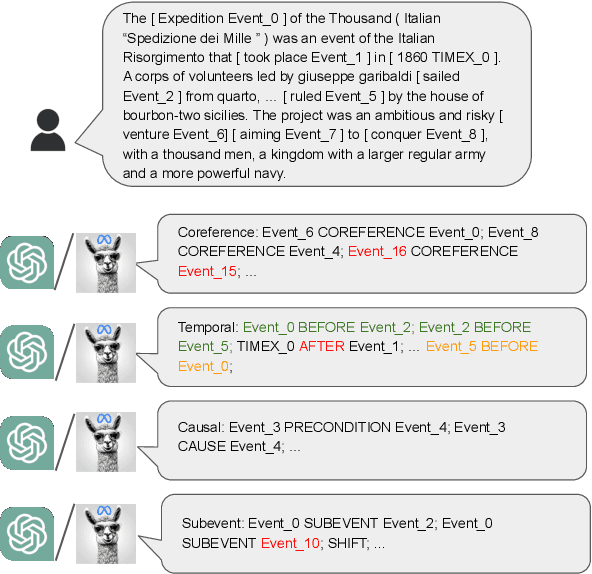
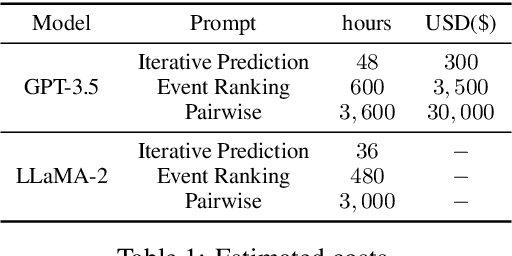
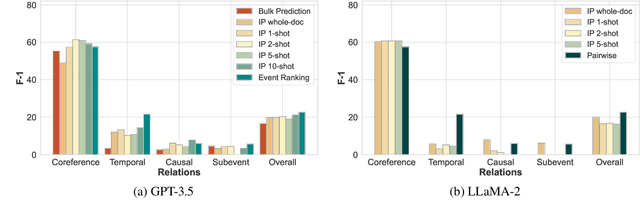
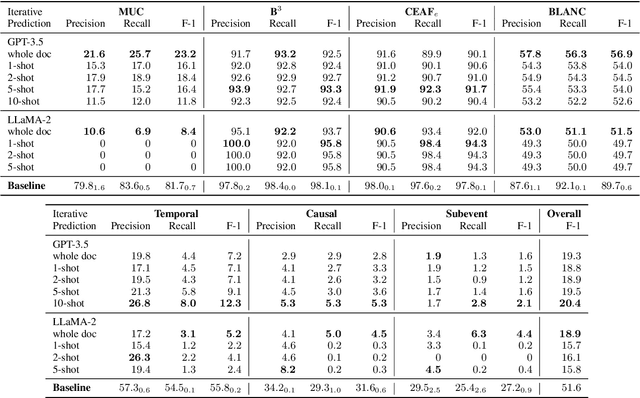
Large Language Models (LLMs) have demonstrated proficiency in a wide array of natural language processing tasks. However, its effectiveness over discourse-level event relation extraction (ERE) tasks remains unexplored. In this paper, we assess the effectiveness of LLMs in addressing discourse-level ERE tasks characterized by lengthy documents and intricate relations encompassing coreference, temporal, causal, and subevent types. Evaluation is conducted using an commercial model, GPT-3.5, and an open-source model, LLaMA-2. Our study reveals a notable underperformance of LLMs compared to the baseline established through supervised learning. Although Supervised Fine-Tuning (SFT) can improve LLMs performance, it does not scale well compared to the smaller supervised baseline model. Our quantitative and qualitative analysis shows that LLMs have several weaknesses when applied for extracting event relations, including a tendency to fabricate event mentions, and failures to capture transitivity rules among relations, detect long distance relations, or comprehend contexts with dense event mentions.