 Add to Chrome
 Add to Firefox
 Add to Edge
Generative and Nonparametric Approaches for Conditional Distribution Estimation: Methods, Perspectives, and Comparative Evaluations
Jan 30, 2026
The inference of conditional distributions is a fundamental problem in statistics, essential for prediction, uncertainty quantification, and probabilistic modeling. A wide range of methodologies have been developed for this task. This article reviews and compares several representative approaches spanning classical nonparametric methods and modern generative models. We begin with the single-index method of Hall and Yao (2005), which estimates the conditional distribution through a dimension-reducing index and nonparametric smoothing of the resulting one-dimensional cumulative conditional distribution function. We then examine the basis-expansion approaches, including FlexCode (Izbicki and Lee, 2017) and DeepCDE (Dalmasso et al., 2020), which convert conditional density estimation into a set of nonparametric regression problems. In addition, we discuss two recent generative simulation-based methods that leverage modern deep generative architectures: the generative conditional distribution sampler (Zhou et al., 2023) and the conditional denoising diffusion probabilistic model (Fu et al., 2024; Yang et al., 2025). A systematic numerical comparison of these approaches is provided using a unified evaluation framework that ensures fairness and reproducibility. The performance metrics used for the estimated conditional distribution include the mean-squared errors of conditional mean and standard deviation, as well as the Wasserstein distance. We also discuss their flexibility and computational costs, highlighting the distinct advantages and limitations of each approach.

A Generalized Mean Approach for Distributed-PCA
Oct 01, 2024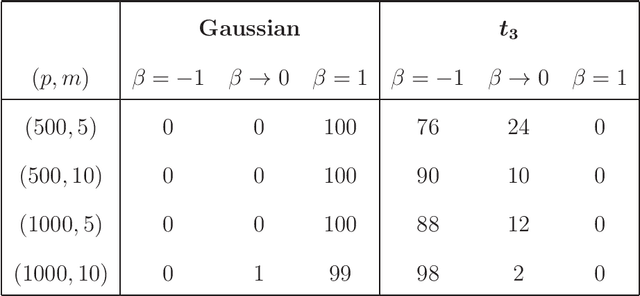
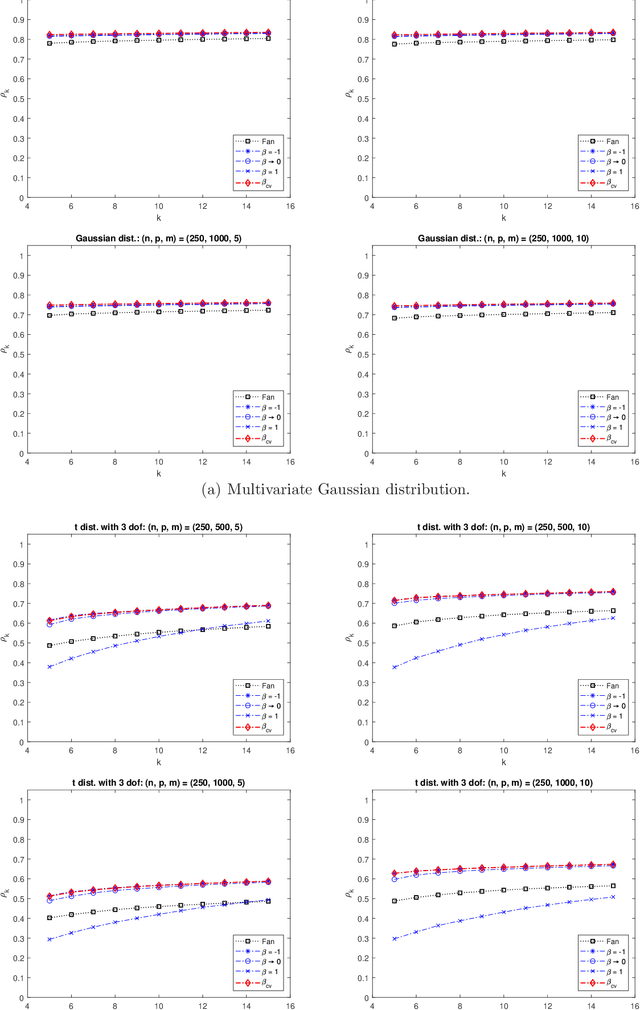
Principal component analysis (PCA) is a widely used technique for dimension reduction. As datasets continue to grow in size, distributed-PCA (DPCA) has become an active research area. A key challenge in DPCA lies in efficiently aggregating results across multiple machines or computing nodes due to computational overhead. Fan et al. (2019) introduced a pioneering DPCA method to estimate the leading rank-$r$ eigenspace, aggregating local rank-$r$ projection matrices by averaging. However, their method does not utilize eigenvalue information. In this article, we propose a novel DPCA method that incorporates eigenvalue information to aggregate local results via the matrix $\beta$-mean, which we call $\beta$-DPCA. The matrix $\beta$-mean offers a flexible and robust aggregation method through the adjustable choice of $\beta$ values. Notably, for $\beta=1$, it corresponds to the arithmetic mean; for $\beta=-1$, the harmonic mean; and as $\beta \to 0$, the geometric mean. Moreover, the matrix $\beta$-mean is shown to associate with the matrix $\beta$-divergence, a subclass of the Bregman matrix divergence, to support the robustness of $\beta$-DPCA. We also study the stability of eigenvector ordering under eigenvalue perturbation for $\beta$-DPCA. The performance of our proposal is evaluated through numerical studies.