 Add to Chrome
 Add to Firefox
 Add to Edge
CORE:Toward Ubiquitous 6G Intelligence Through Collaborative Orchestration of Large Language Model Agents Over Hierarchical Edge
Jan 29, 2026
Rapid advancements in sixth-generation (6G) networks and large language models (LLMs) have paved the way for ubiquitous intelligence, wherein seamless connectivity and distributed artificial intelligence (AI) have revolutionized various aspects of our lives.However, realizing this vision faces significant challenges owing to the fragmented and heterogeneous computing resources across hierarchical networks, which are insufficient for individual LLM agents to perform complex reasoning tasks.To address this issue, we propose Collaborative Orchestration Role at Edge (CORE), an innovative framework that employs a collaborative learning system in which multiple LLMs, each assigned a distinct functional role, are distributed across mobile devices and tiered edge servers. The system integrates three optimization modules, encompassing real-time perception,dynamic role orchestration, and pipeline-parallel execution, to facilitate efficient and rapid collaboration among distributed agents. Furthermore, we introduce a novel role affinity scheduling algorithm for dynamically orchestrating LLM role assignments across the hierarchical edge infrastructure, intelligently matching computational demands with available dispersed resources.Finally, comprehensive case studies and performance evaluations across various 6G application scenarios demonstrated the efficacy of CORE, revealing significant enhancements in the system efficiency and task completion rates. Building on these promising outcomes, we further validated the practical applicability of CORE by deploying it on a real-world edge-computing platform,that exhibits robust performance in operational environments.

LLM Enabled Multi-Agent System for 6G Networks: Framework and Method of Dual-Loop Edge-Terminal Collaboration
Sep 05, 2025The ubiquitous computing resources in 6G networks provide ideal environments for the fusion of large language models (LLMs) and intelligent services through the agent framework. With auxiliary modules and planning cores, LLM-enabled agents can autonomously plan and take actions to deal with diverse environment semantics and user intentions. However, the limited resources of individual network devices significantly hinder the efficient operation of LLM-enabled agents with complex tool calls, highlighting the urgent need for efficient multi-level device collaborations. To this end, the framework and method of the LLM-enabled multi-agent system with dual-loop terminal-edge collaborations are proposed in 6G networks. Firstly, the outer loop consists of the iterative collaborations between the global agent and multiple sub-agents deployed on edge servers and terminals, where the planning capability is enhanced through task decomposition and parallel sub-task distribution. Secondly, the inner loop utilizes sub-agents with dedicated roles to circularly reason, execute, and replan the sub-task, and the parallel tool calling generation with offloading strategies is incorporated to improve efficiency. The improved task planning capability and task execution efficiency are validated through the conducted case study in 6G-supported urban safety governance. Finally, the open challenges and future directions are thoroughly analyzed in 6G networks, accelerating the advent of the 6G era.
CourseGPT-zh: an Educational Large Language Model Based on Knowledge Distillation Incorporating Prompt Optimization
May 08, 2024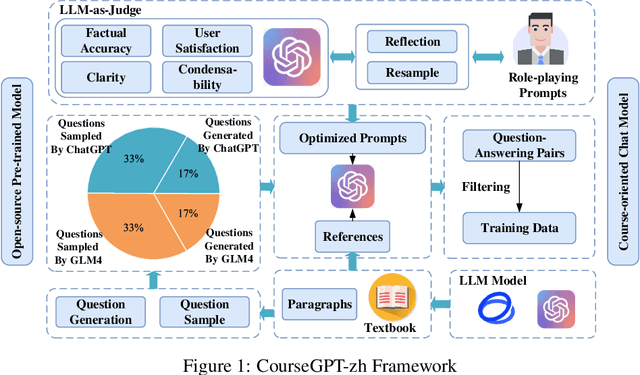

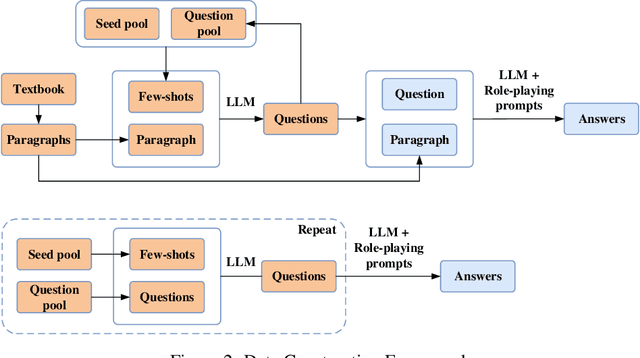
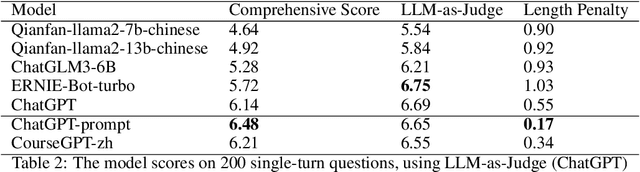
Large language models (LLMs) have demonstrated astonishing capabilities in natural language processing (NLP) tasks, sparking interest in their application to professional domains with higher specialized requirements. However, restricted access to closed-source LLMs via APIs and the difficulty in collecting massive high-quality datasets pose obstacles to the development of large language models in education fields of various courses. Given these challenges, we propose CourseGPT-zh, a course-oriented education LLM that supports customization and low-cost deployment. To address the comprehensiveness and diversity requirements of course-specific corpora, we design a high-quality question-answering corpus distillation framework incorporating prompt optimization, which effectively mines textbook knowledge and enhances its diversity. Moreover, considering the alignment of LLM responses with user needs, a novel method for discrete prompt optimization based on LLM-as-Judge is introduced. During optimization, this framework leverages the LLM's ability to reflect on and exploit error feedback and patterns, allowing for prompts that meet user needs and preferences while saving response length. Lastly, we obtain CourseGPT-zh based on the open-source LLM using parameter-efficient fine-tuning. Experimental results show that our discrete prompt optimization framework effectively improves the response quality of ChatGPT, and CourseGPT-zh exhibits strong professional capabilities in specialized knowledge question-answering, significantly outperforming comparable open-source models.