 Add to Chrome
 Add to Firefox
 Add to Edge
Two-chart Beltrami Optimization for Distortion-Controlled Spherical Bijection with Application to Brain Surface Registration
Feb 04, 2026
Many genus-0 surface mapping tasks such as landmark alignment, feature matching, and image-driven registration, can be reduced (via an initial spherical conformal map) to optimizing a spherical self-homeomorphism with controlled distortion. However, existing works lack efficient mechanisms to control the geometric distortion of the resulting mapping. To resolve this issue, we formulate this as a Beltrami-space optimization problem, where the angle distortion is encoded explicitly by the Beltrami differential and bijectivity can be enforced through the constraint $\|μ\|_{\infty}<1$. To make this practical on the sphere, we introduce the Spherical Beltrami Differential (SBD), a two-chart representation of quasiconformal self-maps of the unit sphere $\mathbb{S}^2$, together with cross-chart consistency conditions that yield a globally bijective spherical deformation (up to conformal automorphisms). Building on the Spectral Beltrami Network, we develop BOOST, a differentiable optimization framework that updates two Beltrami fields to minimize task-driven losses while regularizing distortion and enforcing consistency along the seam. Experiments on large-deformation landmark matching and intensity-based spherical registration demonstrate improved task performance meanwhile maintaining controlled distortion and robust bijective behavior. We also apply the method to cortical surface registration by aligning sulcal landmarks and matching cortical sulcal depth, achieving comparative or better registration performance without sacrificing geometric validity.

Genus-0 Surface Parameterization using Spherical Beltrami Differentials
Feb 02, 2026Spherical surface parameterization is a fundamental tool in geometry processing and imaging science. For a genus-0 closed surface, many efficient algorithms can map the surface to the sphere; consequently, a broad class of task-driven genus-0 mapping problems can be reduced to constructing a high-quality spherical self-map. However, existing approaches often face a trade-off between satisfying task objectives (e.g., landmark or feature alignment), maintaining bijectivity, and controlling geometric distortion. We introduce the Spherical Beltrami Differential (SBD), a two-chart representation of quasiconformal self-maps of the sphere, and establish its correspondence with spherical homeomorphisms up to conformal automorphisms. Building on the Spectral Beltrami Network (SBN), we propose a neural optimization framework BOOST that optimizes two Beltrami fields on hemispherical stereographic charts and enforces global consistency through explicit seam-aware constraints. Experiments on large-deformation landmark matching and intensity-based spherical registration demonstrate the effectiveness of our proposed framework. We further apply the method to brain cortical surface registration, aligning sulcal landmarks and jointly matching cortical sulci depth maps, showing improved task fidelity with controlled distortion and robust bijective behavior.
A neural optimization framework for free-boundary diffeomorphic mapping problems and its applications
Nov 12, 2025Free-boundary diffeomorphism optimization is a core ingredient in the surface mapping problem but remains notoriously difficult because the boundary is unconstrained and local bijectivity must be preserved under large deformation. Numerical Least-Squares Quasiconformal (LSQC) theory, with its provable existence, uniqueness, similarity-invariance and resolution-independence, offers an elegant mathematical remedy. However, the conventional numerical algorithm requires landmark conditioning, and cannot be applied into gradient-based optimization. We propose a neural surrogate, the Spectral Beltrami Network (SBN), that embeds LSQC energy into a multiscale mesh-spectral architecture. Next, we propose the SBN guided optimization framework SBN-Opt which optimizes free-boundary diffeomorphism for the problem, with local geometric distortion explicitly controllable. Extensive experiments on density-equalizing maps and inconsistent surface registration demonstrate our SBN-Opt's superiority over traditional numerical algorithms.
From optimal score matching to optimal sampling
Sep 11, 2024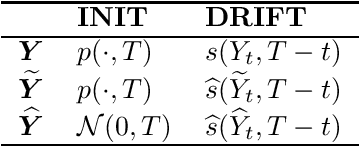
The recent, impressive advances in algorithmic generation of high-fidelity image, audio, and video are largely due to great successes in score-based diffusion models. A key implementing step is score matching, that is, the estimation of the score function of the forward diffusion process from training data. As shown in earlier literature, the total variation distance between the law of a sample generated from the trained diffusion model and the ground truth distribution can be controlled by the score matching risk. Despite the widespread use of score-based diffusion models, basic theoretical questions concerning exact optimal statistical rates for score estimation and its application to density estimation remain open. We establish the sharp minimax rate of score estimation for smooth, compactly supported densities. Formally, given \(n\) i.i.d. samples from an unknown \(\alpha\)-H\"{o}lder density \(f\) supported on \([-1, 1]\), we prove the minimax rate of estimating the score function of the diffused distribution \(f * \mathcal{N}(0, t)\) with respect to the score matching loss is \(\frac{1}{nt^2} \wedge \frac{1}{nt^{3/2}} \wedge (t^{\alpha-1} + n^{-2(\alpha-1)/(2\alpha+1)})\) for all \(\alpha > 0\) and \(t \ge 0\). As a consequence, it is shown the law \(\hat{f}\) of a sample generated from the diffusion model achieves the sharp minimax rate \(\bE(\dTV(\hat{f}, f)^2) \lesssim n^{-2\alpha/(2\alpha+1)}\) for all \(\alpha > 0\) without any extraneous logarithmic terms which are prevalent in the literature, and without the need for early stopping which has been required for all existing procedures to the best of our knowledge.