 Add to Chrome
 Add to Firefox
 Add to Edge
Bridging Local and Global Knowledge: Cascaded Mixture-of-Experts Learning for Near-Shortest Path Routing
Mar 16, 2026
While deep learning models that leverage local features have demonstrated significant potential for near-optimal routing in dense Euclidean graphs, they struggle to generalize well in sparse networks where topological irregularities require broader structural awareness. To address this limitation, we train a Cascaded Mixture of Experts (Ca-MoE) to solve the all-pairs near-shortest path (APNSP) routing problem. Our Ca-MoE is a modular two-tier architecture that supports the decision-making for forwarder selection with lower-tier experts relying on local features and upper-tier experts relying on global features. It performs adaptive inference wherein the upper-tier experts are triggered only when the lower-tier ones do not suffice to achieve adequate decision quality. Computational efficiency is thus achieved by escalating model capacity only when necessitated by topological complexity, and parameter redundancy is avoided. Furthermore, we incorporate an online meta-learning strategy that facilitates independent expert fine-tuning and utilizes a stability-focused update mechanism to prevent catastrophic forgetting as new graph environments are encountered. Experimental evaluations demonstrate that Ca-MoE routing improves accuracy by up to 29.1% in sparse networks compared to single-expert baselines and maintains performance within 1%-6% of the theoretical upper bound across diverse graph densities.

Learning from A Single Graph is All You Need for Near-Shortest Path Routing in Wireless Networks
Aug 18, 2023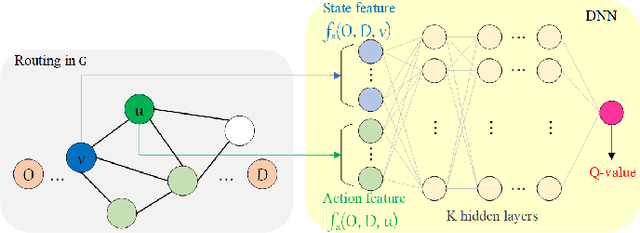
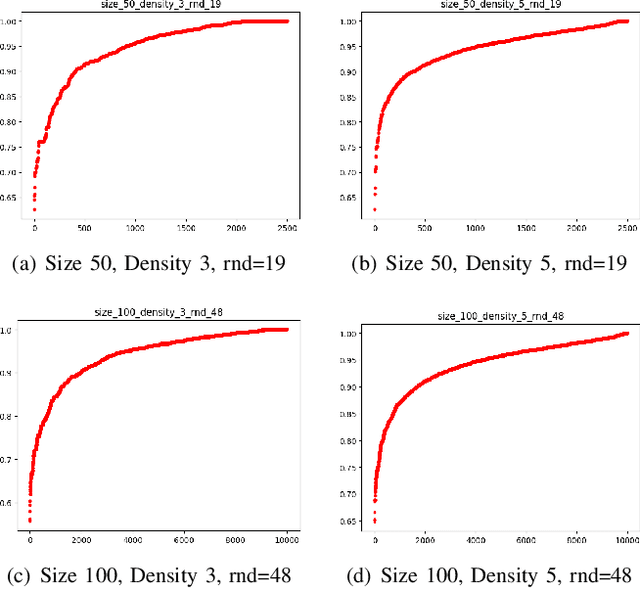
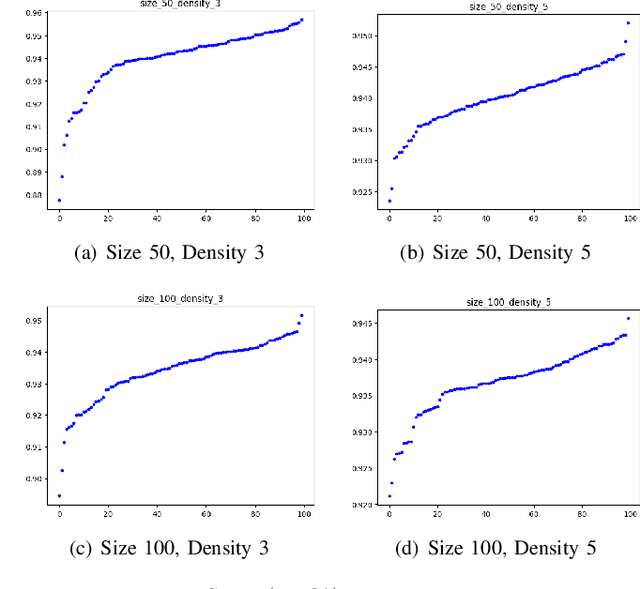
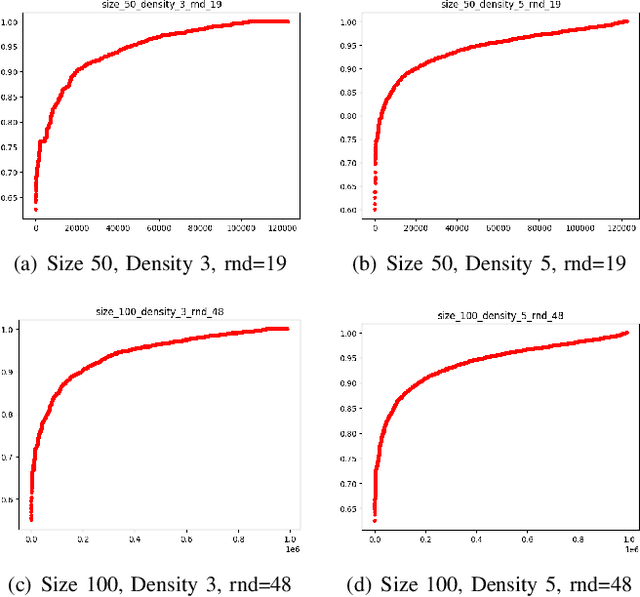
We propose a learning algorithm for local routing policies that needs only a few data samples obtained from a single graph while generalizing to all random graphs in a standard model of wireless networks. We thus solve the all-pairs near-shortest path problem by training deep neural networks (DNNs) that efficiently and scalably learn routing policies that are local, i.e., they only consider node states and the states of neighboring nodes. Remarkably, one of these DNNs we train learns a policy that exactly matches the performance of greedy forwarding; another generally outperforms greedy forwarding. Our algorithm design exploits network domain knowledge in several ways: First, in the selection of input features and, second, in the selection of a ``seed graph'' and subsamples from its shortest paths. The leverage of domain knowledge provides theoretical explainability of why the seed graph and node subsampling suffice for learning that is efficient, scalable, and generalizable. Simulation-based results on uniform random graphs with diverse sizes and densities empirically corroborate that using samples generated from a few routing paths in a modest-sized seed graph quickly learns a model that is generalizable across (almost) all random graphs in the wireless network model.