 Add to Chrome
 Add to Firefox
 Add to Edge
Learning Soccer Skills for Humanoid Robots: A Progressive Perception-Action Framework
Feb 05, 2026
Soccer presents a significant challenge for humanoid robots, demanding tightly integrated perception-action capabilities for tasks like perception-guided kicking and whole-body balance control. Existing approaches suffer from inter-module instability in modular pipelines or conflicting training objectives in end-to-end frameworks. We propose Perception-Action integrated Decision-making (PAiD), a progressive architecture that decomposes soccer skill acquisition into three stages: motion-skill acquisition via human motion tracking, lightweight perception-action integration for positional generalization, and physics-aware sim-to-real transfer. This staged decomposition establishes stable foundational skills, avoids reward conflicts during perception integration, and minimizes sim-to-real gaps. Experiments on the Unitree G1 demonstrate high-fidelity human-like kicking with robust performance under diverse conditions-including static or rolling balls, various positions, and disturbances-while maintaining consistent execution across indoor and outdoor scenarios. Our divide-and-conquer strategy advances robust humanoid soccer capabilities and offers a scalable framework for complex embodied skill acquisition. The project page is available at https://soccer-humanoid.github.io/.

Interpreting Multi-objective Evolutionary Algorithms via Sokoban Level Generation
Jun 15, 2024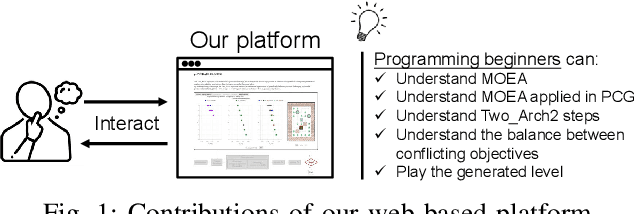
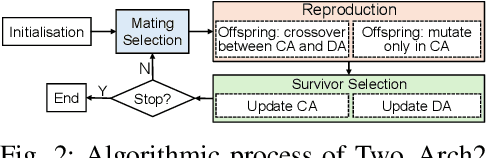
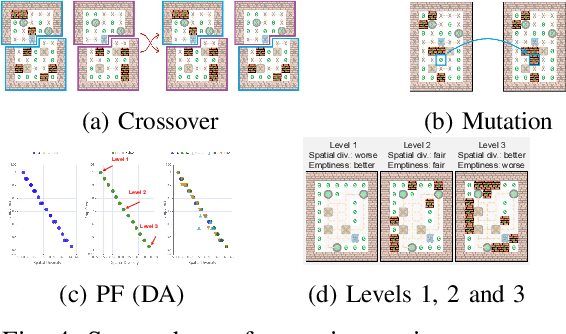
This paper presents an interactive platform to interpret multi-objective evolutionary algorithms. Sokoban level generation is selected as a showcase for its widespread use in procedural content generation. By balancing the emptiness and spatial diversity of Sokoban levels, we illustrate the improved two-archive algorithm, Two_Arch2, a well-known multi-objective evolutionary algorithm. Our web-based platform integrates Two_Arch2 into an interface that visually and interactively demonstrates the evolutionary process in real-time. Designed to bridge theoretical optimisation strategies with practical game generation applications, the interface is also accessible to both researchers and beginners to multi-objective evolutionary algorithms or procedural content generation on a website. Through dynamic visualisations and interactive gameplay demonstrations, this web-based platform also has potential as an educational tool.
A reproducible pipeline for extracting representative signals from wire cuts
May 17, 2024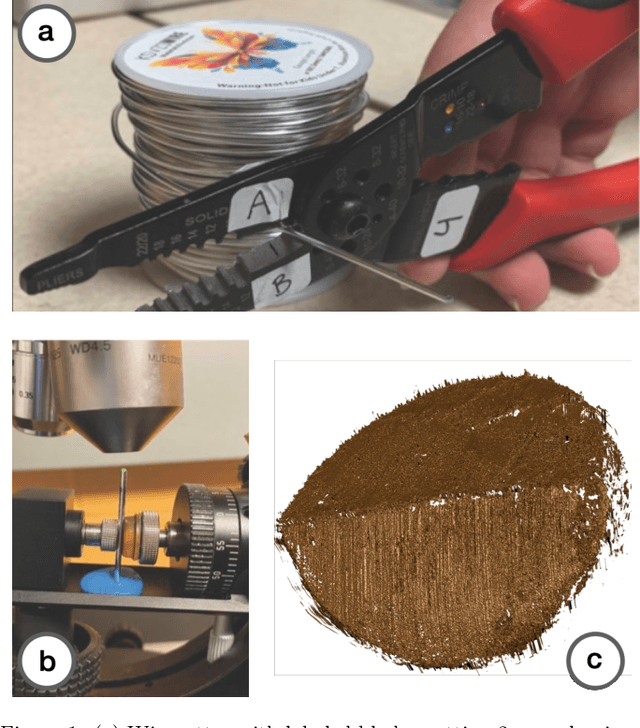
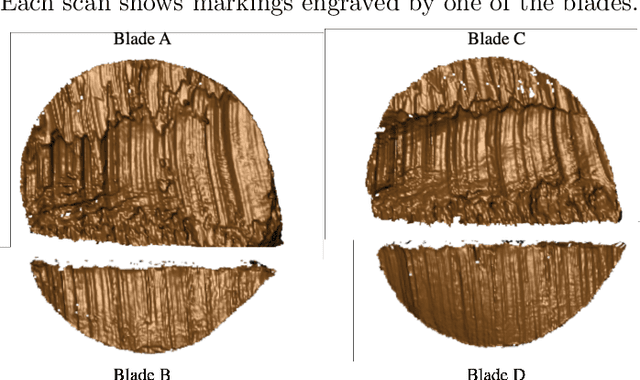
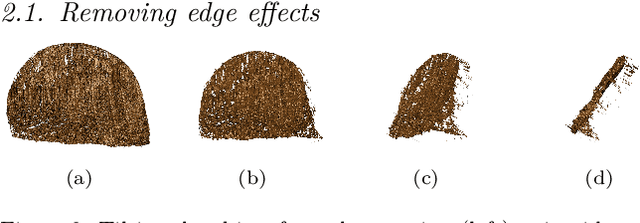
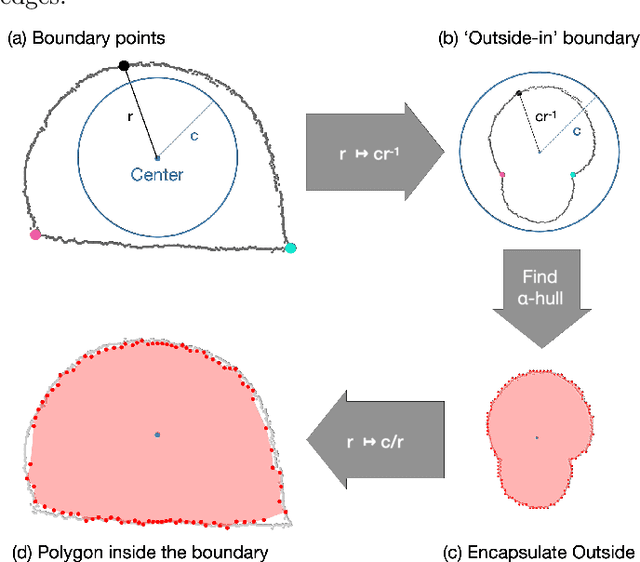
We propose a reproducible pipeline for extracting representative signals from 2D topographic scans of the tips of cut wires. The process fully addresses many potential problems in the quality of wire cuts, including edge effects, extreme values, trends, missing values, angles, and warping. The resulting signals can be further used in source determination, which plays an important role in forensic examinations. With commonly used measurements such as the cross-correlation function, the procedure controls the false positive rate and false negative rate to the desirable values as the manual extraction pipeline but outperforms it with robustness and objectiveness.