 Add to Chrome
 Add to Firefox
 Add to Edge
Fully 3D Unrolled Magnetic Resonance Fingerprinting Reconstruction via Staged Pretraining and Implicit Gridding
Jan 23, 2026
Magnetic Resonance Fingerprinting (MRF) enables fast quantitative imaging, yet reconstructing high-resolution 3D data remains computationally demanding. Non-Cartesian reconstructions require repeated non-uniform FFTs, and the commonly used Locally Low Rank (LLR) prior adds computational overhead and becomes insufficient at high accelerations. Learned 3D priors could address these limitations, but training them at scale is challenging due to memory and runtime demands. We propose SPUR-iG, a fully 3D deep unrolled subspace reconstruction framework that integrates efficient data consistency with a progressive training strategy. Data consistency leverages implicit GROG, which grids non-Cartesian data onto a Cartesian grid with an implicitly learned kernel, enabling FFT-based updates with minimal artifacts. Training proceeds in three stages: (1) pretraining a denoiser with extensive data augmentation, (2) greedy per-iteration unrolled training, and (3) final fine-tuning with gradient checkpointing. Together, these stages make large-scale 3D unrolled learning feasible within a reasonable compute budget. On a large in vivo dataset with retrospective undersampling, SPUR-iG improves subspace coefficient maps quality and quantitative accuracy at 1-mm isotropic resolution compared with LLR and a hybrid 2D/3D unrolled baseline. Whole-brain reconstructions complete in under 15-seconds, with up to $\times$111 speedup for 2-minute acquisitions. Notably, $T_1$ maps with our method from 30-second scans achieve accuracy on par with or exceeding LLR reconstructions from 2-minute scans. Overall, the framework improves both accuracy and speed in large-scale 3D MRF reconstruction, enabling efficient and reliable accelerated quantitative imaging.

Accelerating Longitudinal MRI using Prior Informed Latent Diffusion
Jun 29, 2024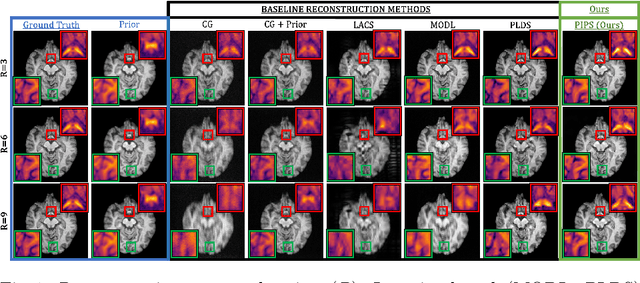
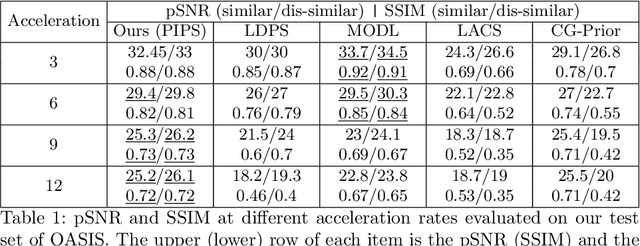
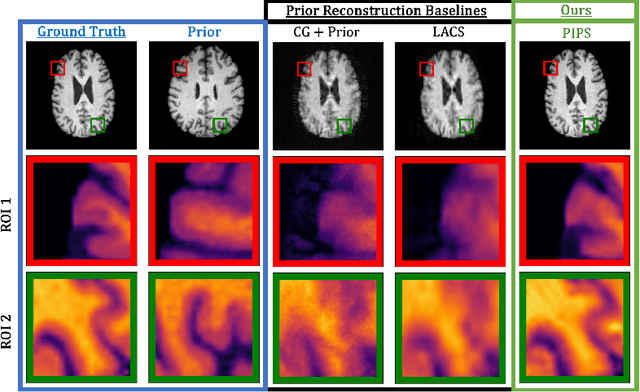
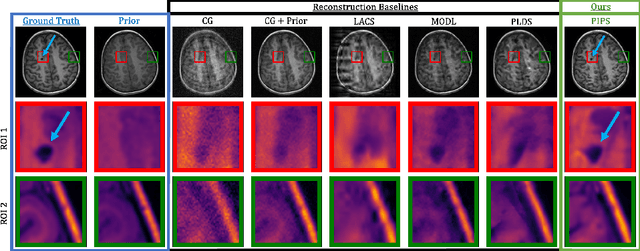
MRI is a widely used ionization-free soft-tissue imaging modality, often employed repeatedly over a patient's lifetime. However, prolonged scanning durations, among other issues, can limit availability and accessibility. In this work, we aim to substantially reduce scan times by leveraging prior scans of the same patient. These prior scans typically contain considerable shared information with the current scan, thereby enabling higher acceleration rates when appropriately utilized. We propose a prior informed reconstruction method with a trained diffusion model in conjunction with data-consistency steps. Our method can be trained with unlabeled image data, eliminating the need for a dataset of either k-space measurements or paired longitudinal scans as is required of other learning-based methods. We demonstrate superiority of our method over previously suggested approaches in effectively utilizing prior information without over-biasing prior consistency, which we validate on both an open-source dataset of healthy patients as well as several longitudinal cases of clinical interest.