 Add to Chrome
 Add to Firefox
 Add to Edge
HawkesRank: Event-Driven Centrality for Real-Time Importance Ranking
Mar 12, 2026
Quantifying influence in networks is important across science, economics, and public health, yet widely used centrality measures remain limited: they rely on static representations, heuristic network constructions, and purely endogenous notions of importance, while offering little semantic connection to observable activity. We introduce HawkesRank, a dynamic framework grounded in multivariate Hawkes point processes that models exogenous drivers (intrinsic contributions) and endogenous amplification (self- and cross-excitation). This yields a principled, empirically calibrated, and adaptive importance measure. Classical indices such as Katz centrality and PageRank emerge as mean-field limits of the framework, clarifying both their validity and their limitations. Unlike static averages, HawkesRank measures importance through instantaneous event intensities, enabling prediction, transparent endo-exo decomposition, and adaptability to shocks. Using both simulations and empirical analysis of emotion dynamics in online communication platforms, we show that HawkesRank closely tracks system activity and consistently outperforms static centrality metrics.

QC-SPHRAM: Quasi-conformal Spherical Harmonics Based Geometric Distortions on Hippocampal Surfaces for Early Detection of the Alzheimer's Disease
Mar 20, 2020
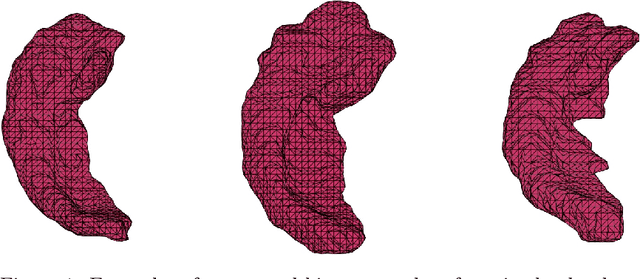


We propose a disease classification model, called the QC-SPHARM, for the early detection of the Alzheimer's Disease (AD). The proposed QC-SPHARM can distinguish between normal control (NC) subjects and AD patients, as well as between amnestic mild cognitive impairment (aMCI) patients having high possibility progressing into AD and those who do not. Using the spherical harmonics (SPHARM) based registration, hippocampal surfaces segmented from the ADNI data are individually registered to a template surface constructed from the NC subjects using SPHARM. Local geometric distortions of the deformation from the template surface to each subject are quantified in terms of conformality distortions and curvatures distortions. The measurements are combined with the spherical harmonics coefficients and the total volume change of the subject from the template. Afterwards, a t-test based feature selection method incorporating the bagging strategy is applied to extract those local regions having high discriminating power of the two classes. The disease diagnosis machine can therefore be built using the data under the Support Vector Machine (SVM) setting. Using 110 NC subjects and 110 AD patients from the ADNI database, the proposed algorithm achieves 85:2% testing accuracy on 80 random samples as testing subjects, with the incorporation of surface geometry in the classification machine. Using 20 aMCI patients who has advanced to AD during a two-year period and another 20 aMCI patients who remain non-AD for the next two years, the algorithm achieves 81:2% accuracy using 10 randomly picked subjects as testing data. Our proposed method is 6%-15% better than other classification models without the incorporation of surface geometry. The results demonstrate the advantages of using local geometric distortions as the discriminating criterion for early AD diagnosis.