 Add to Chrome
 Add to Firefox
 Add to Edge
Next Best View Selections for Semantic and Dynamic 3D Gaussian Splatting
Dec 28, 2025
Understanding semantics and dynamics has been crucial for embodied agents in various tasks. Both tasks have much more data redundancy than the static scene understanding task. We formulate the view selection problem as an active learning problem, where the goal is to prioritize frames that provide the greatest information gain for model training. To this end, we propose an active learning algorithm with Fisher Information that quantifies the informativeness of candidate views with respect to both semantic Gaussian parameters and deformation networks. This formulation allows our method to jointly handle semantic reasoning and dynamic scene modeling, providing a principled alternative to heuristic or random strategies. We evaluate our method on large-scale static images and dynamic video datasets by selecting informative frames from multi-camera setups. Experimental results demonstrate that our approach consistently improves rendering quality and semantic segmentation performance, outperforming baseline methods based on random selection and uncertainty-based heuristics.

SCORE: Saturated Consensus Relocalization in Semantic Line Maps
Mar 05, 2025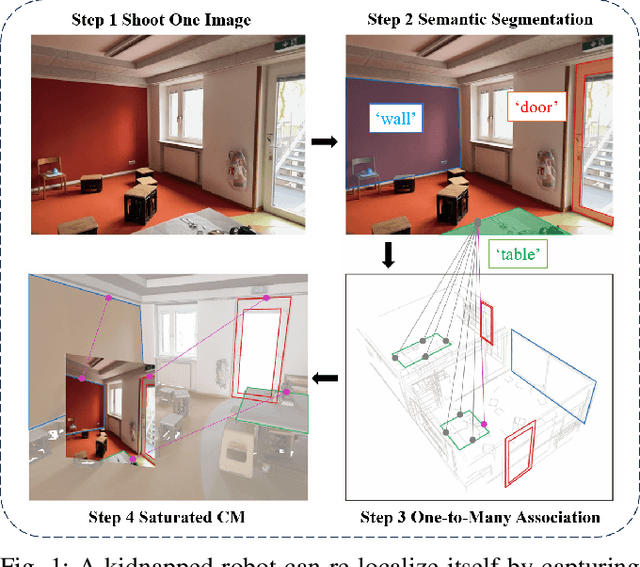
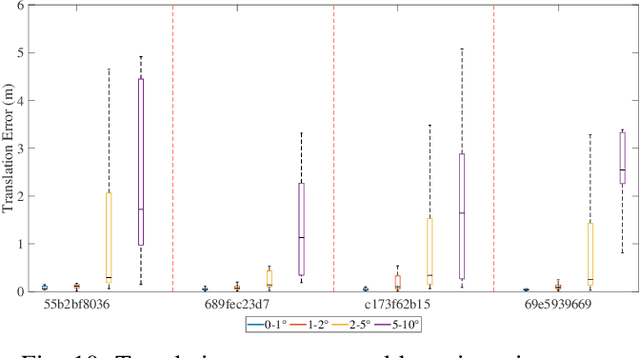
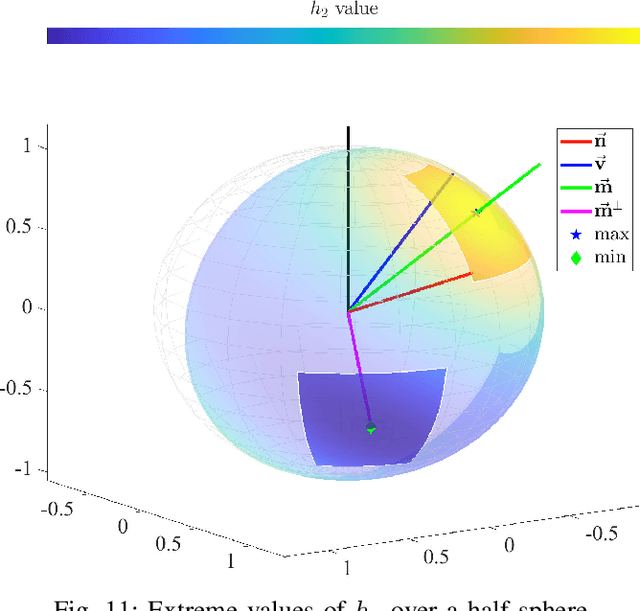
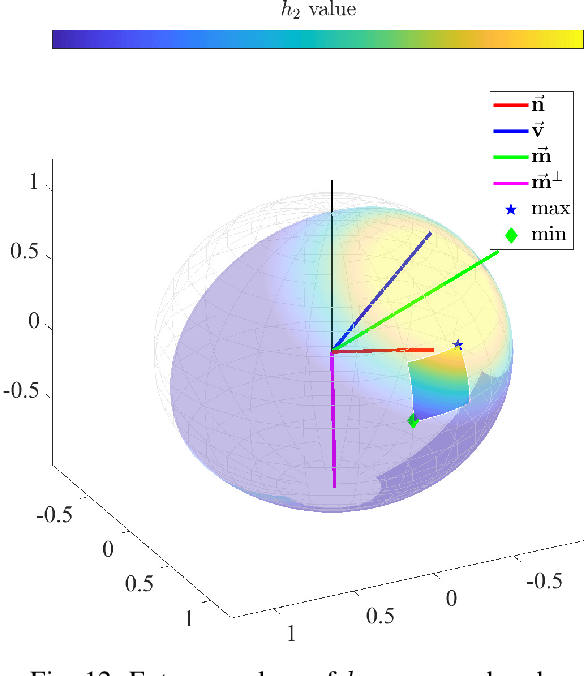
This is the arxiv version for our paper submitted to IEEE/RSJ IROS 2025. We propose a scene-agnostic and light-weight visual relocalization framework that leverages semantically labeled 3D lines as a compact map representation. In our framework, the robot localizes itself by capturing a single image, extracting 2D lines, associating them with semantically similar 3D lines in the map, and solving a robust perspective-n-line problem. To address the extremely high outlier ratios~(exceeding 99.5\%) caused by one-to-many ambiguities in semantic matching, we introduce the Saturated Consensus Maximization~(Sat-CM) formulation, which enables accurate pose estimation when the classic Consensus Maximization framework fails. We further propose a fast global solver to the formulated Sat-CM problems, leveraging rigorous interval analysis results to ensure both accuracy and computational efficiency. Additionally, we develop a pipeline for constructing semantic 3D line maps using posed depth images. To validate the effectiveness of our framework, which integrates our innovations in robust estimation and practical engineering insights, we conduct extensive experiments on the ScanNet++ dataset.