 Add to Chrome
 Add to Firefox
 Add to Edge
Privacy-Preserving End-to-End Full-Duplex Speech Dialogue Models
Mar 09, 2026
End-to-end full-duplex speech models feed user audio through an always-on LLM backbone, yet the speaker privacy implications of their hidden representations remain unexamined. Following the VoicePrivacy 2024 protocol with a lazy-informed attacker, we show that the hidden states of SALM-Duplex and Moshi leak substantial speaker identity across all transformer layers. Layer-wise and turn-wise analyses reveal that leakage persists across all layers, with SALM-Duplex showing stronger leakage in early layers while Moshi leaks uniformly, and that Linkability rises sharply within the first few turns. We propose two streaming anonymization setups using Stream-Voice-Anon: a waveform-level front-end (Anon-W2W) and a feature-domain replacement (Anon-W2F). Anon-W2F raises EER by over 3.5x relative to the discrete encoder baseline (11.2% to 41.0%), approaching the 50% random-chance ceiling, while Anon-W2W retains 78-93% of baseline sBERT across setups with sub-second response latency (FRL under 0.8 s).

Configurable Multilingual ASR with Speech Summary Representations
Oct 06, 2024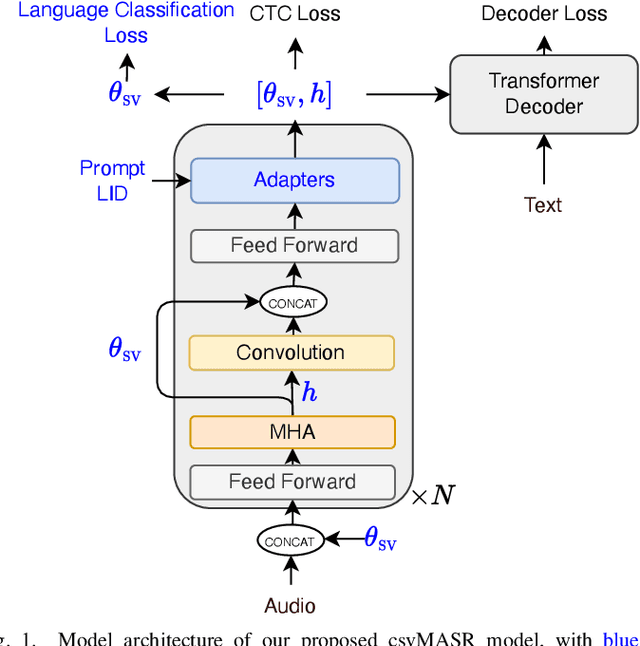
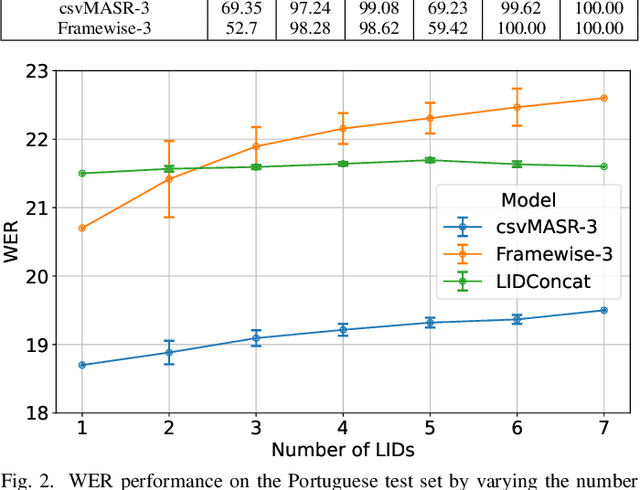
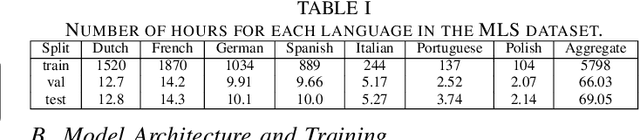
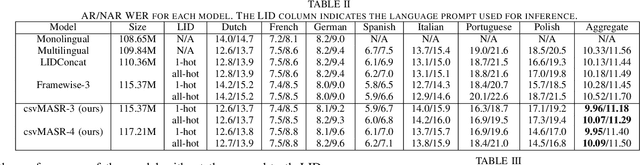
Approximately half of the world's population is multilingual, making multilingual ASR (MASR) essential. Deploying multiple monolingual models is challenging when the ground-truth language is unknown in advance. This motivates research efforts on configurable multilingual MASR models that can be prompted manually or adapted automatically to recognise specific languages. In this paper, we present the Configurable MASR model with Summary Vector (csvMASR), a novel architecture designed to enhance configurability. Our approach leverages adapters and introduces speech summary vector representations, inspired by conversational summary representations in speech diarization, to combine outputs from language-specific components at the utterance level. We also incorporate an auxiliary language classification loss to enhance configurability. Using data from 7 languages in the Multilingual Librispeech (MLS) dataset, csvMASR outperforms existing MASR models and reduces the word error rate (WER) from 10.33\% to 9.95\% when compared with the baseline. Additionally, csvMASR demonstrates superior performance in language classification and prompting tasks.