 Add to Chrome
 Add to Firefox
 Add to Edge
Hindsight Distillation Reasoning with Knowledge Encouragement Preference for Knowledge-based Visual Question Answering
Nov 14, 2025
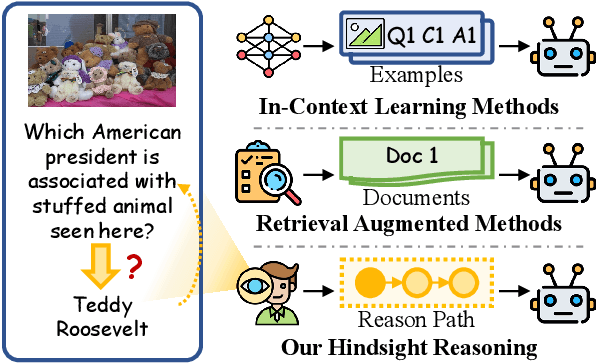

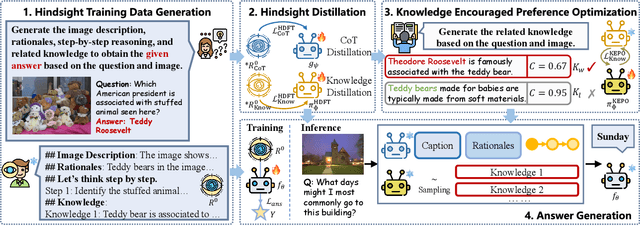
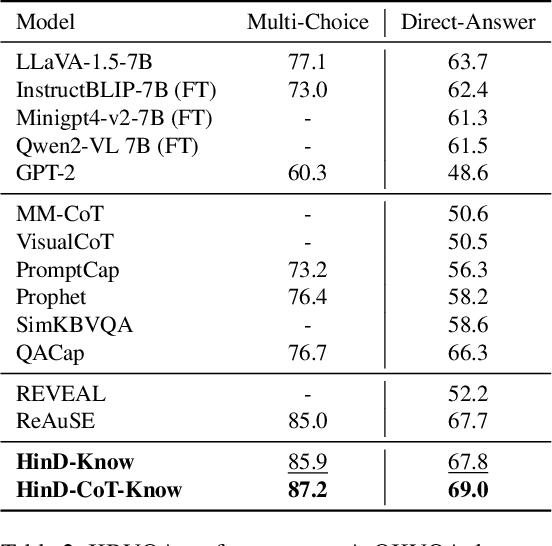
Knowledge-based Visual Question Answering (KBVQA) necessitates external knowledge incorporation beyond cross-modal understanding. Existing KBVQA methods either utilize implicit knowledge in multimodal large language models (MLLMs) via in-context learning or explicit knowledge via retrieval augmented generation. However, their reasoning processes remain implicit, without explicit multi-step trajectories from MLLMs. To address this gap, we provide a Hindsight Distilled Reasoning (HinD) framework with Knowledge Encouragement Preference Optimization (KEPO), designed to elicit and harness internal knowledge reasoning ability in MLLMs. First, to tackle the reasoning supervision problem, we propose to emphasize the hindsight wisdom of MLLM by prompting a frozen 7B-size MLLM to complete the reasoning process between the question and its ground truth answer, constructing Hindsight-Zero training data. Then we self-distill Hindsight-Zero into Chain-of-Thought (CoT) Generator and Knowledge Generator, enabling the generation of sequential steps and discrete facts. Secondly, to tackle the misalignment between knowledge correctness and confidence, we optimize the Knowledge Generator with KEPO, preferring under-confident but helpful knowledge over the over-confident but unhelpful one. The generated CoT and sampled knowledge are then exploited for answer prediction. Experiments on OK-VQA and A-OKVQA validate the effectiveness of HinD, showing that HinD with elicited reasoning from 7B-size MLLM achieves superior performance without commercial model APIs or outside knowledge.

Plan of Knowledge: Retrieval-Augmented Large Language Models for Temporal Knowledge Graph Question Answering
Nov 06, 2025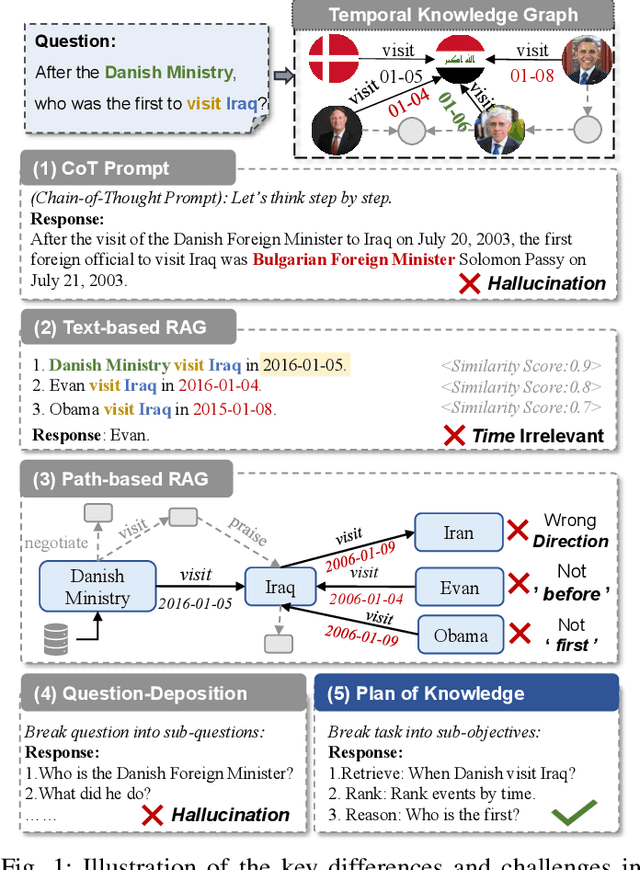
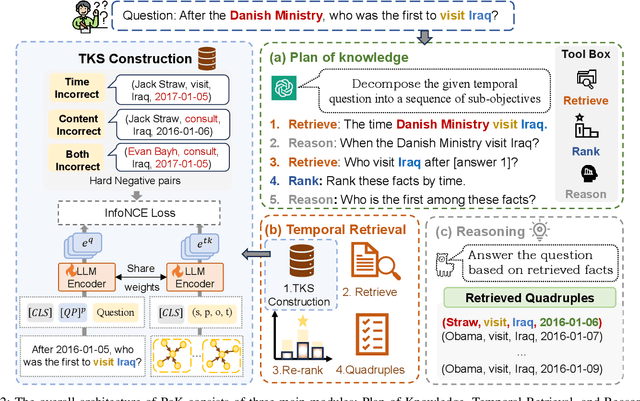
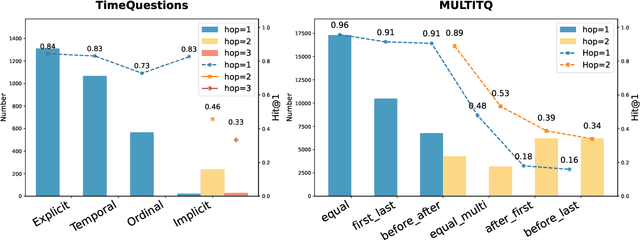
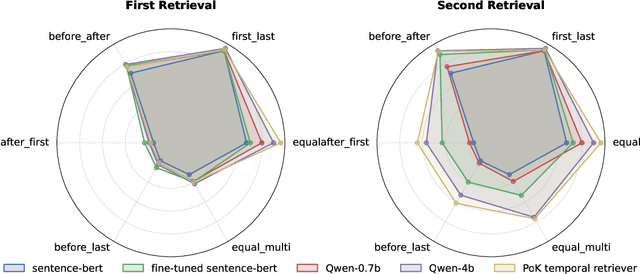
Temporal Knowledge Graph Question Answering (TKGQA) aims to answer time-sensitive questions by leveraging factual information from Temporal Knowledge Graphs (TKGs). While previous studies have employed pre-trained TKG embeddings or graph neural networks to inject temporal knowledge, they fail to fully understand the complex semantic information of time constraints. Recently, Large Language Models (LLMs) have shown remarkable progress, benefiting from their strong semantic understanding and reasoning generalization capabilities. However, their temporal reasoning ability remains limited. LLMs frequently suffer from hallucination and a lack of knowledge. To address these limitations, we propose the Plan of Knowledge framework with a contrastive temporal retriever, which is named PoK. Specifically, the proposed Plan of Knowledge module decomposes a complex temporal question into a sequence of sub-objectives from the pre-defined tools, serving as intermediate guidance for reasoning exploration. In parallel, we construct a Temporal Knowledge Store (TKS) with a contrastive retrieval framework, enabling the model to selectively retrieve semantically and temporally aligned facts from TKGs. By combining structured planning with temporal knowledge retrieval, PoK effectively enhances the interpretability and factual consistency of temporal reasoning. Extensive experiments on four benchmark TKGQA datasets demonstrate that PoK significantly improves the retrieval precision and reasoning accuracy of LLMs, surpassing the performance of the state-of-the-art TKGQA methods by 56.0% at most.
Multi-grained Label Refinement Network with Dependency Structures for Joint Intent Detection and Slot Filling
Sep 09, 2022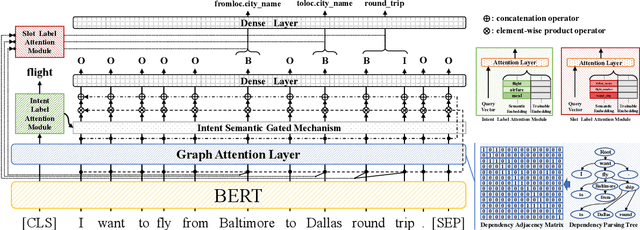
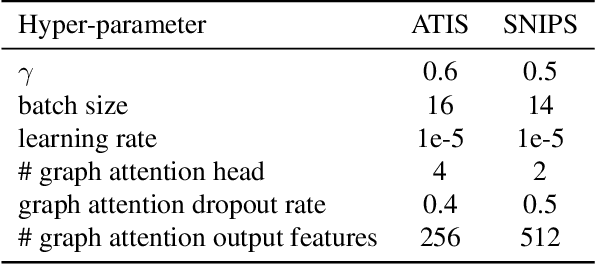
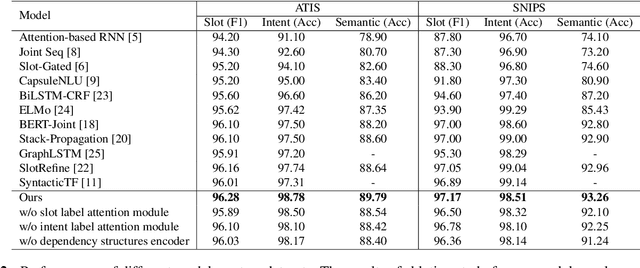
Slot filling and intent detection are two fundamental tasks in the field of natural language understanding. Due to the strong correlation between these two tasks, previous studies make efforts on modeling them with multi-task learning or designing feature interaction modules to improve the performance of each task. However, none of the existing approaches consider the relevance between the structural information of sentences and the label semantics of two tasks. The intent and semantic components of a utterance are dependent on the syntactic elements of a sentence. In this paper, we investigate a multi-grained label refinement network, which utilizes dependency structures and label semantic embeddings. Considering to enhance syntactic representations, we introduce the dependency structures of sentences into our model by graph attention layer. To capture the semantic dependency between the syntactic information and task labels, we combine the task specific features with corresponding label embeddings by attention mechanism. The experimental results demonstrate that our model achieves the competitive performance on two public datasets.