 Add to Chrome
 Add to Firefox
 Add to Edge
DGGAN: Degradation Guided Generative Adversarial Network for Real-time Endoscopic Video Enhancement
Dec 08, 2025
Endoscopic surgery relies on intraoperative video, making image quality a decisive factor for surgical safety and efficacy. Yet, endoscopic videos are often degraded by uneven illumination, tissue scattering, occlusions, and motion blur, which obscure critical anatomical details and complicate surgical manipulation. Although deep learning-based methods have shown promise in image enhancement, most existing approaches remain too computationally demanding for real-time surgical use. To address this challenge, we propose a degradation-aware framework for endoscopic video enhancement, which enables real-time, high-quality enhancement by propagating degradation representations across frames. In our framework, degradation representations are first extracted from images using contrastive learning. We then introduce a fusion mechanism that modulates image features with these representations to guide a single-frame enhancement model, which is trained with a cycle-consistency constraint between degraded and restored images to improve robustness and generalization. Experiments demonstrate that our framework achieves a superior balance between performance and efficiency compared with several state-of-the-art methods. These results highlight the effectiveness of degradation-aware modeling for real-time endoscopic video enhancement. Nevertheless, our method suggests that implicitly learning and propagating degradation representation offer a practical pathway for clinical application.

Portable, High-Frequency, and High-Voltage Control Circuits for Untethered Miniature Robots Driven by Dielectric Elastomer Actuators
Feb 10, 2025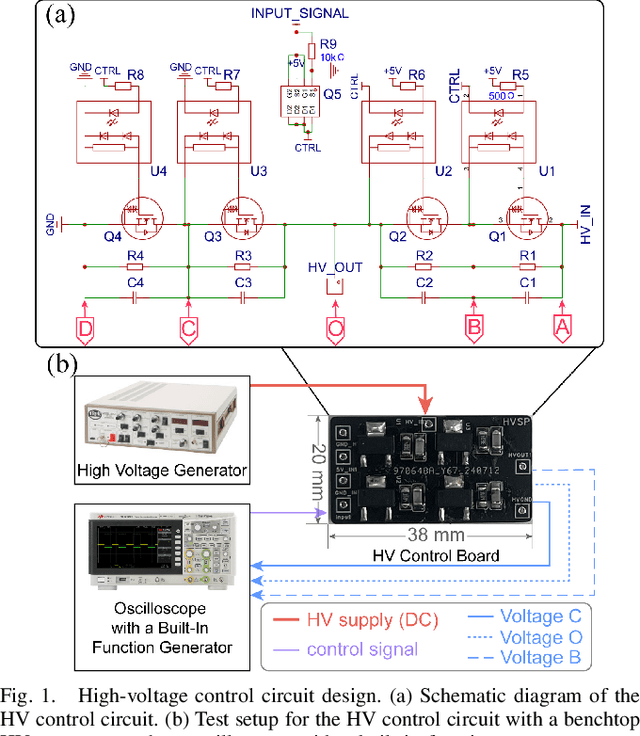
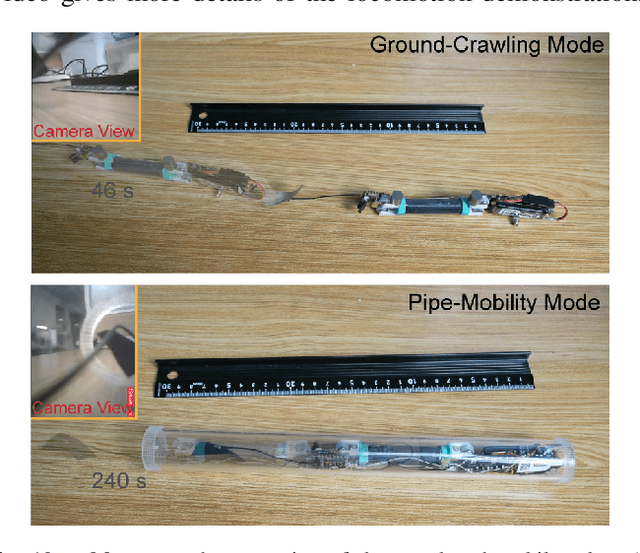
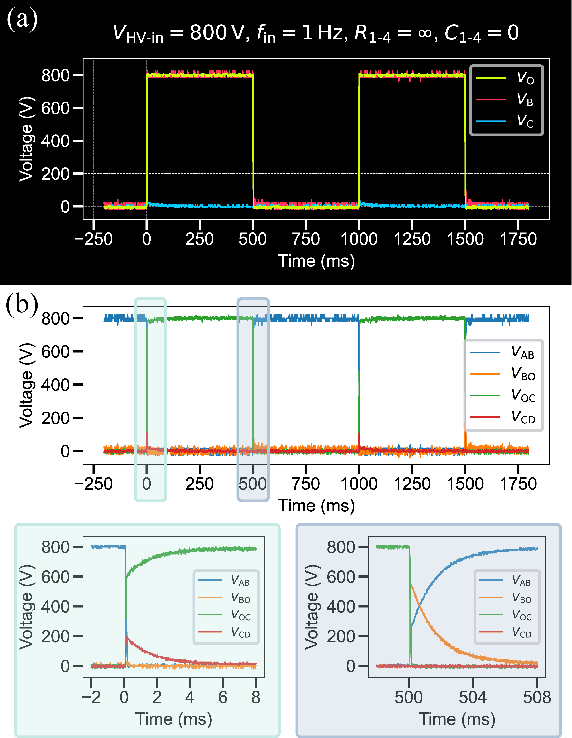
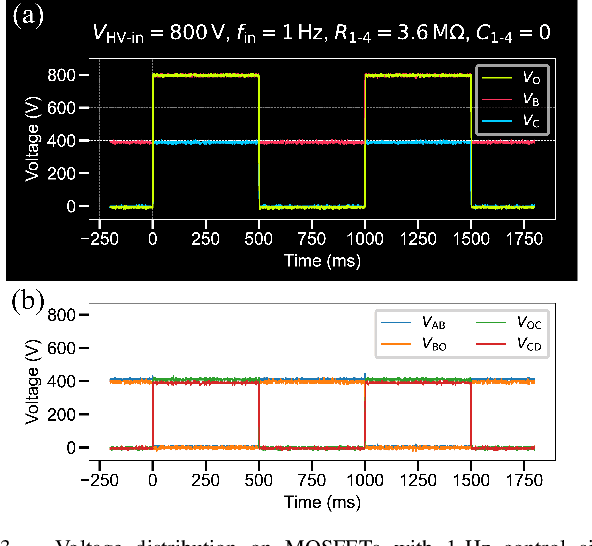
In this work, we propose a high-voltage, high-frequency control circuit for the untethered applications of dielectric elastomer actuators (DEAs). The circuit board leverages low-voltage resistive components connected in series to control voltages of up to 1.8 kV within a compact size, suitable for frequencies ranging from 0 to 1 kHz. A single-channel control board weighs only 2.5 g. We tested the performance of the control circuit under different load conditions and power supplies. Based on this control circuit, along with a commercial miniature high-voltage power converter, we construct an untethered crawling robot driven by a cylindrical DEA. The 42-g untethered robots successfully obtained crawling locomotion on a bench and within a pipeline at a driving frequency of 15 Hz, while simultaneously transmitting real-time video data via an onboard camera and antenna. Our work provides a practical way to use low-voltage control electronics to achieve the untethered driving of DEAs, and therefore portable and wearable devices.