 Add to Chrome
 Add to Firefox
 Add to Edge
Enhancing Automated Essay Scoring with Three Techniques: Two-Stage Fine-Tuning, Score Alignment, and Self-Training
Feb 02, 2026
Automated Essay Scoring (AES) plays a crucial role in education by providing scalable and efficient assessment tools. However, in real-world settings, the extreme scarcity of labeled data severely limits the development and practical adoption of robust AES systems. This study proposes a novel approach to enhance AES performance in both limited-data and full-data settings by introducing three key techniques. First, we introduce a Two-Stage fine-tuning strategy that leverages low-rank adaptations to better adapt an AES model to target prompt essays. Second, we introduce a Score Alignment technique to improve consistency between predicted and true score distributions. Third, we employ uncertainty-aware self-training using unlabeled data, effectively expanding the training set with pseudo-labeled samples while mitigating label noise propagation. We implement above three key techniques on DualBERT. We conduct extensive experiments on the ASAP++ dataset. As a result, in the 32-data setting, all three key techniques improve performance, and their integration achieves 91.2% of the full-data performance trained on approximately 1,000 labeled samples. In addition, the proposed Score Alignment technique consistently improves performance in both limited-data and full-data settings: e.g., it achieves state-of-the-art results in the full-data setting when integrated into DualBERT.

The slurk Interaction Server Framework: Better Data for Better Dialog Models
Feb 02, 2022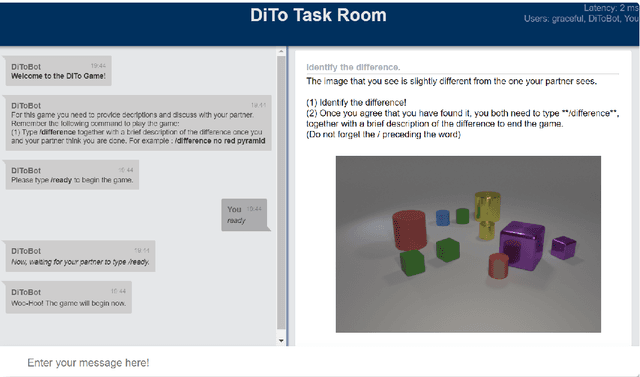
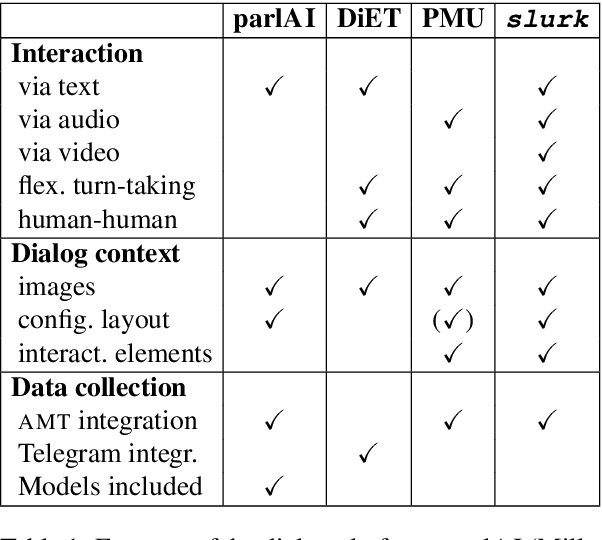
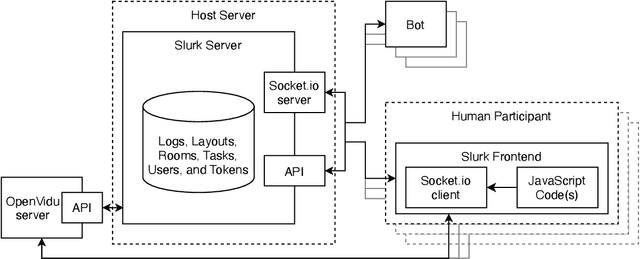
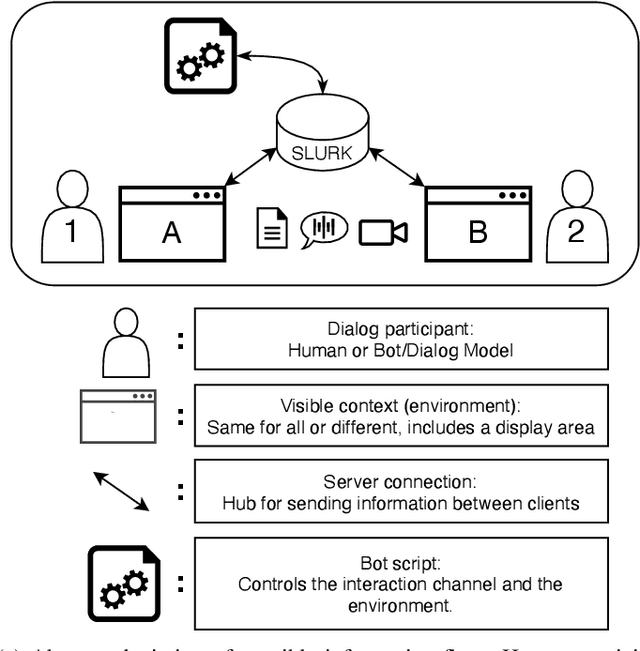
This paper presents the slurk software, a lightweight interaction server for setting up dialog data collections and running experiments. Slurk enables a multitude of settings including text-based, speech and video interaction between two or more humans or humans and bots, and a multimodal display area for presenting shared or private interactive context. The software is implemented in Python with an HTML and JS frontend that can easily be adapted to individual needs. It also provides a setup for pairing participants on common crowdworking platforms such as Amazon Mechanical Turk and some example bot scripts for common interaction scenarios.