 Add to Chrome
 Add to Firefox
 Add to Edge
MiMo-V2-Flash Technical Report
Jan 08, 2026
We present MiMo-V2-Flash, a Mixture-of-Experts (MoE) model with 309B total parameters and 15B active parameters, designed for fast, strong reasoning and agentic capabilities. MiMo-V2-Flash adopts a hybrid attention architecture that interleaves Sliding Window Attention (SWA) with global attention, with a 128-token sliding window under a 5:1 hybrid ratio. The model is pre-trained on 27 trillion tokens with Multi-Token Prediction (MTP), employing a native 32k context length and subsequently extended to 256k. To efficiently scale post-training compute, MiMo-V2-Flash introduces a novel Multi-Teacher On-Policy Distillation (MOPD) paradigm. In this framework, domain-specialized teachers (e.g., trained via large-scale reinforcement learning) provide dense and token-level reward, enabling the student model to perfectly master teacher expertise. MiMo-V2-Flash rivals top-tier open-weight models such as DeepSeek-V3.2 and Kimi-K2, despite using only 1/2 and 1/3 of their total parameters, respectively. During inference, by repurposing MTP as a draft model for speculative decoding, MiMo-V2-Flash achieves up to 3.6 acceptance length and 2.6x decoding speedup with three MTP layers. We open-source both the model weights and the three-layer MTP weights to foster open research and community collaboration.

MiMo-Audio: Audio Language Models are Few-Shot Learners
Dec 29, 2025Existing audio language models typically rely on task-specific fine-tuning to accomplish particular audio tasks. In contrast, humans are able to generalize to new audio tasks with only a few examples or simple instructions. GPT-3 has shown that scaling next-token prediction pretraining enables strong generalization capabilities in text, and we believe this paradigm is equally applicable to the audio domain. By scaling MiMo-Audio's pretraining data to over one hundred million of hours, we observe the emergence of few-shot learning capabilities across a diverse set of audio tasks. We develop a systematic evaluation of these capabilities and find that MiMo-Audio-7B-Base achieves SOTA performance on both speech intelligence and audio understanding benchmarks among open-source models. Beyond standard metrics, MiMo-Audio-7B-Base generalizes to tasks absent from its training data, such as voice conversion, style transfer, and speech editing. MiMo-Audio-7B-Base also demonstrates powerful speech continuation capabilities, capable of generating highly realistic talk shows, recitations, livestreaming and debates. At the post-training stage, we curate a diverse instruction-tuning corpus and introduce thinking mechanisms into both audio understanding and generation. MiMo-Audio-7B-Instruct achieves open-source SOTA on audio understanding benchmarks (MMSU, MMAU, MMAR, MMAU-Pro), spoken dialogue benchmarks (Big Bench Audio, MultiChallenge Audio) and instruct-TTS evaluations, approaching or surpassing closed-source models. Model checkpoints and full evaluation suite are available at https://github.com/XiaomiMiMo/MiMo-Audio.
MiMo: Unlocking the Reasoning Potential of Language Model -- From Pretraining to Posttraining
May 12, 2025We present MiMo-7B, a large language model born for reasoning tasks, with optimization across both pre-training and post-training stages. During pre-training, we enhance the data preprocessing pipeline and employ a three-stage data mixing strategy to strengthen the base model's reasoning potential. MiMo-7B-Base is pre-trained on 25 trillion tokens, with additional Multi-Token Prediction objective for enhanced performance and accelerated inference speed. During post-training, we curate a dataset of 130K verifiable mathematics and programming problems for reinforcement learning, integrating a test-difficulty-driven code-reward scheme to alleviate sparse-reward issues and employing strategic data resampling to stabilize training. Extensive evaluations show that MiMo-7B-Base possesses exceptional reasoning potential, outperforming even much larger 32B models. The final RL-tuned model, MiMo-7B-RL, achieves superior performance on mathematics, code and general reasoning tasks, surpassing the performance of OpenAI o1-mini. The model checkpoints are available at https://github.com/xiaomimimo/MiMo.
Sliding Spectrum Decomposition for Diversified Recommendation
Jul 12, 2021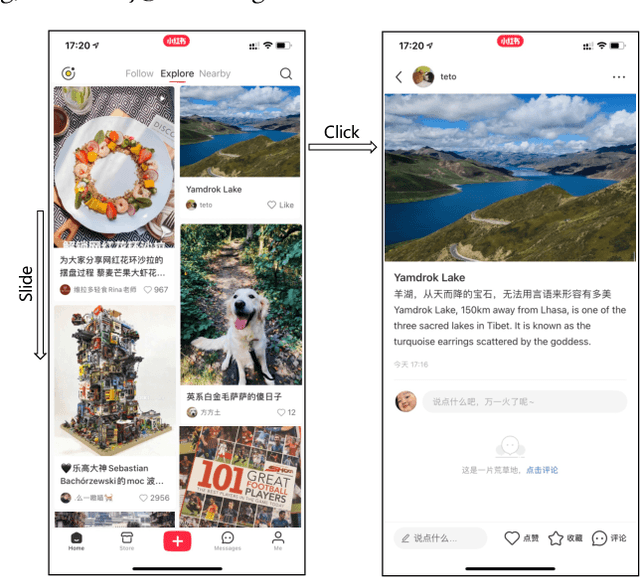
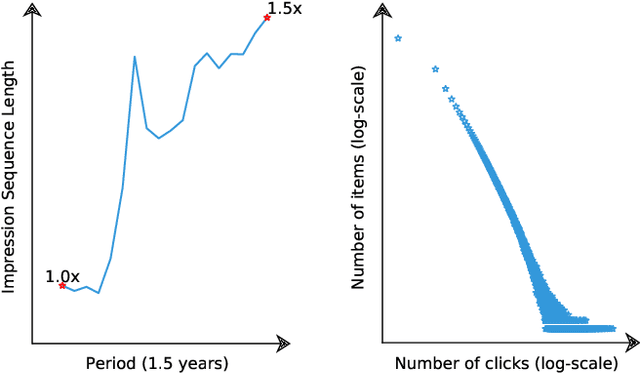
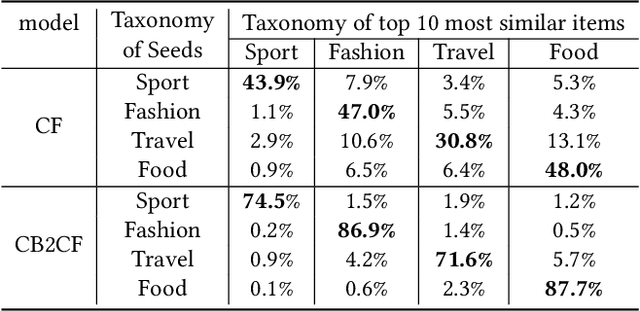

Content feed, a type of product that recommends a sequence of items for users to browse and engage with, has gained tremendous popularity among social media platforms. In this paper, we propose to study the diversity problem in such a scenario from an item sequence perspective using time series analysis techniques. We derive a method called sliding spectrum decomposition (SSD) that captures users' perception of diversity in browsing a long item sequence. We also share our experiences in designing and implementing a suitable item embedding method for accurate similarity measurement under long tail effect. Combined together, they are now fully implemented and deployed in Xiaohongshu App's production recommender system that serves the main Explore Feed product for tens of millions of users every day. We demonstrate the effectiveness and efficiency of the method through theoretical analysis, offline experiments and online A/B tests.