 Add to Chrome
 Add to Firefox
 Add to Edge
THD-BAR: Topology Hierarchical Derived Brain Autoregressive Modeling for EEG Generic Representations
Nov 05, 2025
Large-scale pre-trained models hold significant potential for learning universal EEG representations. However, most existing methods, particularly autoregressive (AR) frameworks, primarily rely on straightforward temporal sequencing of multi-channel EEG data, which fails to capture the rich physiological characteristics inherent to EEG signals. Moreover, their time-centered modeling approach also limits the effective representation of the dynamic spatial topology of brain activity. To address these challenges and fully exploit the potential of large-scale EEG models, we propose a novel Topology Hierarchical Derived Brain Autoregressive Modeling (THD-BAR) for EEG generic representations. The core innovation of THD-BAR lies in the introduction of the Brain Topology Hierarchy (BTH), which establishes a multi-scale spatial order for EEG channels. This hierarchical structure enables a redefinition of autoregressive learning as a "next-scale-time prediction" problem, effectively capturing both spatial and temporal dynamics. Based on BTH, we design a Topology-Hierarchical Vector Quantized-Variational Autoencoder (THVQ-VAE) for multi-scale tokenization and develop an enhanced Brain Autoregressive (BAR) module with specialized masking strategies for prediction. Through extensive large-scale pre-training on 17 datasets, followed by rigorous validation on 10 downstream datasets spanning 5 distinct tasks, THD-BAR consistently outperforms existing methods. These results highlight the superior generalization and modeling capabilities of our proposed approach.

Unsupervised convolutional neural network fusion approach for change detection in remote sensing images
Nov 07, 2023
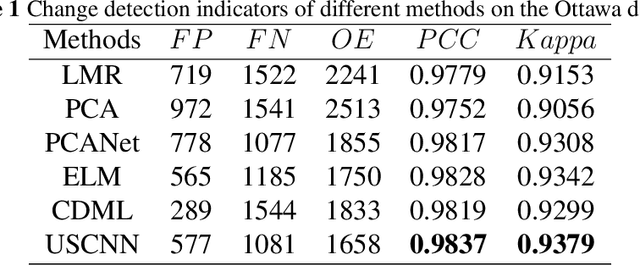


With the rapid development of deep learning, a variety of change detection methods based on deep learning have emerged in recent years. However, these methods usually require a large number of training samples to train the network model, so it is very expensive. In this paper, we introduce a completely unsupervised shallow convolutional neural network (USCNN) fusion approach for change detection. Firstly, the bi-temporal images are transformed into different feature spaces by using convolution kernels of different sizes to extract multi-scale information of the images. Secondly, the output features of bi-temporal images at the same convolution kernels are subtracted to obtain the corresponding difference images, and the difference feature images at the same scale are fused into one feature image by using 1 * 1 convolution layer. Finally, the output features of different scales are concatenated and a 1 * 1 convolution layer is used to fuse the multi-scale information of the image. The model parameters are obtained by a redesigned sparse function. Our model has three features: the entire training process is conducted in an unsupervised manner, the network architecture is shallow, and the objective function is sparse. Thus, it can be seen as a kind of lightweight network model. Experimental results on four real remote sensing datasets indicate the feasibility and effectiveness of the proposed approach.