 Add to Chrome
 Add to Firefox
 Add to Edge
WiFo-E: A Scalable Wireless Foundation Model for End-to-End FDD Precoding in Communication Networks
Jan 14, 2026
Accurate precoding in massive multiple-input multiple-output (MIMO) frequency-division duplexing (FDD) systems relies on efficient channel state information (CSI) acquisition. End-to-end learning frameworks improve performance by jointly optimizing this process, but they lack scalability and fail to generalize across different system configurations, such as varying numbers of antennas and users. To overcome this limitation, we introduce WiFo-E, a wireless foundation model designed for scalable end-to-end precoding. WiFo-E employs multi-task pretraining on a diverse set of configurations to learn transferable representations of underlying wireless principles. Central to the model is a sparse Mixture-of-Experts (MoE) Transformer architecture, which mitigates task interference and enhances training efficiency by activating specialized parameter subsets adaptively. Extensive simulations demonstrate that WiFo-E outperforms conventional per-configuration training and shows strong generalization to unseen system configurations, providing a flexible and efficient foundation for adaptive massive MIMO precoding.

Synesthesia of Machines (SoM)-Aided Online FDD Precoding via Heterogeneous Multi-Modal Sensing: A Vertical Federated Learning Approach
Jun 09, 2025This paper investigates a heterogeneous multi-vehicle, multi-modal sensing (H-MVMM) aided online precoding problem. The proposed H-MVMM scheme utilizes a vertical federated learning (VFL) framework to minimize pilot sequence length and optimize the sum rate. This offers a promising solution for reducing latency in frequency division duplexing systems. To achieve this, three preprocessing modules are designed to transform raw sensory data into informative representations relevant to precoding. The approach effectively addresses local data heterogeneity arising from diverse on-board sensor configurations through a well-structured VFL training procedure. Additionally, a label-free online model updating strategy is introduced, enabling the H-MVMM scheme to adapt its weights flexibly. This strategy features a pseudo downlink channel state information label simulator (PCSI-Simulator), which is trained using a semi-supervised learning (SSL) approach alongside an online loss function. Numerical results show that the proposed method can closely approximate the performance of traditional optimization techniques with perfect channel state information, achieving a significant 90.6\% reduction in pilot sequence length.
Synesthesia of Machines (SoM)-Aided FDD Precoding with Sensing Heterogeneity: A Vertical Federated Learning Approach
Jan 19, 2025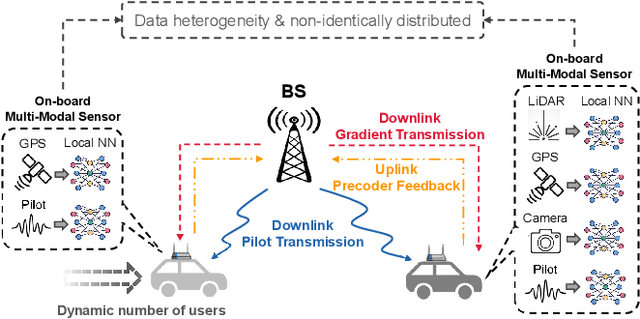
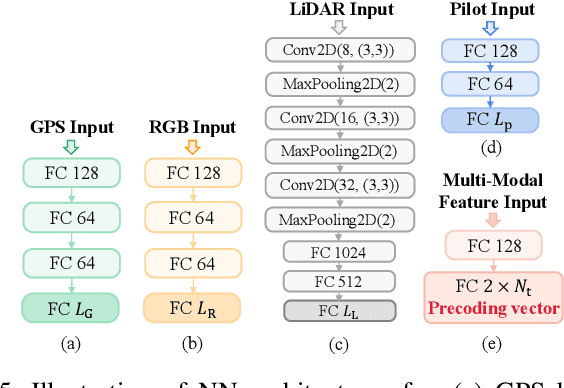
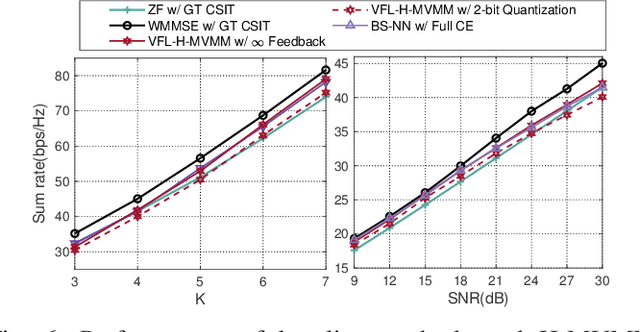
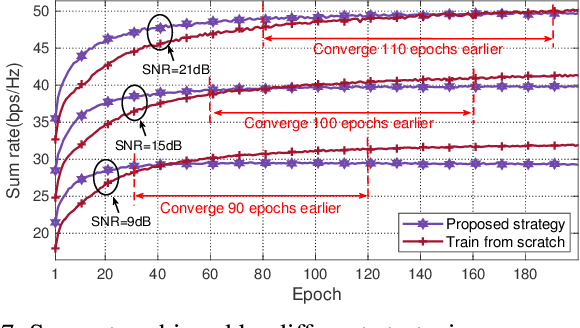
High complexity in precoding design for frequency division duplex systems necessitates streamlined solutions. Guided by Synesthesia of Machines (SoM), this paper introduces a heterogeneous multi-vehicle, multi-modal sensing aided precoding scheme within a vertical federated learning (VFL) framework, which significantly minimizes pilot sequence length while optimizing the system's sum rate. We address the challenges posed by local data heterogeneity due to varying on-board sensor configurations through a meticulously designed VFL training procedure. To extract valuable channel features from multi-modal sensing, we employ three distinct data preprocessing methods that convert raw data into informative representations relevant for precoding. Additionally, we propose an online training strategy based on VFL framework, enabling the scheme to adapt dynamically to fluctuations in user numbers. Numerical results indicate that our approach, utilizing short pilot sequences, closely approximates the performance of traditional optimization methods with perfect channel state information.