 Add to Chrome
 Add to Firefox
 Add to Edge
Attacking the First-Principle: A Black-Box, Query-Free Targeted Mimicry Attack on Binary Function Classifiers
May 18, 2026
Binary function classifiers play a crucial role in maintaining the security and integrity of software systems by detecting malicious code and unauthorized modifications. However, machine learning-based classifiers are vulnerable to adversarial attacks that can evade detection. In this study, we present Kelpie, a novel framework for executing mimicry attacks, a stronger type of targeted evasion attacks, on binary function classifiers in a black-box, zero-query setting. Unlike previous approaches that rely on querying the target classifier to refine untargeted evasion attacks, Kelpie leverages code transformations that preserve the functionality of malicious payloads while causing them to be misclassified as we want. Through extensive experimentation, we demonstrate that Kelpie can successfully execute mimicry attacks against six state-of-the-art binary function classifiers representing different model architectures without requiring direct interaction with them. We further validate our approach with a practical demonstration, involving a keylogger and a wiper concealed within benign-looking functions embedded in an application. This work, to our best knowledge, is the first to demonstrate such a mimicry attack in a black-box, zero-query context, raising important questions about the reliability and security of existing machine learning-based binary function classifiers.

"Wait, did you mean the doctor?": Collecting a Dialogue Corpus for Topical Analysis
Jan 14, 2025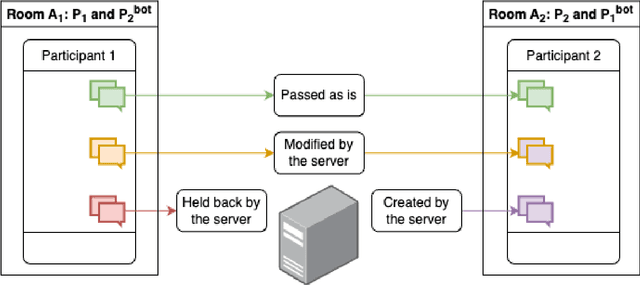
Dialogue is at the core of human behaviour and being able to identify the topic at hand is crucial to take part in conversation. Yet, there are few accounts of the topical organisation in casual dialogue and of how people recognise the current topic in the literature. Moreover, analysing topics in dialogue requires conversations long enough to contain several topics and types of topic shifts. Such data is complicated to collect and annotate. In this paper we present a dialogue collection experiment which aims to build a corpus suitable for topical analysis. We will carry out the collection with a messaging tool we developed.