 Add to Chrome
 Add to Firefox
 Add to Edge
The Complexity of Bayesian Network Learning: Revisiting the Superstructure
Feb 10, 2026
We investigate the parameterized complexity of Bayesian Network Structure Learning (BNSL), a classical problem that has received significant attention in empirical but also purely theoretical studies. We follow up on previous works that have analyzed the complexity of BNSL w.r.t. the so-called superstructure of the input. While known results imply that BNSL is unlikely to be fixed-parameter tractable even when parameterized by the size of a vertex cover in the superstructure, here we show that a different kind of parameterization - notably by the size of a feedback edge set - yields fixed-parameter tractability. We proceed by showing that this result can be strengthened to a localized version of the feedback edge set, and provide corresponding lower bounds that complement previous results to provide a complexity classification of BNSL w.r.t. virtually all well-studied graph parameters. We then analyze how the complexity of BNSL depends on the representation of the input. In particular, while the bulk of past theoretical work on the topic assumed the use of the so-called non-zero representation, here we prove that if an additive representation can be used instead then BNSL becomes fixed-parameter tractable even under significantly milder restrictions to the superstructure, notably when parameterized by the treewidth alone. Last but not least, we show how our results can be extended to the closely related problem of Polytree Learning.

A Structural Complexity Analysis of Synchronous Dynamical Systems
Dec 12, 2023
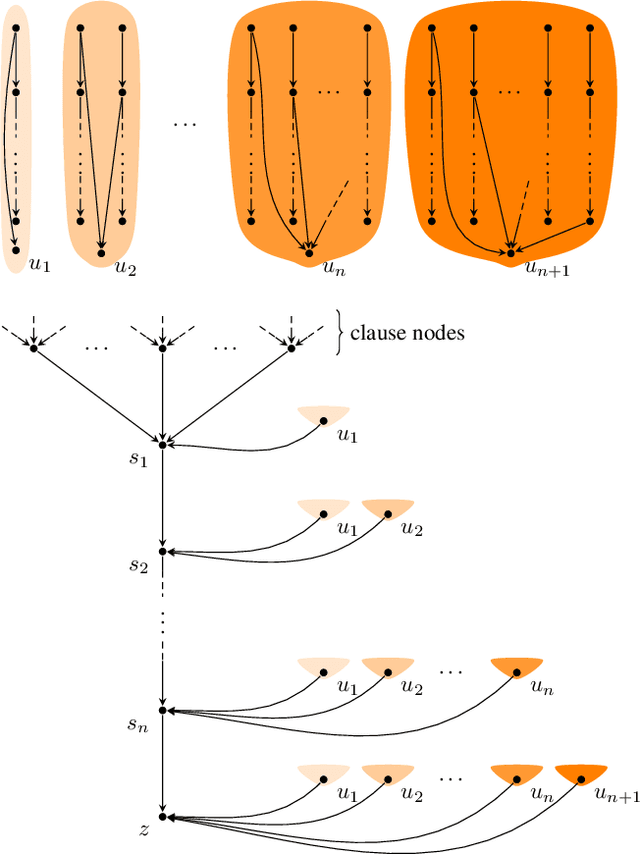
Synchronous dynamic systems are well-established models that have been used to capture a range of phenomena in networks, including opinion diffusion, spread of disease and product adoption. We study the three most notable problems in synchronous dynamic systems: whether the system will transition to a target configuration from a starting configuration, whether the system will reach convergence from a starting configuration, and whether the system is guaranteed to converge from every possible starting configuration. While all three problems were known to be intractable in the classical sense, we initiate the study of their exact boundaries of tractability from the perspective of structural parameters of the network by making use of the more fine-grained parameterized complexity paradigm. As our first result, we consider treewidth - as the most prominent and ubiquitous structural parameter - and show that all three problems remain intractable even on instances of constant treewidth. We complement this negative finding with fixed-parameter algorithms for the former two problems parameterized by treedepth, a well-studied restriction of treewidth. While it is possible to rule out a similar algorithm for convergence guarantee under treedepth, we conclude with a fixed-parameter algorithm for this last problem when parameterized by treedepth and the maximum in-degree.