 Add to Chrome
 Add to Firefox
 Add to Edge
LitS: A novel Neighborhood Descriptor for Point Clouds
Feb 04, 2026
With the advancement of 3D scanning technologies, point clouds have become fundamental for representing 3D spatial data, with applications that span across various scientific and technological fields. Practical analysis of this data depends crucially on available neighborhood descriptors to accurately characterize the local geometries of the point cloud. This paper introduces LitS, a novel neighborhood descriptor for 2D and 3D point clouds. LitS are piecewise constant functions on the unit circle that allow points to keep track of their surroundings. Each element in LitS' domain represents a direction with respect to a local reference system. Once constructed, evaluating LitS at any given direction gives us information about the number of neighbors in a cone-like region centered around that same direction. Thus, LitS conveys a lot of information about the local neighborhood of a point, which can be leveraged to gain global structural understanding by analyzing how LitS changes between close points. In addition, LitS comes in two versions ('regular' and 'cumulative') and has two parameters, allowing them to adapt to various contexts and types of point clouds. Overall, they are a versatile neighborhood descriptor, capable of capturing the nuances of local point arrangements and resilient to common point cloud data issues such as variable density and noise.

Model Performance Prediction for Hyperparameter Optimization of Deep Learning Models Using High Performance Computing and Quantum Annealing
Nov 29, 2023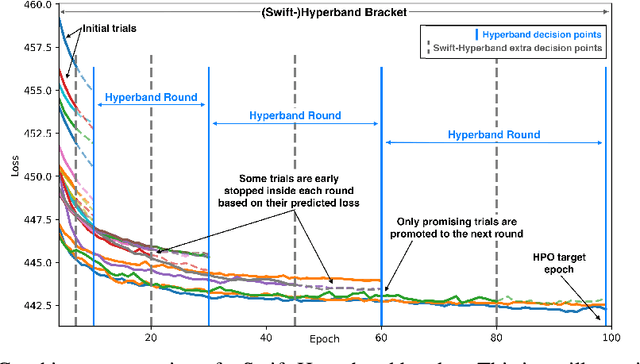
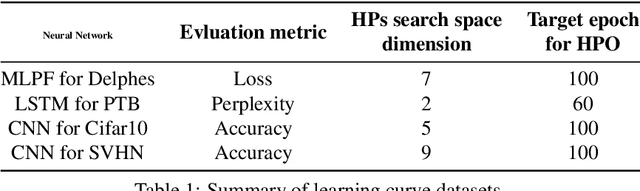
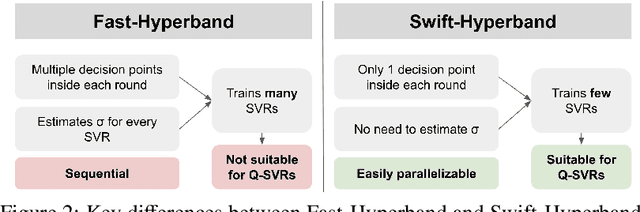
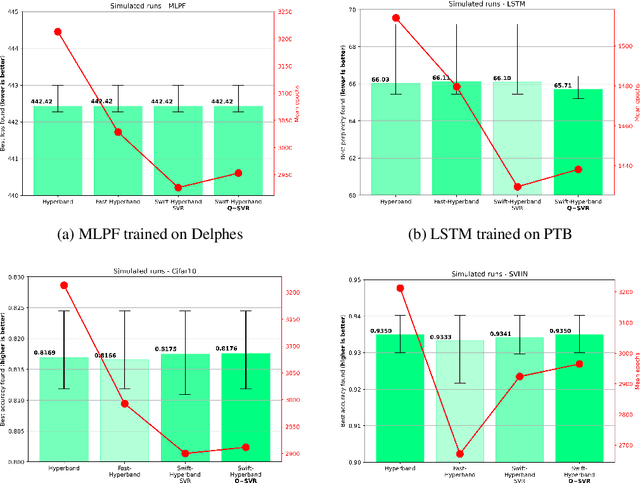
Hyperparameter Optimization (HPO) of Deep Learning-based models tends to be a compute resource intensive process as it usually requires to train the target model with many different hyperparameter configurations. We show that integrating model performance prediction with early stopping methods holds great potential to speed up the HPO process of deep learning models. Moreover, we propose a novel algorithm called Swift-Hyperband that can use either classical or quantum support vector regression for performance prediction and benefit from distributed High Performance Computing environments. This algorithm is tested not only for the Machine-Learned Particle Flow model used in High Energy Physics, but also for a wider range of target models from domains such as computer vision and natural language processing. Swift-Hyperband is shown to find comparable (or better) hyperparameters as well as using less computational resources in all test cases.