 Add to Chrome
 Add to Firefox
 Add to Edge
Adoption of Generative Artificial Intelligence in the German Software Engineering Industry: An Empirical Study
Jan 23, 2026
Generative artificial intelligence (GenAI) tools have seen rapid adoption among software developers. While adoption rates in the industry are rising, the underlying factors influencing the effective use of these tools, including the depth of interaction, organizational constraints, and experience-related considerations, have not been thoroughly investigated. This issue is particularly relevant in environments with stringent regulatory requirements, such as Germany, where practitioners must address the GDPR and the EU AI Act while balancing productivity gains with intellectual property considerations. Despite the significant impact of GenAI on software engineering, to the best of our knowledge, no empirical study has systematically examined the adoption dynamics of GenAI tools within the German context. To address this gap, we present a comprehensive mixed-methods study on GenAI adoption among German software engineers. Specifically, we conducted 18 exploratory interviews with practitioners, followed by a developer survey with 109 participants. We analyze patterns of tool adoption, prompting strategies, and organizational factors that influence effectiveness. Our results indicate that experience level moderates the perceived benefits of GenAI tools, and productivity gains are not evenly distributed among developers. Further, organizational size affects both tool selection and the intensity of tool use. Limited awareness of the project context is identified as the most significant barrier. We summarize a set of actionable implications for developers, organizations, and tool vendors seeking to advance artificial intelligence (AI) assisted software development.

Leveraging Large Language Models for Use Case Model Generation from Software Requirements
Nov 13, 2025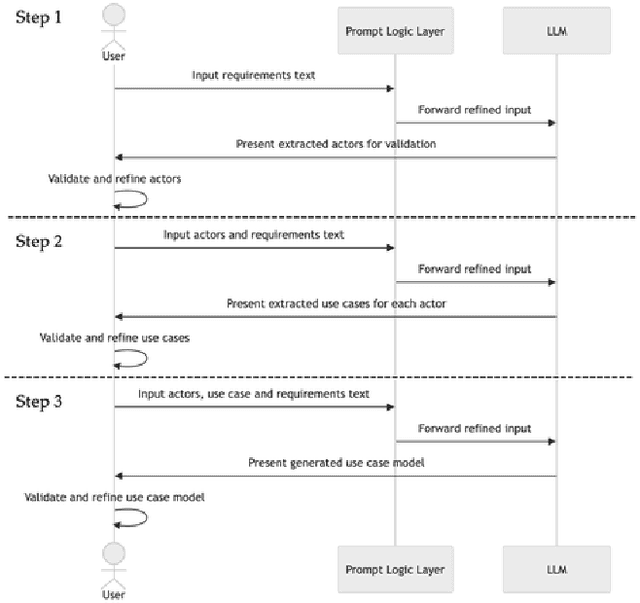
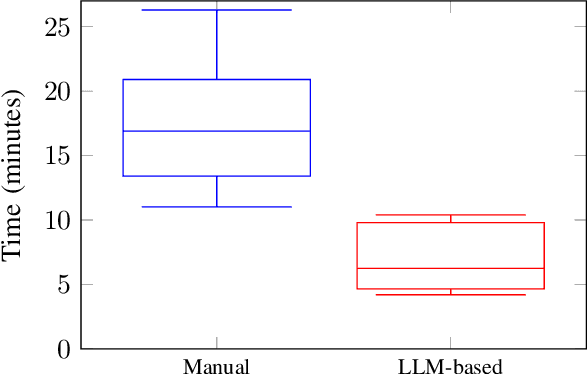
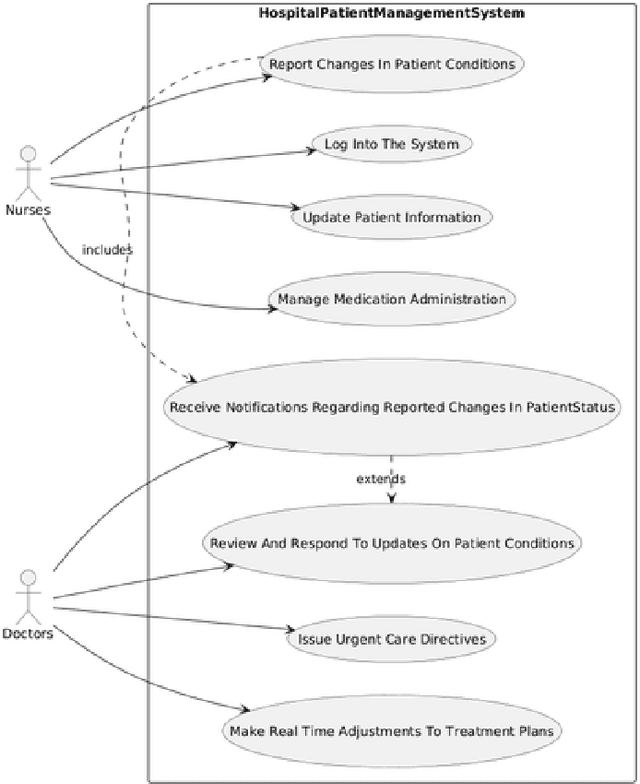
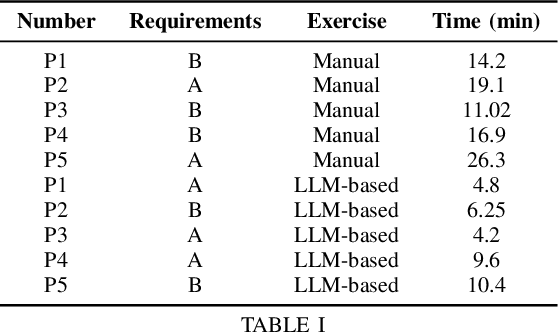
Use case modeling employs user-centered scenarios to outline system requirements. These help to achieve consensus among relevant stakeholders. Because the manual creation of use case models is demanding and time-consuming, it is often skipped in practice. This study explores the potential of Large Language Models (LLMs) to assist in this tedious process. The proposed method integrates an open-weight LLM to systematically extract actors and use cases from software requirements with advanced prompt engineering techniques. The method is evaluated using an exploratory study conducted with five professional software engineers, which compares traditional manual modeling to the proposed LLM-based approach. The results show a substantial acceleration, reducing the modeling time by 60\%. At the same time, the model quality remains on par. Besides improving the modeling efficiency, the participants indicated that the method provided valuable guidance in the process.
From Requirements to Architecture: Semi-Automatically Generating Software Architectures
Apr 16, 2025To support junior and senior architects, I propose developing a new architecture creation method that leverages LLMs' evolving capabilities to support the architect. This method involves the architect's close collaboration with LLM-fueled tooling over the whole process. The architect is guided through Domain Model creation, Use Case specification, architectural decisions, and architecture evaluation. While the architect can take complete control of the process and the results, and use the tooling as a building set, they can follow the intended process for maximum tooling support. The preliminary results suggest the feasibility of this process and indicate major time savings for the architect.
From Requirements to Architecture: An AI-Based Journey to Semi-Automatically Generate Software Architectures
Jan 25, 2024
Designing domain models and software architectures represents a significant challenge in software development, as the resulting architectures play a vital role in fulfilling the system's quality of service. Due to time pressure, architects often model only one architecture based on their known limited domain understanding, patterns, and experience instead of thoroughly analyzing the domain and evaluating multiple candidates, selecting the best fitting. Existing approaches try to generate domain models based on requirements, but still require time-consuming manual effort to achieve good results. Therefore, in this vision paper, we propose a method to generate software architecture candidates semi-automatically based on requirements using artificial intelligence techniques. We further envision an automatic evaluation and trade-off analysis of the generated architecture candidates using, e.g., the architecture trade-off analysis method combined with large language models and quantitative analyses. To evaluate this approach, we aim to analyze the quality of the generated architecture models and the efficiency and effectiveness of our proposed process by conducting qualitative studies.