 Add to Chrome
 Add to Firefox
 Add to Edge
A Cautionary Tale of Self-Supervised Learning for Imaging Biomarkers: Alzheimer's Disease Case Study
Jan 23, 2026
Discovery of sensitive and biologically grounded biomarkers is essential for early detection and monitoring of Alzheimer's disease (AD). Structural MRI is widely available but typically relies on hand-crafted features such as cortical thickness or volume. We ask whether self-supervised learning (SSL) can uncover more powerful biomarkers from the same data. Existing SSL methods underperform FreeSurfer-derived features in disease classification, conversion prediction, and amyloid status prediction. We introduce Residual Noise Contrastive Estimation (R-NCE), a new SSL framework that integrates auxiliary FreeSurfer features while maximizing additional augmentation-invariant information. R-NCE outperforms traditional features and existing SSL methods across multiple benchmarks, including AD conversion prediction. To assess biological relevance, we derive Brain Age Gap (BAG) measures and perform genome-wide association studies. R-NCE-BAG shows high heritability and associations with MAPT and IRAG1, with enrichment in astrocytes and oligodendrocytes, indicating sensitivity to neurodegenerative and cerebrovascular processes.

DrasCLR: A Self-supervised Framework of Learning Disease-related and Anatomy-specific Representation for 3D Medical Images
Mar 15, 2023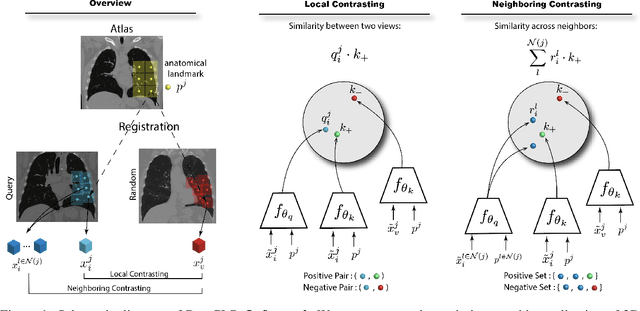


Large-scale volumetric medical images with annotation are rare, costly, and time prohibitive to acquire. Self-supervised learning (SSL) offers a promising pre-training and feature extraction solution for many downstream tasks, as it only uses unlabeled data. Recently, SSL methods based on instance discrimination have gained popularity in the medical imaging domain. However, SSL pre-trained encoders may use many clues in the image to discriminate an instance that are not necessarily disease-related. Moreover, pathological patterns are often subtle and heterogeneous, requiring the ability of the desired method to represent anatomy-specific features that are sensitive to abnormal changes in different body parts. In this work, we present a novel SSL framework, named DrasCLR, for 3D medical imaging to overcome these challenges. We propose two domain-specific contrastive learning strategies: one aims to capture subtle disease patterns inside a local anatomical region, and the other aims to represent severe disease patterns that span larger regions. We formulate the encoder using conditional hyper-parameterized network, in which the parameters are dependant on the anatomical location, to extract anatomically sensitive features. Extensive experiments on large-scale computer tomography (CT) datasets of lung images show that our method improves the performance of many downstream prediction and segmentation tasks. The patient-level representation improves the performance of the patient survival prediction task. We show how our method can detect emphysema subtypes via dense prediction. We demonstrate that fine-tuning the pre-trained model can significantly reduce annotation efforts without sacrificing emphysema detection accuracy. Our ablation study highlights the importance of incorporating anatomical context into the SSL framework.