 Add to Chrome
 Add to Firefox
 Add to Edge
A Foundation Model for Virtual Sensors
Jan 28, 2026
Virtual sensors use machine learning to predict target signals from available measurements, replacing expensive physical sensors in critical applications. Existing virtual sensor approaches require application-specific models with hand-selected inputs for each sensor, cannot leverage task synergies, and lack consistent benchmarks. At the same time, emerging time series foundation models are computationally expensive and limited to predicting their input signals, making them incompatible with virtual sensors. We introduce the first foundation model for virtual sensors addressing both limitations. Our unified model can simultaneously predict diverse virtual sensors exploiting synergies while maintaining computational efficiency. It learns relevant input signals for each virtual sensor, eliminating expert knowledge requirements while adding explainability. In our large-scale evaluation on a standard benchmark and an application-specific dataset with over 18 billion samples, our architecture achieves 415x reduction in computation time and 951x reduction in memory requirements, while maintaining or even improving predictive quality compared to baselines. Our model scales gracefully to hundreds of virtual sensors with nearly constant parameter count, enabling practical deployment in large-scale sensor networks.

Distributed Semantic Segmentation with Efficient Joint Source and Task Decoding
Jul 15, 2024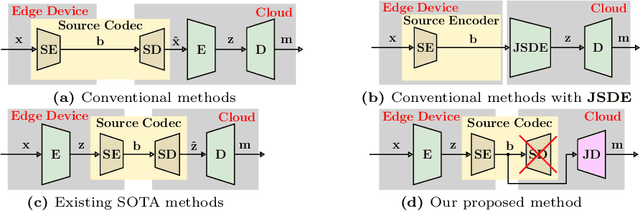
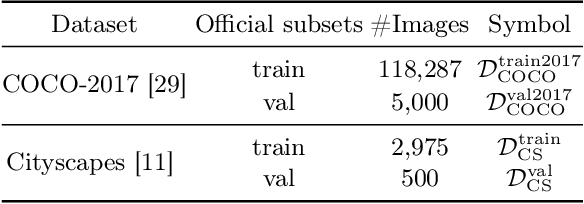
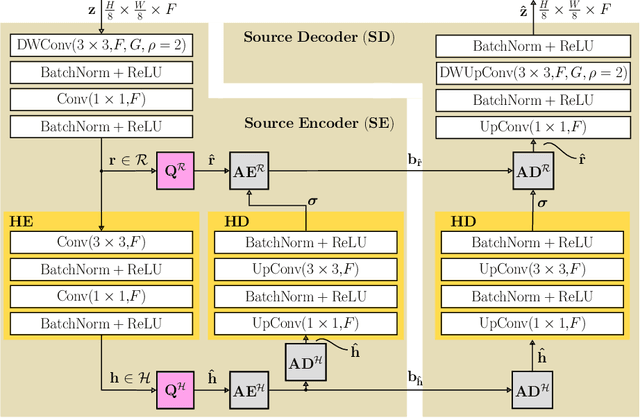
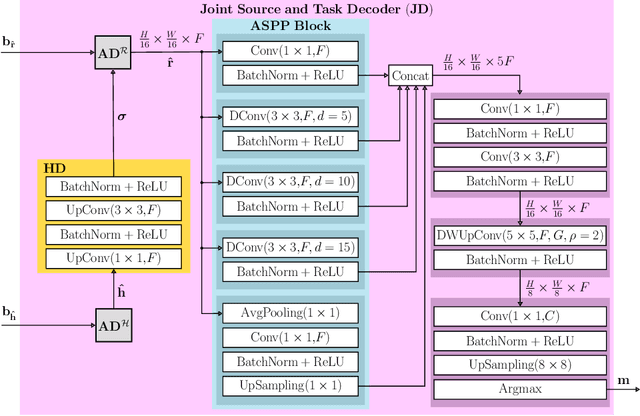
Distributed computing in the context of deep neural networks (DNNs) implies the execution of one part of the network on edge devices and the other part typically on a large-scale cloud platform. Conventional methods propose to employ a serial concatenation of a learned image and source encoder, the latter projecting the image encoder output (bottleneck features) into a quantized representation for bitrate-efficient transmission. In the cloud, a respective source decoder reprojects the quantized representation to the original feature representation, serving as an input for the downstream task decoder performing, e.g., semantic segmentation. In this work, we propose joint source and task decoding, as it allows for a smaller network size in the cloud. This further enables the scalability of such services in large numbers without requiring extensive computational load on the cloud per channel. We demonstrate the effectiveness of our method by achieving a distributed semantic segmentation SOTA over a wide range of bitrates on the mean intersection over union metric, while using only $9.8 \%$ ... $11.59 \%$ of cloud DNN parameters used in the previous SOTA on the COCO and Cityscapes datasets.