 Add to Chrome
 Add to Firefox
 Add to Edge
Toward Scalable Normalizing Flows for the Hubbard Model
Jan 26, 2026
Normalizing flows have recently demonstrated the ability to learn the Boltzmann distribution of the Hubbard model, opening new avenues for generative modeling in condensed matter physics. In this work, we investigate the steps required to extend such simulations to larger lattice sizes and lower temperatures, with a focus on enhancing stability and efficiency. Additionally, we present the scaling behavior of stochastic normalizing flows and non-equilibrium Markov chain Monte Carlo methods for this fermionic system.

Simulating the Hubbard Model with Equivariant Normalizing Flows
Jan 13, 2025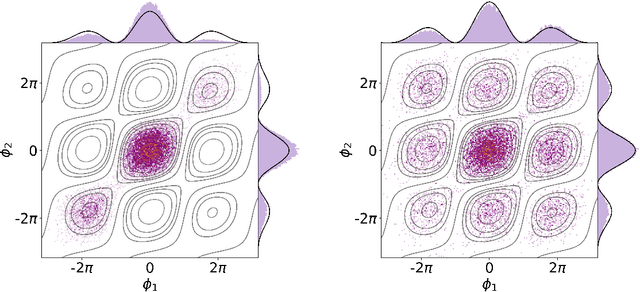
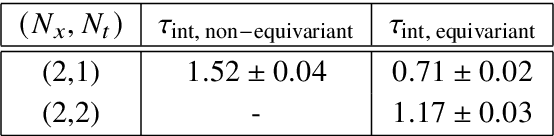
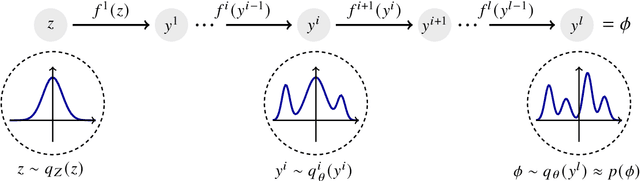
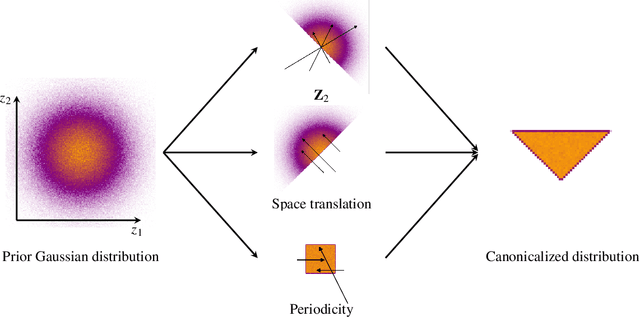
Generative models, particularly normalizing flows, have shown exceptional performance in learning probability distributions across various domains of physics, including statistical mechanics, collider physics, and lattice field theory. In the context of lattice field theory, normalizing flows have been successfully applied to accurately learn the Boltzmann distribution, enabling a range of tasks such as direct estimation of thermodynamic observables and sampling independent and identically distributed (i.i.d.) configurations. In this work, we present a proof-of-concept demonstration that normalizing flows can be used to learn the Boltzmann distribution for the Hubbard model. This model is widely employed to study the electronic structure of graphene and other carbon nanomaterials. State-of-the-art numerical simulations of the Hubbard model, such as those based on Hybrid Monte Carlo (HMC) methods, often suffer from ergodicity issues, potentially leading to biased estimates of physical observables. Our numerical experiments demonstrate that leveraging i.i.d.\ sampling from the normalizing flow effectively addresses these issues.